Which camera for photography? Professionals explain why the technology comes second. Analogue or digital, full frame or APS-C, mirrorless or DSLR? Magnum photographer Nanna Heitmann and lecturers at Hochschule Hannover explain why good photos depend not on the camera brand but on the person behind it.
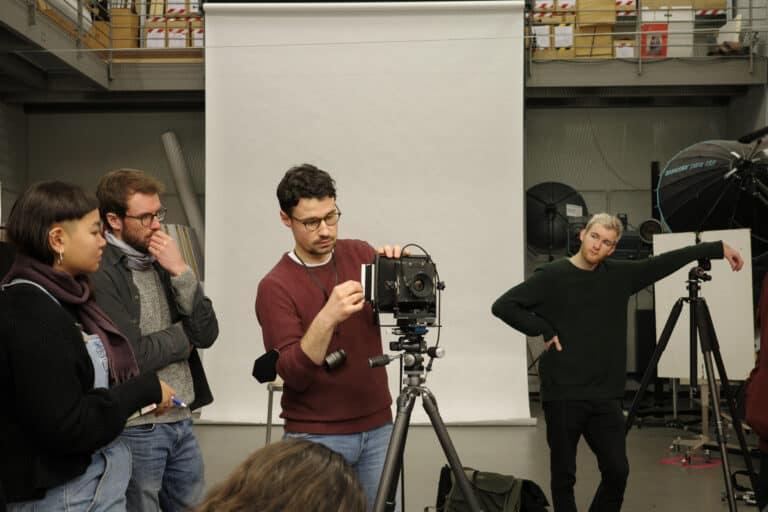
 Photo: Meike Dalhoff
‘The choice of camera is crucial. The camera should lead you to visual ideas you wouldn’t otherwise have,’ says Christoph Bangert, professor at Hochschule Hannover. That is why, in his classes, he sometimes turns the saying ‘It’s the photographer, not the camera’ on its head. The well-known quote – often used to stress that the person behind the camera matters more than the device – originally comes from Magnum photographer Eve Arnold. Bangert’s reversal adds a new nuance: sometimes choosing a particular camera is exactly what opens up new ideas for pictures. Anyone looking for a professional camera quickly faces a bewildering choice. This huge variety makes it hard to keep track and to develop a personal preference.
Digital or analogue? Two routes to making pictures
The choice between digital and analogue photography often makes the biggest difference. Shooting on film slows down not only taking the pictures but also processing them later. Those willing to invest the time – and the high cost of film – can be rewarded with a special look. In professional commissions, however, many clients expect fast, digital workflows, which is why analogue cameras are rarely used there. Today, analogue photography mostly happens in artistic or personal work, or among enthusiasts.
As a photography student, Christoph Bangert initially had to shoot exclusively on film – an experience that helped him understand the technology in depth. After a career photographing in war and crisis zones exclusively with digital cameras, which became increasingly common from the 1990s, Christoph Bangert now shoots on film again: ‘I’m currently working on a project about my family with a Nikon FM3. Black-and-white film, 35 mm, very classic.’
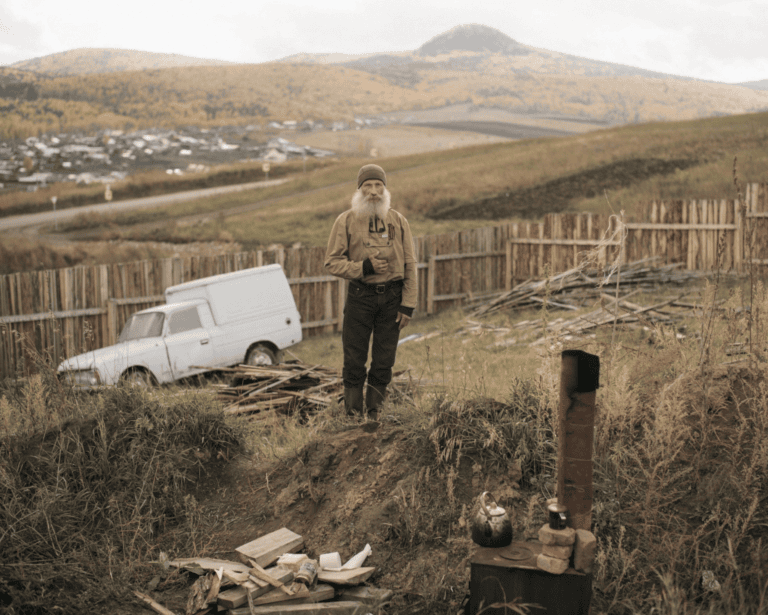 From the work ‘Hiding from Baba Yaga’ by Nanna Heitmann, Russia, 2018
‘A colleague always used to make fun of me and call me “the girl with the thousand cameras”, because I often had panoramic, large-format and medium-format cameras with me at the same time and tried out everything that came my way,’ says Nanna Heitmann.
Why sensor size affects image quality and the way you work
The question of sensor size (digital) or film size (analogue) arises with both digital and analogue cameras. Sensor size affects shooting speed, image quality and depth of field (bokeh). Larger sensors capture more detail, especially in enlargements. Raimund Zakowski has taught documentary photography and digital photography at Hochschule Hannover for more than 20 years. ‘In my experience, any recent digital camera with a full-frame sensor is good enough to see you through your entire degree – and beyond.’ He currently uses a Sony Alpha 7R III himself.
Digital cameras with the smaller APS-C sensor are usually not classed as professional equipment. There are generally good reasons for that, although the technology has improved in recent years: while losses in image quality can be compensated for in post-production, APS-C cameras are now particularly compact, fast and relatively inexpensive.
Medium- and large-format cameras are considerably larger and heavier, whether analogue or digital. On top of high purchase costs come expenses for film and development. In return, they offer outstanding image quality, a distinctive shallow depth of field and flexible movements – reasons why they are valued in portrait photography.
For Nanna Heitmann, unwieldiness is no disadvantage. The Magnum photographer and former Hochschule Hannover student says: ‘Working with a large-format camera helped me enormously. It slows down the whole process and gives you a lot of time. When people agree to a portrait with this camera, they understand that it’s a long but intense process. That creates a very special dynamic between photographer and subject.’ Today, though, she does without film: ‘It’s become incredibly expensive.’ Instead, as a Canon ambassador, she works with an EOS R5, a mirrorless full-frame camera.
In my experience, any recent digital camera with a full-frame sensor is good enough to see you through your entire degree – and beyond.
 Raimund Zakowski
 ‘Diez de Octubre’ by Raimund Zakowski, Havana, 2011
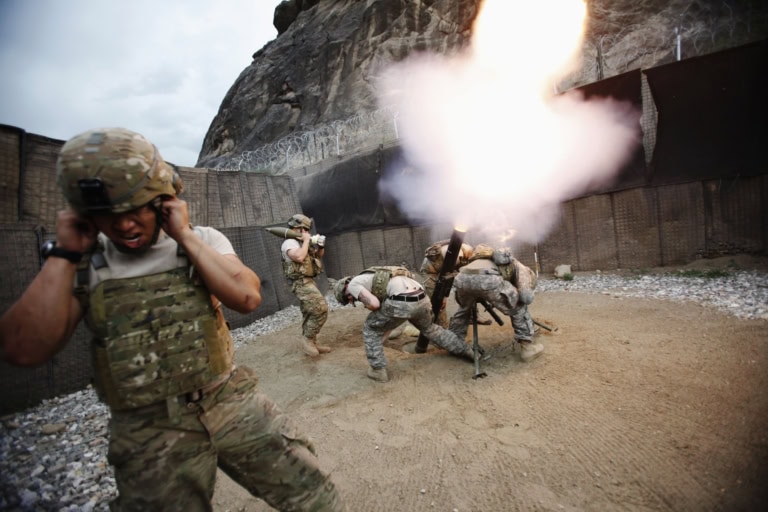 ‘Korengal Withdrawal’ by Christoph Bangert, Afghanistan
DSLR or mirrorless: which design wins?
In the digital world, a distinction is made between DSLRs and system cameras (mirrorless cameras). DSLRs are considered robust, with long battery life – but they are heavy and bulky. Mirrorless cameras are lighter and more compact and offer modern technology such as fast autofocus and numerous video functions. There are differences in the choice of lenses, too: DSLRs offer a huge range, especially of older models, while the range for mirrorless cameras is growing all the time and supports modern lens mounts.
System cameras are seen as the future of photography, while DSLRs remain a cheaper, tried-and-tested alternative. Both offer all the settings and automatic modes needed for professional use. Christoph Bangert describes how differently they can be used: ‘My whole working life, I’ve shot on Canon cameras in program mode P. My colleagues made a lot of fun of me for it, because everyone thinks they have to work in manual mode. But for me, P always stood for “Pro”.’
My whole working life, I’ve shot on Canon cameras in program mode P. But for me, P always stood for ‘Pro’.
 Prof. Christoph Bangert
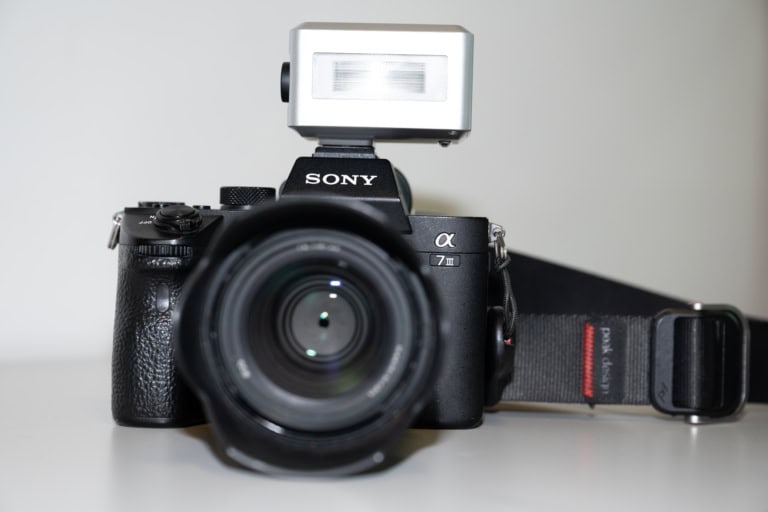
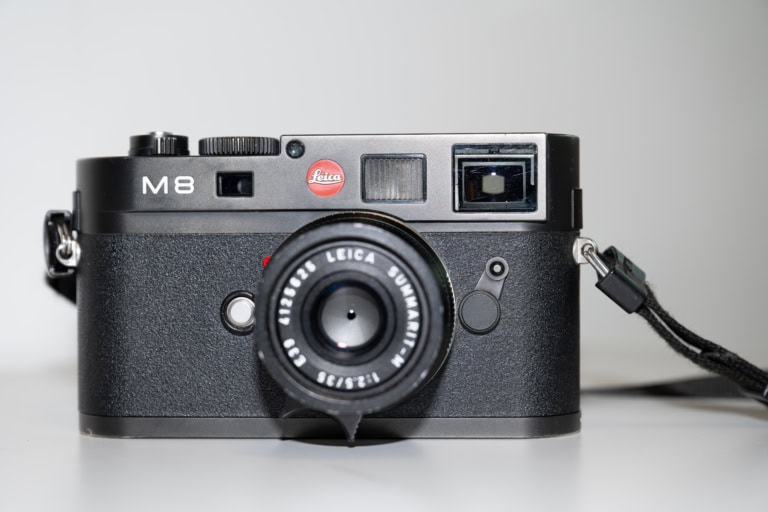
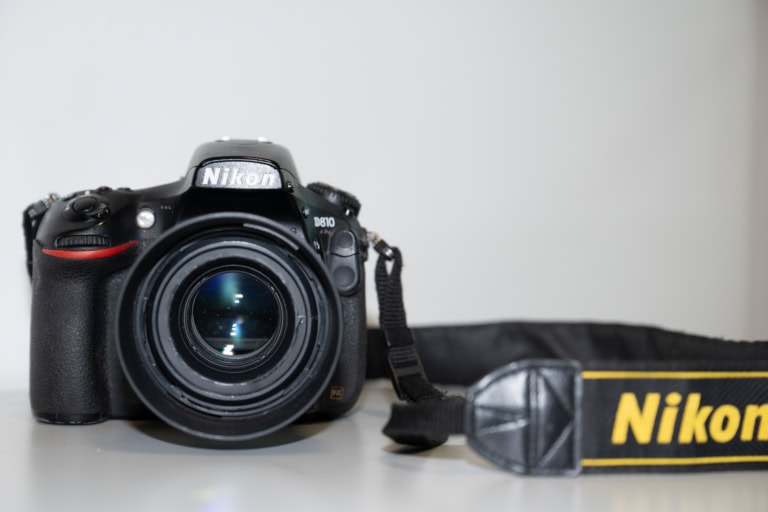 Photos: Meike Dalhoff

Brands compared: which cameras professionals choose
‘Sony, Nikon or Canon – it doesn’t matter. All the major manufacturers work at a comparable level today,’ says Raimund Zakowski. What matters, he says, is that the camera sits well in your hand, is intuitive to use and suits your personal visual language. A survey of 90 students on the Visual Journalism and Documentary Photography programme at Hochschule Hannover shows that Fujifilm and Leica cameras are also used alongside Canon, Sony and Nikon.
Conclusion: it’s the photographer that counts, not the camera
‘A colleague always used to make fun of me and call me “the girl with the thousand cameras”, because I often had panoramic, large-format and medium-format cameras with me at the same time and tried out everything that came my way,’ says Nanna Heitmann. Her conclusion: only by constantly trying things out can you find out which camera suits you.
Christoph Bangert agrees: ‘Which camera is right always depends on the project, too – on how and which story you want to tell.’
In many cities, professional rental companies hire out cameras by the day, so you don’t have to buy every piece of kit. Adult education centres, universities or photo clubs often offer cheap alternatives too. Students at Hochschule Hannover can also use the university’s own equipment loan service, and members of Fotobus e.V. can borrow equipment free of charge as well. ‘Unfortunately, photography is a very expensive hobby – or degree. So everyone should have access to good equipment that they might not be able to buy themselves,’ says Christoph Bangert.
In the end, what matters is who uses the camera – not the technology: ‘It’s the photographer, not the camera.’