Lake Neusiedl: tracing the salt pans
In 2022 Austria’s largest lake was at risk of drying up for the first time in 150 years. Our photographer Florian Sulzer investigated the causes.


In the easternmost part of Austria the effects of hot years with little rainfall are becoming ever more visible. The salt pans in the already dry Seewinkel region are suffering from a low water table, made worse by climate-related extremes and intensively irrigated crops.
Lake Neusiedl, Austria’s largest lake, recorded its lowest water level since records began in 2022. The steppe lake is at risk of drying out completely for the first time in 150 years. An artificial feed channel is intended to stabilise the lake’s water level, but the possible consequences for the sensitive ecosystem would be impossible to predict.
Thanks to persistent rainfall in 2024, both the salt pans and the lake have recovered slightly. The water level, however, is still below average.
For Florian Sulzer, the project ‘Hoda eh wieda Wossa’ – dialect for ‘it’s got water again anyway’ – marks the start of a long-term study of one of the driest regions in Austria. Steering clear of dystopian visions of the future and simplistic human fixes, he aims to take a calm look at a highly emotional debate.
 Darscho, 9 October 2023
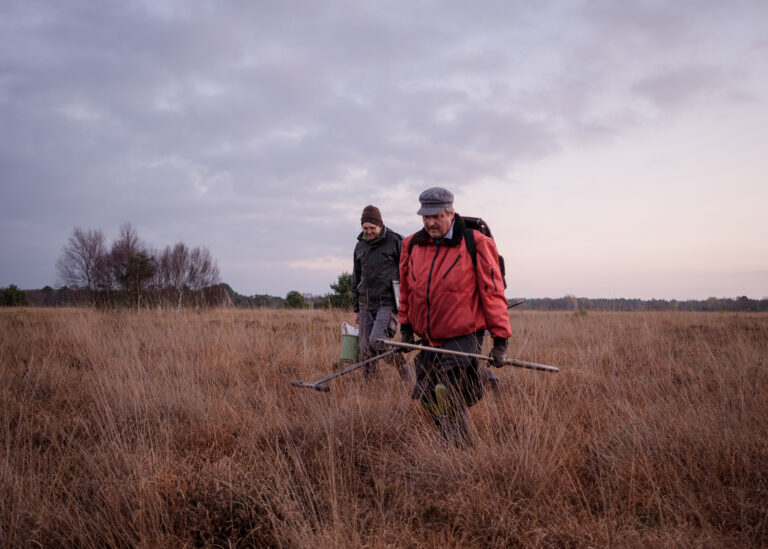
Salt pans are unique resting and breeding grounds for various bird species. To survive, the pans need high groundwater levels to carry salts to the surface. Over the past 150 years around 80 per cent of the salt-pan area in the Seewinkel has disappeared. As part of the national park’s salt-pan monitoring, around 50 points are examined every two weeks and their condition documented. Benjamin Knes and Bjarne Voss take a water sample at the Darscho.
 St. Andrä am Zicksee, 8 November 2023
The Zicksee in the Seewinkel dried out completely in summer 2022. For years this former steppe lake had been fed with groundwater. Because of the drastic fall in groundwater levels in the Seewinkel, the artificial supply had to be stopped. After the lake bed was completely overgrown with plants in 2023 (pictured), a small body of water returned in 2024.
 Freistadt Rust, 12 November 2023
At 320 square kilometres, Lake Neusiedl is Austria’s largest lake and is surrounded by a belt of reeds. In Rust, on the lakeshore, there are so-called stilt houses. When the water level is low, however, some of these huts can no longer be reached.
 Podersdorf am See, 8 October 2023
Podersdorf am See is very popular with water-sports enthusiasts. The village has no reeds and boasts the longest lido. Iris and Thomas have been coming to Podersdorf since they were children. They lease a mobile-home pitch by the lake, where they go surfing when the temperature and wind are right.
 Freistadt Rust, 23 October 2023
There are more than 400 bathing huts, most of them on stilts, in the bay at Rust. The bay, used mainly for tourism, is home to harbour facilities, the lido, the Storchencamp Rust campsite and the Romantica weekend-house settlement.
 Breitenbrunn am Neusiedler See, 30 October 2023
In Breitenbrunn am Neusiedler See, small machines are used to clear mud from the boat moorings. Around 30,000 cubic metres of mud accumulate in Lake Neusiedl every year, and between 60,000 and 100,000 cubic metres of sediment are supposed to be removed from the lake annually. Some of this is legacy sediment that has built up over the years. The mud is sucked up by a floating dredger and pumped into a settling basin, where the solids settle and most of the water flows back into the lake through pipes. The settled mud is later used on farmland.
 Mörbisch am See, 8 November 2023
Maximilian Rott enjoys sailing on Lake Neusiedl in his free time. In summer he works as a sound engineer at the Mörbisch lake festival and spends the performance weeks on his father’s boat. Because of the low water level, his boat gets stuck in the lake more and more often. In case things don’t improve, he has already learned to windsurf, which is possible in water just ten centimetres deep.
 Mörbisch am See, 8 November 2023
The Mörbisch lake festival has been held every summer since 1957. The 3.5-tonne polystyrene Statue of Liberty at the Mörbisch lido was built specially for the musical ‘West Side Story’.
 Podersdorf am See, 24 October 2023
Years of low rainfall and increasing heatwaves led in October 2022 to the lowest water level in Lake Neusiedl since records began, at 114.87 metres above the Adriatic. In Podersdorf am See the fall in the water level is clearly visible.
 Podersdorf am See, 8 October 2023
The Burgenland state government plans to make up for the lack of rainfall with an artificial supply of water from the Danube, to save the popular holiday destination and with it an important economic factor for the region. The inflow is expected to raise the lake by around ten centimetres.
 Sandeck, 11 November 2023
From November to February, the bird species in the Neusiedler See – Seewinkel National Park are counted once a month. The number of individuals shows how attractive the area is for different species. Before sunrise, Benjamin Knes, a research assistant at the national park, has come to the former Hungarian border watchtower at Sandeck to count cranes, which have been stopping off in Burgenland on their journey south for around twenty years.
 Landesmuseum Burgenland, Eisenstadt, 14 December 2023
The Neusiedler See – Seewinkel National Park is an important breeding and resting area for around 350 bird species. Increasing drought in the Seewinkel is putting migratory birds’ resting places at growing risk.
 Purbach am Neusiedler See, 10 November 2023
Paul Berger has spent his whole life in Purbach am Neusiedler See. He worked shifts on the railway and grew wine on the side. His grandfather witnessed the last time Lake Neusiedl dried out (1865 to 1871), when you could walk from Purbach to the other side. Back then the last fish had crowded together in a few remaining pools.
 Purbach am Neusiedler See, 13 September 2023
Friends and relatives help the Brunäcker-Rosner winegrowing family with the annual grape harvest. Because of the steep slopes, the vines on the Spitz cannot be reached by harvesting machine. The last Müller-Thurgau grapes are tossed into the trailer. Then it’s time for a mid-morning snack.
 Podersdorf am See, 24 October 2023
Martin Steiner from Podersdorf am See runs a winery that has been in his family for four generations. Lake Neusiedl acts as a heat store for the vines in winter and as a coolant in summer. If the lake dried out, the region could see more severe storms, and the cultivation of less heat-resistant grape varieties such as Zweigelt could suffer.
 Mörbisch am See, 30 September 2023
At the end of September 2023 the thirteenth grape harvest festival took place in Mörbisch am See. Brass bands and decorated floats paraded through the little village, inviting visitors to taste fresh Sturm and wine.
 Illmitz, 7 November 2023
Staff at the Biological Station check a light trap that attracts moths with black light. Certain spots are examined regularly to draw conclusions about how the range of species has changed over recent decades. From left: Justin Catau, Johannes J. Reisinger and Jonas Baumgärtner.
 Illmitz, 7 November 2023
After preparing the moths, staff at the Biological Station in Illmitz identify the species. The presence of certain moths says a lot about the state of a habitat. Intensive farming and soil sealing reduce their numbers.
 Illmitzer Zicksee, 18 September 2023
At the Illmitzer Zicksee, Arno Cimadom introduces the national park’s interns to counting noctules, a genus of bat. The maximum number of individuals is counted in five-minute intervals. Equipped with binoculars and a bat detector set to 20 hertz, the participants scan the sky and turn on the spot. At the end of each interval, Arno Cimadom enters the number of noctules counted in his list.
 Northern Silbersee, 9 October 2023
Numerous interventions in the water flow of the former Silbersee left the salt pan largely dry. Its remains now form the northern and southern Silbersee. Because of increasing reed growth, the northern Silbersee is on the verge of complete collapse and needs restoration measures.