Peatland protection: why bogs are among our most important climate savers
From carbon store to political issue: why wet soils matter so much for the climate – and four people who are fighting for them.
By Jonas Dengler

1. You can’t eat a bog.
Two years ago, Svenja Schlüter, 28, took over her family’s dairy farm on a raised bog in Fahrendorf, Lower Saxony. Her ancestors started out in the mid-19th century as subsistence farmers. To earn a little extra, they cut peat. Over the generations, they added horses and pigs.
Today Svenja Schlüter runs the farm, with around 150 cows, largely on her own. When she took over, she wanted to build a new barn to improve animal welfare. But she hesitated because of the uncertain future of farming on peatland: the land she farms could be rewetted in future. That makes it uncertain whether she could repay a loan for a new barn. Instead, she invested in a milking robot.
Many peatland farmers in Lower Saxony face similar challenges. Climate protection requires peatland restoration. But there are no proven concepts yet for farming rewetted bogs. They are unsuitable for food production, and replacement land is often not available. Water buffalo and solar power are options, but not for everyone. On the other hand, farming on peatland has a limited lifespan, because the peat keeps decomposing and the farms sink. Once the peat is gone, the soil is hardly fertile any more.
Background: peatlands and climate change
Bogs form where more water flows into an area than can evaporate or drain away. What makes them special is their peat soils, which form when the dead remains of certain plants are compacted under water. This happens with little oxygen, so the plant matter does not decompose. Wet bogs store carbon, but when they are drained they release climate-damaging CO₂ into the environment, because the peat decomposes in the air.
For many centuries, bogs were considered impassable, dangerous and a ‘mistake of nature’, because the land could not be farmed. From the 17th century onwards, people believed they could correct this ‘mistake’ by starting to cultivate the land – first by burning the bogs, later by draining them systematically. This made the land usable for farming and peat extraction, but – without anyone knowing it – turned large carbon stores into sources of CO₂.
In Lower Saxony, drained peatlands currently account for about 17 per cent of total CO₂ emissions. To meet the climate targets, 50,000 hectares of peatland would have to be rewetted in Germany every year. Covering the peat with water stops it from decomposing, and hardly any more CO₂ is emitted. The German government has understood this too, and in 2022 it adopted the National Peatland Conservation Strategy to improve peatland protection. For Lower Saxony, Germany’s richest state in peatland, this means a structural change comparable to that of the coal industry.
 Svenja Schlüter (28) studied agriculture and runs a dairy farm in Fahrendorf, in the municipality of Gnarrenburg.
Svenja Schlüter stands in the doorway of the oldest part of her barn, where cows are kept tethered.
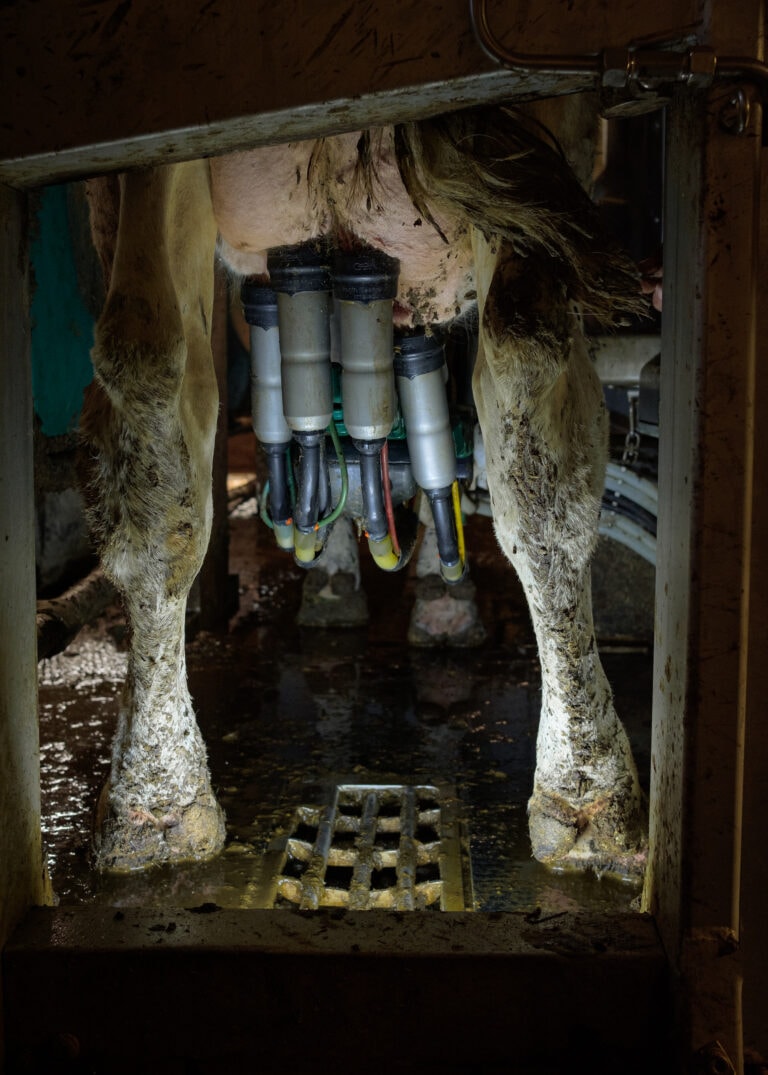 A cow being milked in the milking robot.
Thanks to the new milking robot, the cows can decide for themselves when they are milked and follow their own daily routines. When a cow enters the robot, it is given concentrated feed while the milking unit automatically attaches to the udder.
 A cow feeding in the old barn on Svenja Schlüter’s farm.
Every cow is microchipped and monitored by the milking robot. It collects data on each cow, such as how often it has been milked and how much milk it gives on average. Svenja Schlüter used to see every animal twice a day in the milking parlour; today she has data and charts from the milking robot.
 Bog farmer Svenja Schlüter prepares to feed her cows.
Farmer Svenja Schlüter feeds her 150 cows on grass silage and concentrated feed (maize and grain). She cuts the grass herself on the bog land she farms; the concentrated feed she buys in.
 Overview of Svenja Schlüter’s dairy farm in Fahrendorf, in the municipality of Gnarrenburg.
Svenja Schlüter’s dairy farm stands on a ‘Moorhöhe’. That is the name for the narrow strips of land allocated along the drainage canals of the Gnarrenburg bog. The farm has belonged to the Schlüter family since the mid-19th century.
 Grass silage in wrapped bales behind the dairy farm. In the background, part of the bog land that Svenja Schlüter farms.
Svenja Schlüter stores the grass silage in wrapped bales behind her farm. She would have liked to build a silage clamp. But with future rewetting measures looming, it is uncertain whether she can keep the bog farm going long enough to pay off the loans she would need.
2. Every cucumber needs peat.
Entrepreneur Josef Gramann trades in peat and is working on new extraction methods. Peat is low in nutrients, sterile and loosely structured, and it stores a lot of water – which makes it indispensable for raising young plants in horticulture.
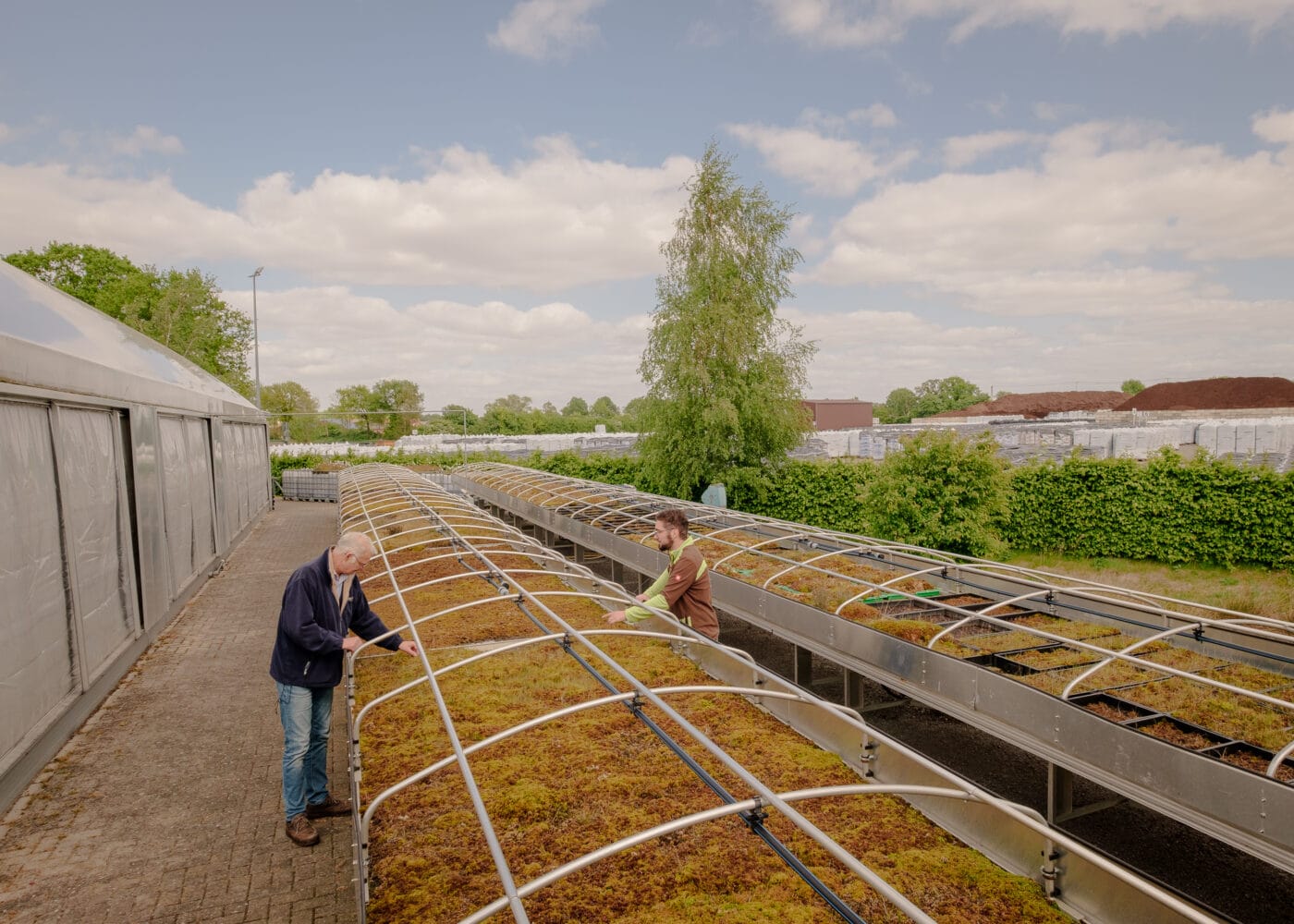 Josef Hermann Gramann, managing director of Gramoflor (left), and employee Eric Thieme at a moss-growing facility.
In a research project with Kiel University, Gramoflor developed a process in which, among other things, typical bog mosses are grown and then introduced into rewetted areas. The aim is for an active bog to form more quickly.
Josef Gramann is managing director of Gramoflor, founded in 1908 as a peat trading company in the district of Vechta, Lower Saxony. Originally used as fuel, peat became important in horticulture from the 20th century onwards. Because it is sterile, low in nutrients and loose in texture, it is ideal for raising young plants. Professional horticulture is a highly efficient business. Substrates are precisely matched to irrigation systems and fertilising intervals so that the plants reach exactly the same stage of development within a given time.
Politically, the end of peat extraction in Germany has been decided, but the industry is hesitant to switch. Gramoflor is experimenting with peat substitutes such as coconut fibre, but the new substrate mixes pose challenges for horticultural businesses, which have to recalibrate their systems – and that initially means losses.
Gramoflor now only extracts peat from agricultural peatland, under strict rules that include rewetting requirements. Its own extraction method, the upper-and-lower-field method, allows peat to be extracted and the land to be rewetted at the same time. The extracted areas therefore emit less CO₂, because they are rewetted straight away. By introducing typical bog vegetation, Gramoflor tries to create active bogs that can become carbon sinks. Depending on the area, the process takes several decades. Gramoflor grows the mosses it needs in its own facility and researches new substrate mixes in an experimental greenhouse.
 Josef Hermann Gramann, managing partner of the company Gramoflor in Vechta, Lower Saxony.
The ‘Ober-Unterfeld’ method makes it possible to rewet an area more quickly after peat extraction. In the background, an area of peat extraction; further forward, a rewetted area with typical bog vegetation.
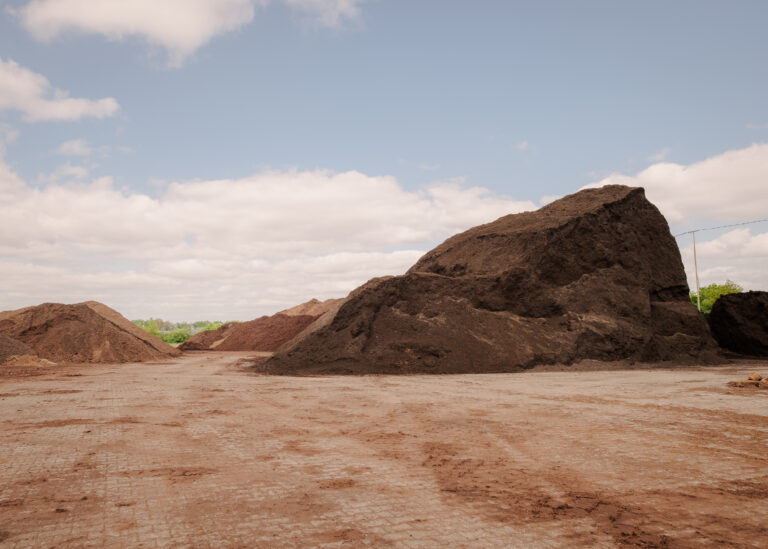 Mounds of peat and mulch on Gramoflor’s premises.
Every company that buys growing media from Gramoflor receives its own recipe, tailored to its specific needs.
 A lettuce plant in Gramoflor’s experimental greenhouse.
Today’s horticultural businesses are geared towards maximum efficiency. Plants have to reach the same size at exactly the same time. For this, peat-based growing media are almost indispensable.
 A cultivation tank for peat moss at Gramoflor.
The peat moss grows in the tank for about four years. The top layer is then cut off and propagated in permeable crates in a water bath until the moss is planted out in the areas being restored.
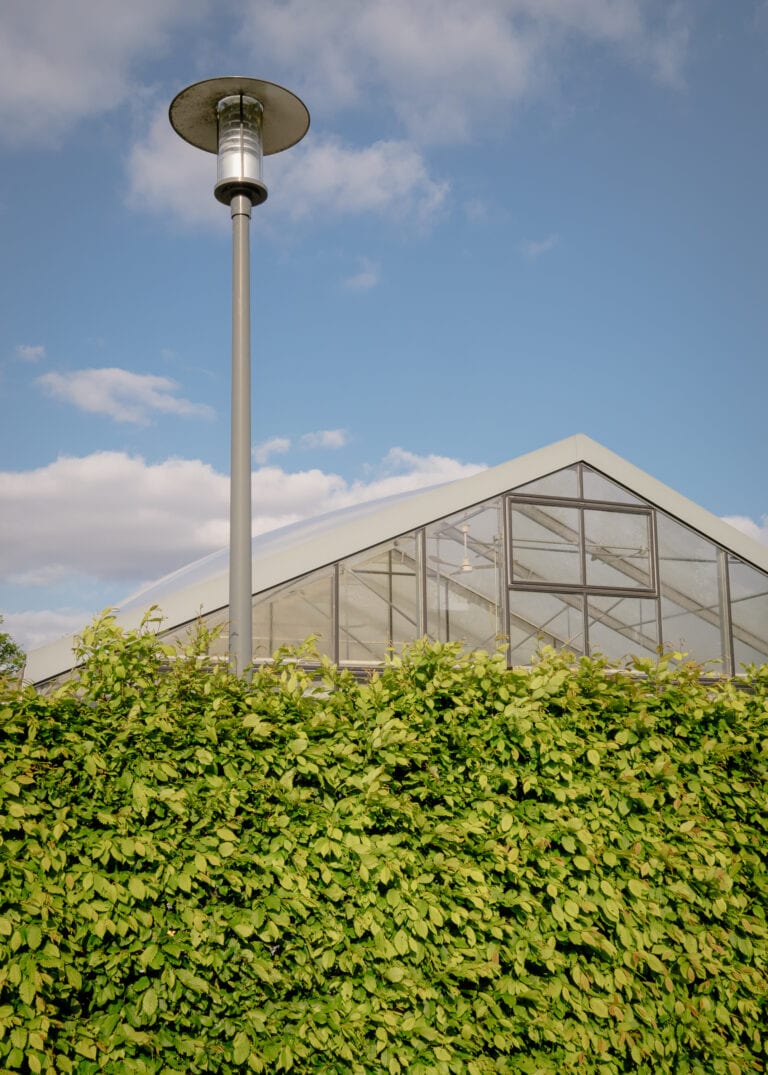 Gramoflor’s laboratory and experimental greenhouse.
New substrate mixtures – for example with peat substitutes – are tested here in small trial series.
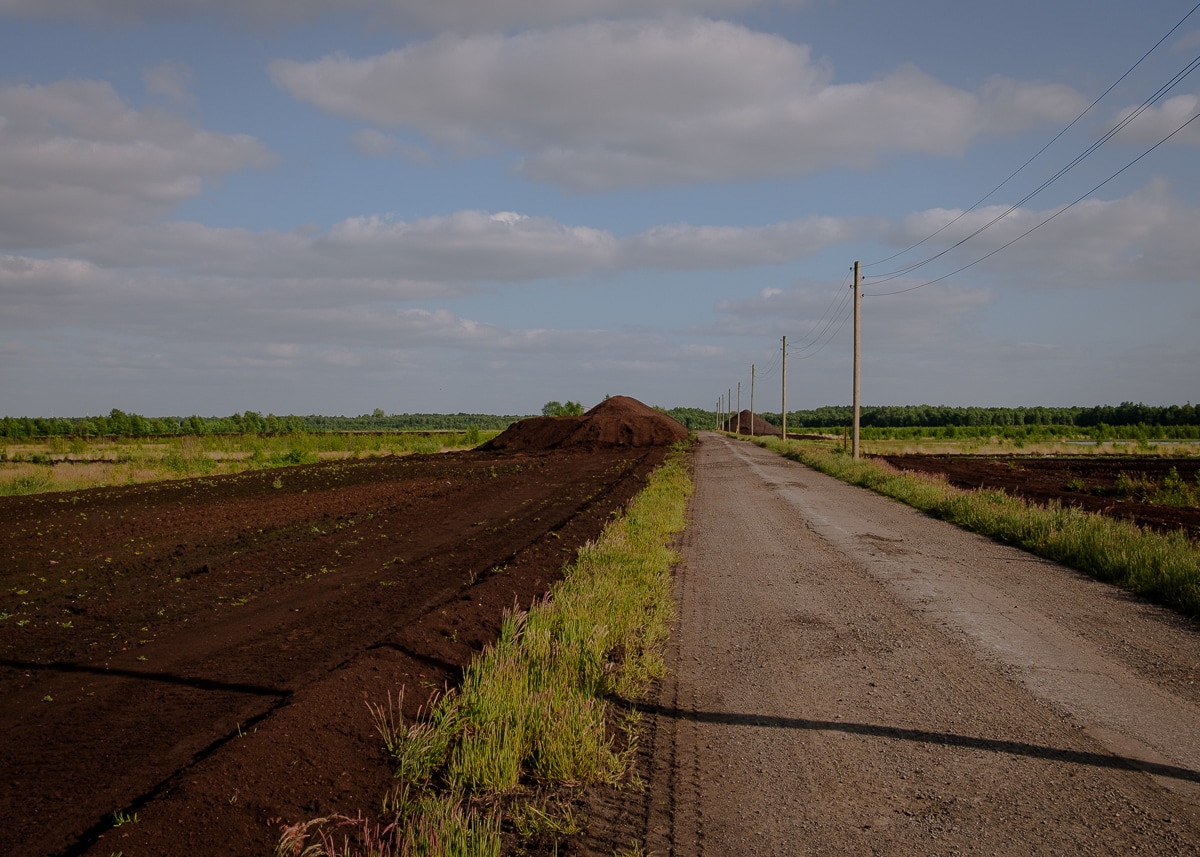 An area of peat extraction belonging to Gramoflor.
On most sites the company digs the peat with an ordinary excavator rather than using traditional peat cutting.
3. Trees are a bad sign.
For researcher Carla Welpelo, one thing is clear: a healthy bog is so wet that trees cannot grow on it. But there are numerous forests on peatland in Lower Saxony – which means those bogs are too dry.
 A measuring device in the ‘Weißer Graben’ nature reserve in the Lichtenmoor bog near Niendorf.
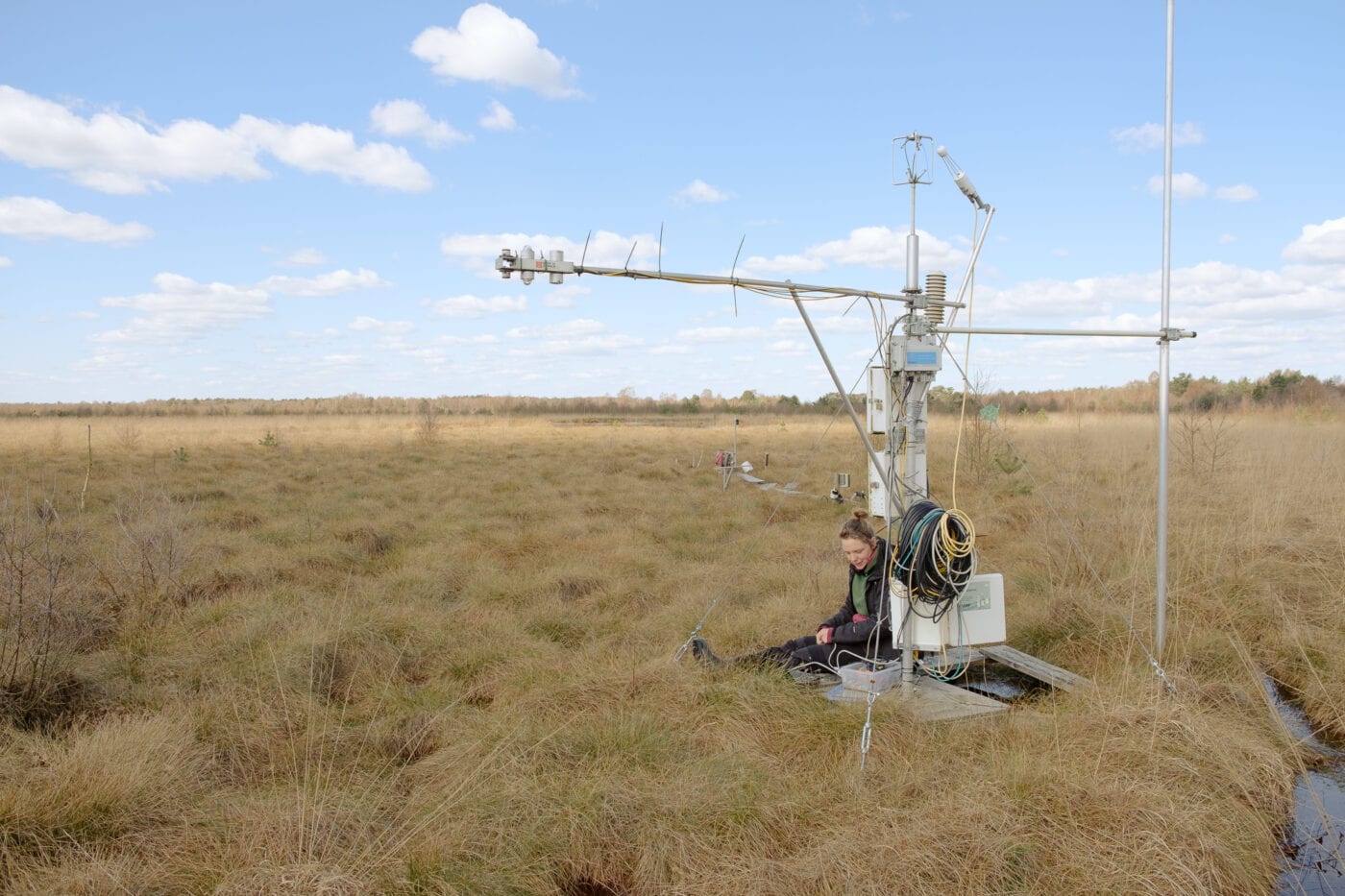
Carla Welpelo cleans the measuring devices on the ‘eddy tower’ in the Lichtenmoor bog. This high-tech method measures air eddies, from which, among other things, the exchange of CO₂ between the air and the bog can be derived.
 Ein
Ein
A dipwell is a hollow pipe sunk deep into the ground, which water can enter only from below. Opening it at the top shows the water level in the area.
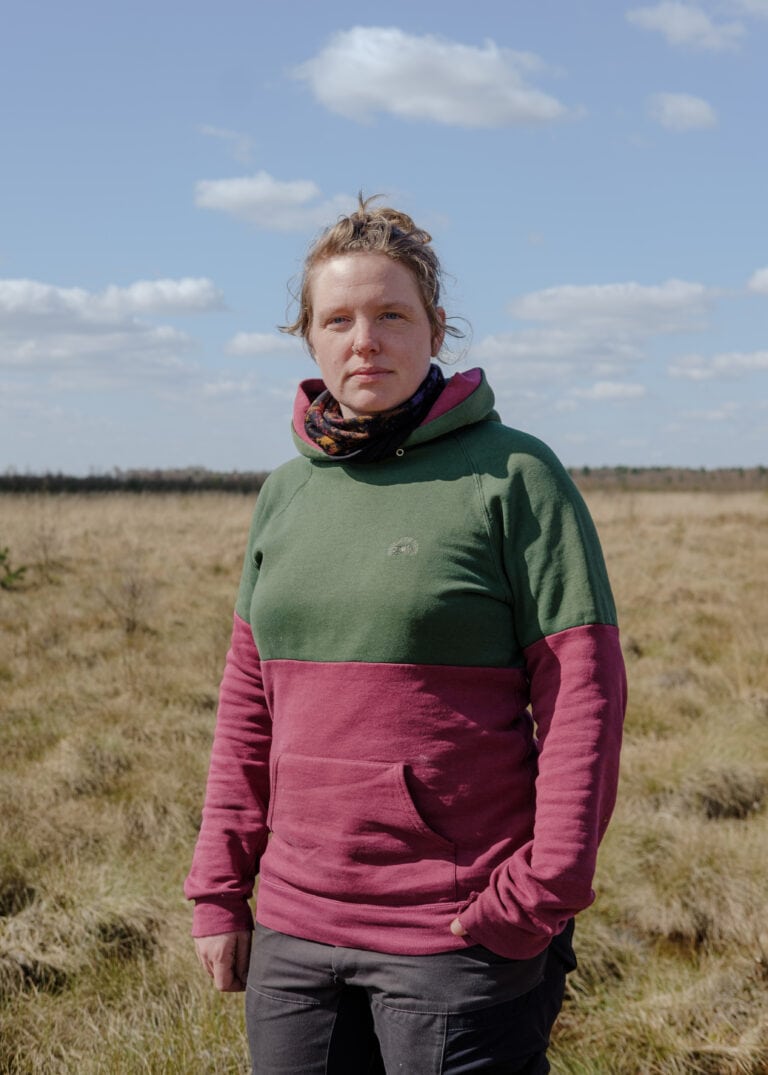 Researcher Carla Welpelo on her trial site.
Carla Welpelo on an area of bog that was rewetted back in 1984 after peat extraction, in the ‘Weißer Graben’ area of the Lichtenmoor bog near Niendorf on the Weser.
How do trees and grasses affect the water and carbon balance of rewetted bogs? This is the question researcher Carla Welpelo, a doctoral candidate at the Thünen Institute, is investigating in her project. She is working on two areas restored in the 1980s in the ‘Weißer Graben’ nature reserve in the Lichtenmoor near Niendorf.
At the heart of the project are two ‘eddy towers’. Each consists of a scaffold tower fitted with sensors that measure the exchange of gases between the bog and the surrounding air. Combined with environmental data such as rainfall, water level, temperature and the growth of neighbouring vegetation, this makes it possible to predict how successful a rewetting measure will be in terms of carbon storage.
Many drained bogs are covered with forests today, typically birch. Large plants such as trees, but also certain grasses, increase the surface area through their leaves, causing water to evaporate. So they withdraw from the bog the water that is urgently needed to cover the layers of peat and stop them from decomposing further.
 Forscherin
At its core, an eddy tower consists of two instruments, the ultrasonic anemometer and the analyser. Together they can record the exchange of gases between the bog and the air.
4. Digging through history with a spade.
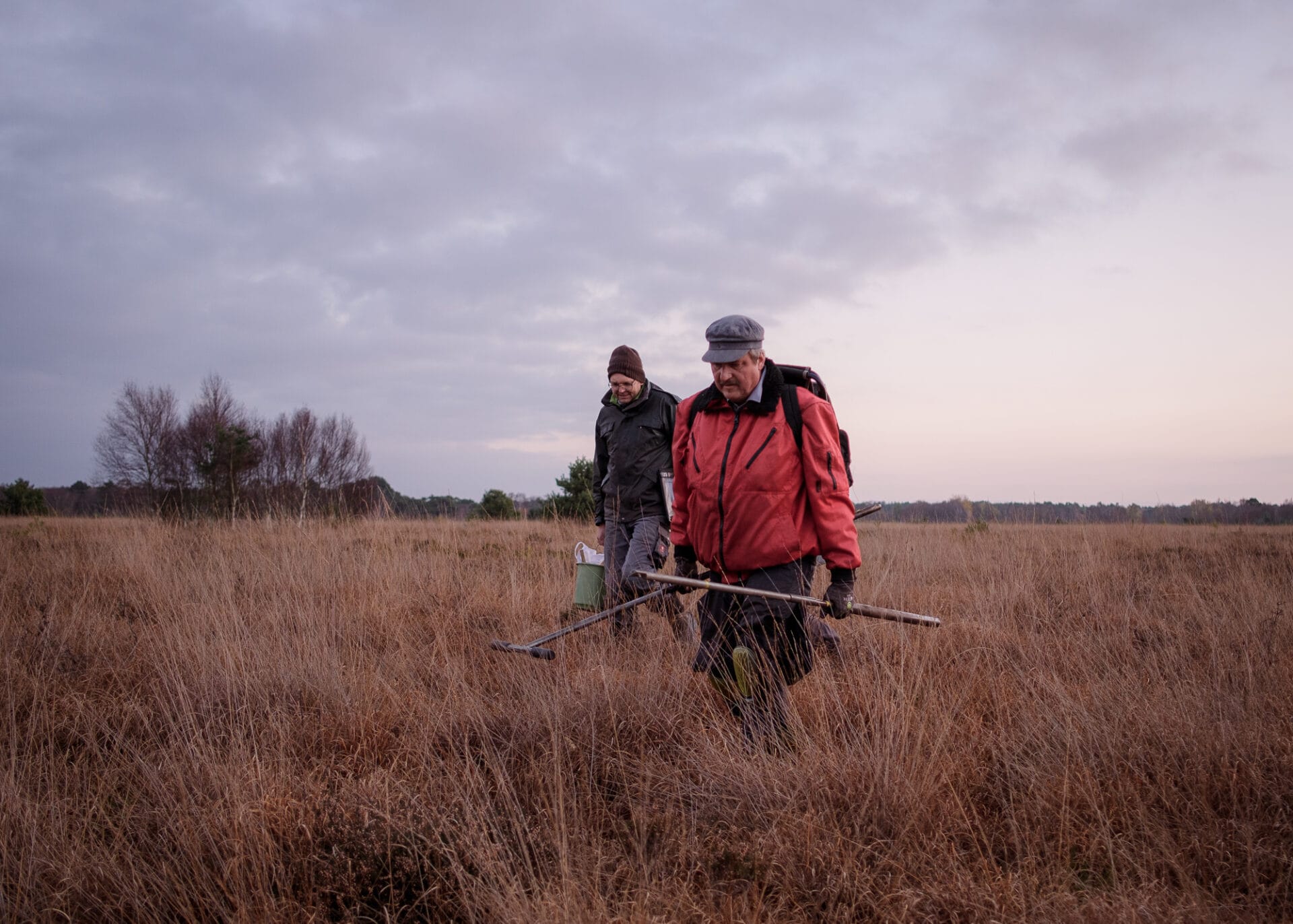
Gero Jahns collects soil samples from every bog in Lower Saxony to compile a comprehensive peatland map on behalf of the State Office for Mining, Energy and Geology (LBEG).
 Gero Jahns examines a soil sample in the Neustädter Moor bog.
Different layers in the extracted peat point to different uses and developments. On land previously used for farming, the surface is often heavily decomposed, because repeated ploughing and fertilising brought a lot of oxygen into the peat.
 Gero Jahns, a technician at the State Office for Mining, Energy and Geology (LBEG), in the Neustädter Moor bog.
Using soil samples, the expert draws conclusions about how the bog has developed and how much carbon it stores.
 A hole for taking a soil sample in the Neustädter Moor bog.
Peat grows at an average rate of 1 millimetre a year. So the thickness of the peat layer shows how old the bog is.
Gero Jahns examines the peat of every bog in Lower Saxony on behalf of the State Office for Mining, Energy and Geology (LBEG). As part of the project ‘Large-scale mapping of carbon-rich soils in Lower Saxony’, he drills into the peat soil – with a folding probe, for example – and then analyses the different layers and the total thickness of the peat.
The aim of the project is to map all peat soils and bring this information together. It should show which areas are worth rewetting and how much CO₂ could potentially be saved.
On average, peat forms at a rate of 1 millimetre a year, while in drained bogs it decomposes at about 1 centimetre a year. This means that peat from a depth of 3.5 metres is 3,500 years old. Soil samples allow conclusions to be drawn about how a bog developed and how much carbon it stores.
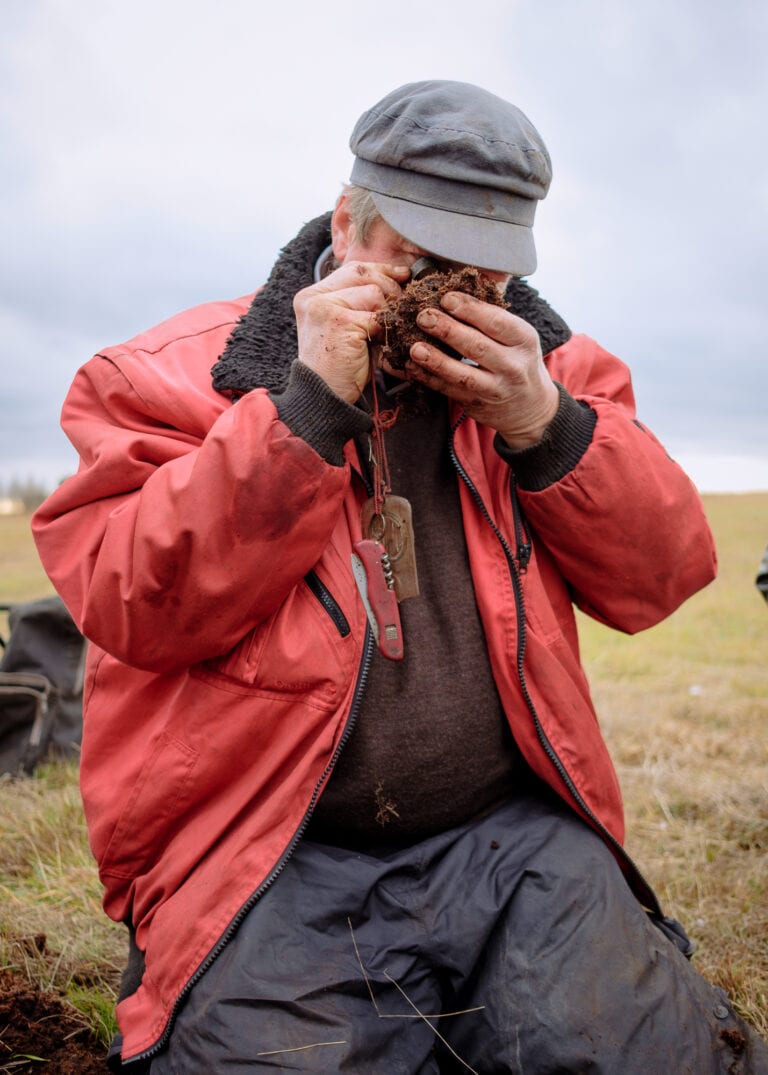 Gero Jahns examines a peat sample with a magnifying glass in the Neustädter Moor bog.
Determining the exact condition of the peat takes a great deal of experience. The tiniest plant fragments, centuries or even millennia old, have to be found and classified.
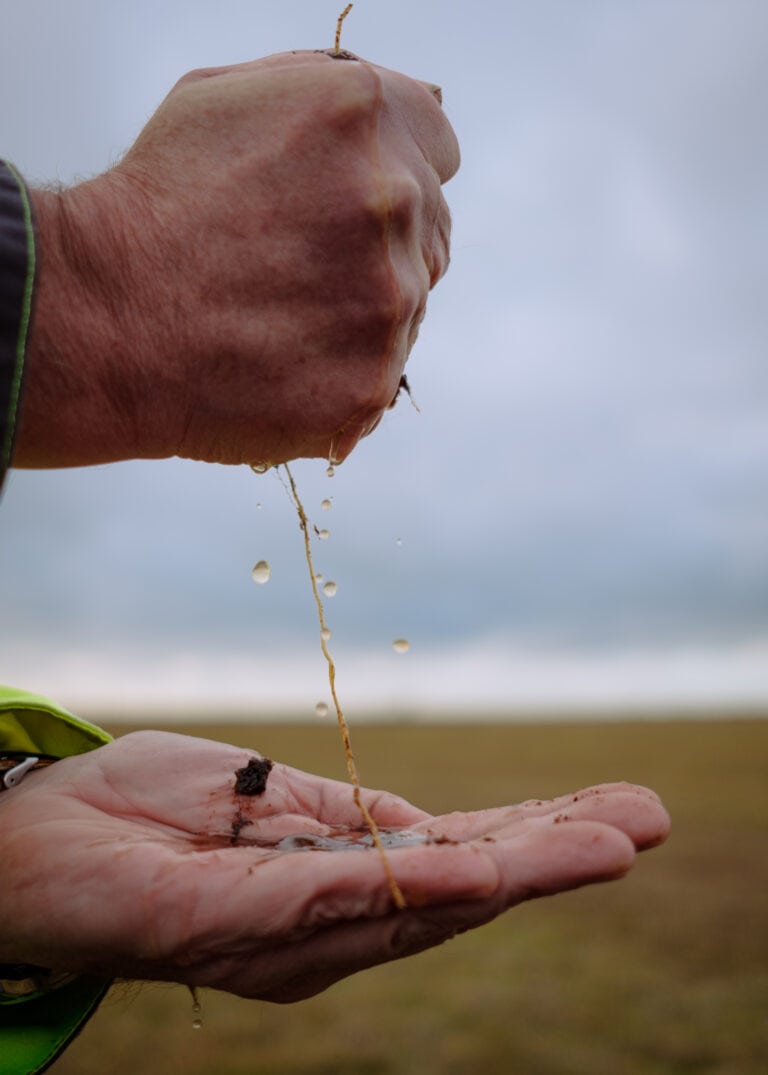 Gero Jahns carries out a squeeze test to determine how far the peat has decomposed.
In the squeeze test a piece of peat about the size of a hen’s egg is squeezed in the hand. What comes out between the fingers – from clear water to black sediment – shows how far the peat has decomposed.
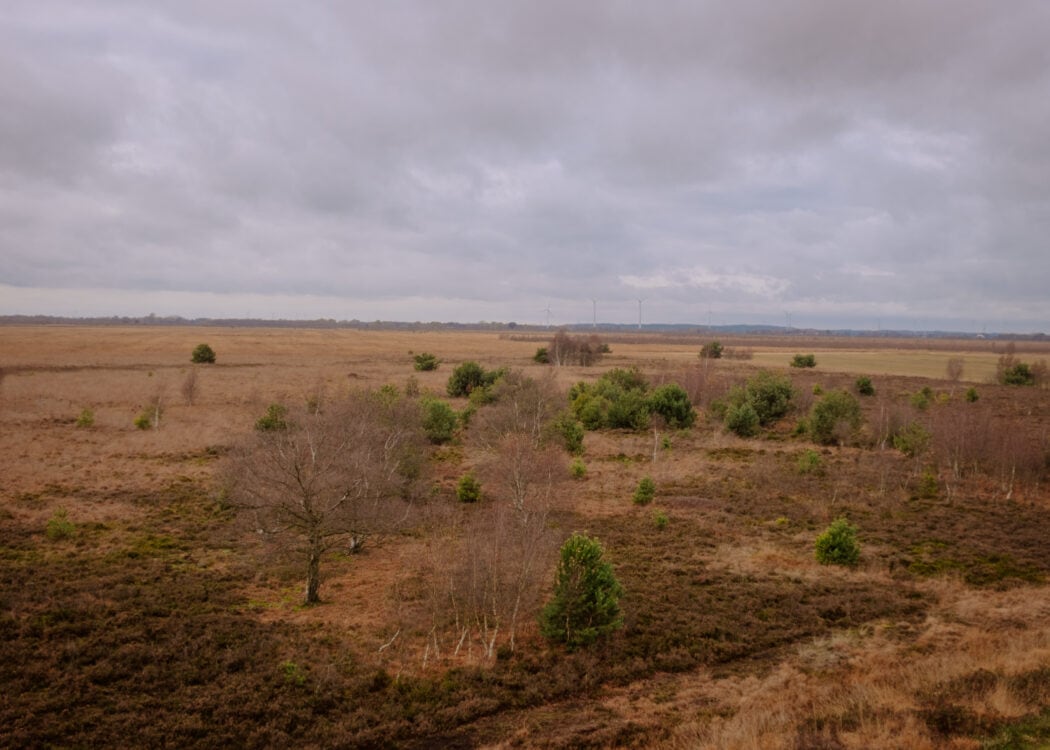 A protected area in the Neustädter Moor bog, looked after by NABU.