Image Market – Business Trends. The development of the trade in and the visual representation of media content as a result of technical, social, economic and media developments, and its consequences for visual publishing.
Triggered by technical developments, the media in general and visual publishing in particular are undergoing a structural change whose dimension and dynamics are hard to compare with anything, either within the visual media or in other industries. As a result of digitisation, the handling of rights to use images is changing beyond recognition. Photographers are becoming multimedia content suppliers. Mono-media publishing is being replaced by the trans-media publication of content. Traditional picture agencies are disappearing for economic reasons, while new providers are entering the market and changing not only business models but also working conditions and visual languages.
The possibilities of digitising image data require changes to legal regulations, with effects on the revenues of those who create images and resulting consequences for visual publishing. Every development in one area simultaneously affects various other areas. The changed conditions under which images are produced and published mean not only a change in photojournalism but in the visual media as a whole, whose overall social effects can only be speculated about at present.
In his research, Prof. Lars Bauernschmitt documents the changes in how media content is handled as a result of technical, social, legal, economic and media developments, and their consequences for visual publishing. He shows how different developments in various areas influence one another, continuously change the market and ultimately determine which images (from which source, in which visual language and with which design) are published at all.
2026 Image Market – Business Trends 2026. Artificial intelligence and its consequences for the collaboration between picture agencies, photographers and journalistic and advertising media.
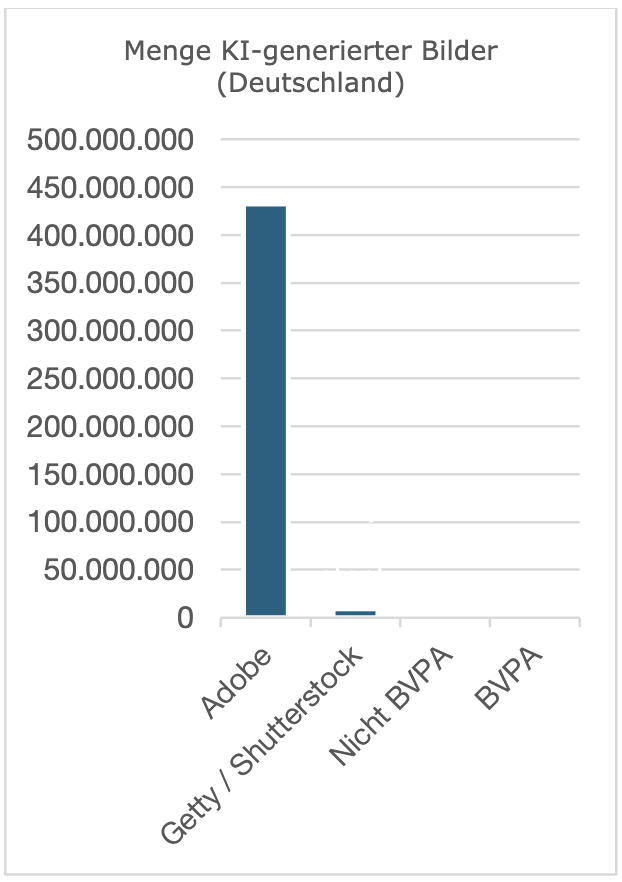
How is artificial intelligence changing the work with images and the situation of photographers, picture agencies, picture desks of print and online media, and image buyers at PR and advertising agencies?
Since consumer AI tools emerged four years ago, the opportunities and risks of artificial intelligence have been debated, at times very emotionally. Yet although artificial intelligence has become part of creatives’ everyday work, many questions about the use of these technologies remain completely unresolved, not least because reliable data is lacking. In a comprehensive survey on the use of AI conducted between 4 January and 28 February 2026, photographers, picture agencies, print and online media, and advertising and PR agencies were asked how they deal with AI tools and AI-generated images.
The aim of this broad view was to show to what extent AI tools now shape everyday life in the professional image business – and where they may not have arrived at all. The intention is to paint a nuanced picture of a situation in which, after initial fears for jobs, scepticism and rejection of AI, many creatives now see the new technology as a creative element whose use can no longer be refused, either in producing images or in publishing them. At the same time, the survey aims to make clear what economic consequences the use of artificial intelligence has for those involved and where they see the limits of the technology.
This study follows on from a series of seven previous surveys carried out between 2018 and 2025 by the ‘image market – business trends’ working group of the Visual Journalism and Documentary Photography programme at Hochschule Hannover, in cooperation with numerous associations from the media sector. It describes a very heterogeneous market in a time of upheaval: alongside the emergence and mass use of artificial intelligence in the image sector over the past two years, influences that have been observable for some time continue to affect the image market.
2025 AI and visual publishing 2025
In early 2025, two surveys by the ‘image market – business trends’ working group examined questions concerning the use of artificial intelligence in visual publishing.
By the beginning of 2022 at the latest, artificial intelligence had found its way into the work of picture agencies, PR and advertising agencies, and the newsrooms and publishers of print and online media. This brings opportunities and risks. Artificial intelligence can speed up editorial workflows by helping to caption images or adjust colour moods, but it becomes a danger when AI-generated photorealistic images suggest reality while in fact conveying false information. Like hardly any other topic before, artificial intelligence has become the subject of debate and reporting. The ability to generate texts and images by linking large amounts of data is also changing how we look at the media. The new technical possibilities also have a considerable impact on the image market. But what are the consequences of using artificial intelligence, and what possibilities does it offer? The working group examined these questions in two surveys at the beginning of 2025.
The sixth survey of the German image market, carried out by the working group together with the German association of professional image providers (BVPA) under the title ‘Image Market – Business Trends 2025 / Artificial intelligence in the editorial routine of picture agencies’, examined how and to what extent picture agencies in Germany use artificial intelligence and how they currently assess this technology with regard to their editorial routine. The study ‘KI und Bildpublizistik 2025’, carried out in cooperation with dpa Picture-Alliance, examined how and to what extent those who publish images in Germany use artificial intelligence and how they assess this technology with regard to their own editorial routine.
Further material (in German)
KI und Bildpublizistik 2025, results report with dpa Picture-Alliance (PDF)
Pictorial Online: How important is AI in the image market? Interview, part 1
Pictorial Online: AI and visual publishing. Interview, part 2
2022 image market 2022 – Fifth survey of the image market in Germany
In March 2022, the ‘image market – business trends’ working group and the German association of professional image providers BVPA conducted their survey of the German image market for the fifth time. Led by Prof. Lars Bauernschmitt, the survey asked picture agencies and photographers working in a similar way to agencies about current developments in the German image market. As in the previous year, the survey was shaped by the coronavirus pandemic, whose effects are still clearly noticeable. At the same time, the results also document the structural change that has long been taking place in the image industry.
Further material (in German)
Press release on the image market 2022 results report (PDF)
Pictorial Online: Interview on the ‘image market 2022’ survey, part 1
2021 image market 2021 – corona and the photo business
Since February 2020 at the latest, the Covid-19 pandemic has dominated the media worldwide – and the work of media professionals around the globe. Picture agencies and photographers in particular are affected by considerable professional and financial consequences. Two questions were therefore at the centre of this year’s survey of picture agencies and photographers, carried out by the image market – business trends working group in cooperation with BFF, BVAF, BVPA, DGPh (image section), dju in Verdi, DJV, Freelens and SAB:
How is the image market developing in 2021?
How is coronavirus changing the image industry?
The consequences of the coronavirus pandemic for the image industry are clear:
– While the photographers surveyed recorded an average drop in turnover of 23.7 per cent, the figure for the participating picture agencies was as high as 26.3 per cent. For the agencies surveyed, this was offset by public funding amounting to 2.3 per cent (measured against the losses).
– Around 80 per cent of the picture agencies and photographers surveyed noted a predominantly sharp decline in the number of photo commissions, accompanied by a reduction in the volume of orders.
– More than 60 per cent of the picture agencies surveyed face a sharp drop in demand for archive material.
The results are set out in detail in a 33-page results report.
Further material (in German)
Press release on the image market 2021 results report (PDF)
Pictorial Online: ‘image market 2021 – corona and the photobusiness’, a conversation, part 1
Pictorial Online: ‘image market 2021 – corona and the photobusiness’, a conversation, part 2
2020 image market 2020 – structure and perspectives
The first comprehensive survey among members of various associations of authors and rights users in Germany is intended to show current developments and to evaluate trends, perspectives and opportunities for development. It attempts to describe the current situation of individual players and groups involved, the possibilities for future cooperation between different market participants, and the future of the production and publication of images and the resale of image rights. The aim is to create the broadest possible data basis across associations, which can form the foundation for a future comprehensive account of the situation of the visual media and their players.
Further material (in German)
Press release image market business trends 2020 (PDF)
Pictorial Online: A conversation on ‘image market 2020 – structure and perspectives’, part 1
Pictorial Online: A conversation on ‘image market 2020 – structure and perspectives’, part 2
2019 image market – business trends 2019
As part of this research project, the second survey on the current situation of German picture agencies was carried out in February and March 2019 in cooperation with the German association of professional image providers (BVPA), under the title ‘image market – business trends 2019’.
Further material (in German)
Results report non-members of the BVPA (PDF)
Press release on the results, 1 April 2019 (PDF)
Pictorial Online, April 2019: The German image market (PDF)
2018 Image market 2018
As part of this research project, a survey on the current situation of German picture agencies was carried out in February and March 2018 in cooperation with the German association of professional image providers (BVPA), under the title ‘Bildermarkt 2018’ (image market 2018).
Selected results were presented at the conference ‘Digital Economy and Global Transformations in the Trade of Photography’ in Heidelberg on 5 February 2019.
Further material (in German)
Results report non-members of the BVPA (PDF)
BVPA survey: press release on the results (PDF)
Pictorial 03/2018: Image market 2018 (PDF)
Conference paper Heidelberg 2019, in English (PDF)
There is no such thing as one image market …
Although seemingly unambiguous, the term is used by different authors, depending on their position or intention, to label very different (sub-)markets in the same way. Depending on the image content and the distribution model applied, however, different rules and laws apply to different markets and market segments. The essay ‘Einen Bildermarkt gibt es nicht …’ (There is no such thing as one image market …) was published in: BVPA – Der Bildermarkt. Handbuch der Bildagenturen 2009, Berlin, 2009, pages 31–43, and in: BVPA – Der Bildermarkt. Handbuch der Bildagenturen 2010, Berlin, 2010, pages 35–47.


Your contact partners will be happy to assist you with your personal concerns. However, due to the large number of enquiries, we ask you to first check our FAQ to see if your question may already have been answered.
Dean of Studies, Design and Media department

Programme representative

Application and admission procedure

Hochschule Hannover
Faculty III – Media, Information and Design
Expo Plaza 2
D-30539 Hanover