The library of rescued East German books
How a pastor in Lower Saxony saved thousands of East German books from destruction – and why one of them gave space research a crucial lead.
By Sarah Schmidt (text), Thomas Müller-Vahl (photos)


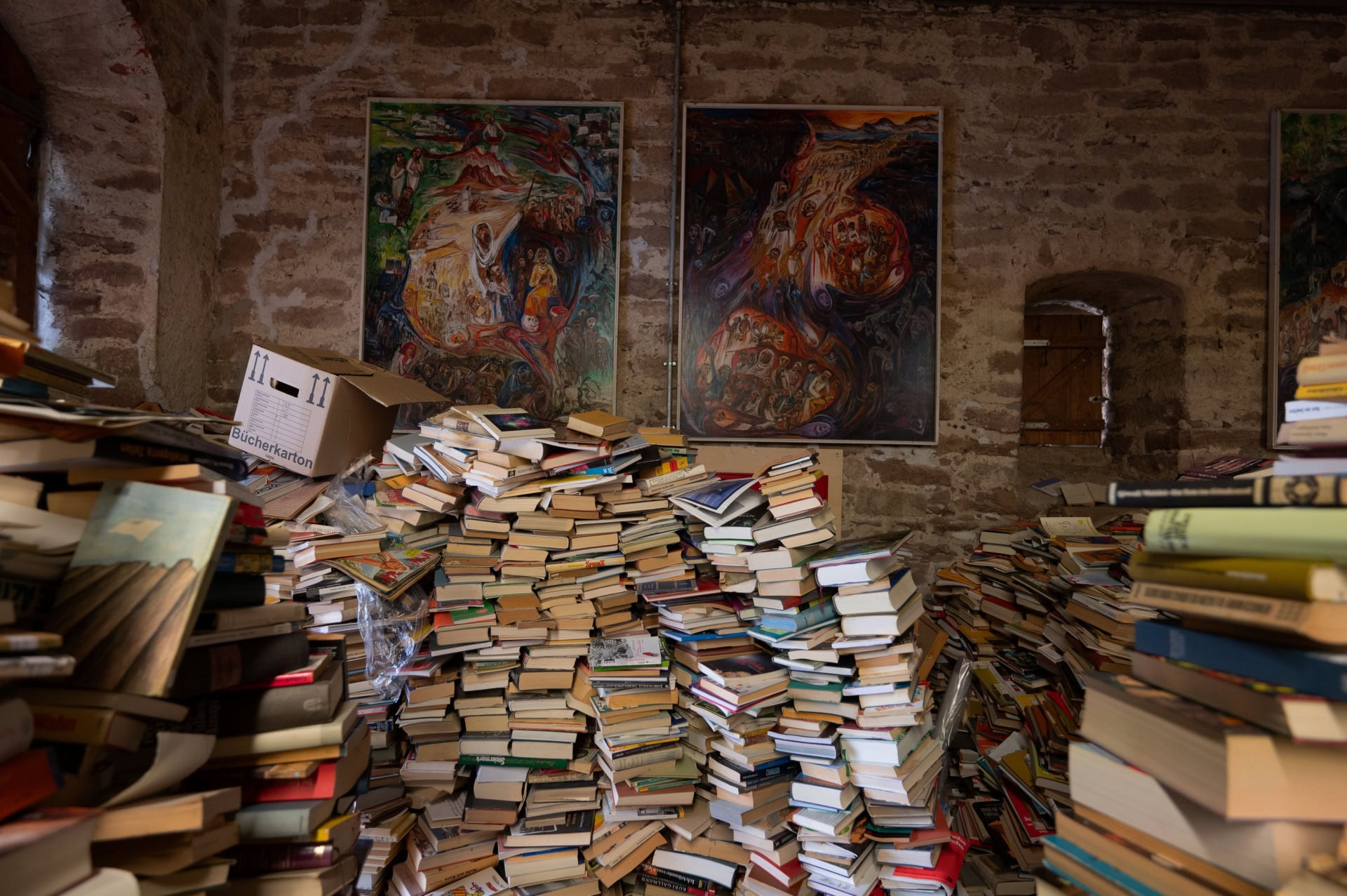
It all began with a picture and a sense of horror. In 1991 Martin Weskott, a Protestant pastor, was leafing through the Süddeutsche Zeitung. On page four was a photo of books being tipped out of a muck spreader at a rubbish dump near Plottendorf – in the open air, exposed to the rain, piled up like worthless rubble. Books from East German stocks: Phaedrus, Heinrich Mann, Stefan Heym. Complete, fresh from the printers, some still packed on pallets.
100,000 books on the tip – and one man sets off
Together with volunteers from his parish in Katlenburg-Lindau, he set off. With a VW van, a trailer and later lorries, when a drinks wholesaler helped out at weekends, they collected books. Tens of thousands of works that were due to be destroyed.
‘Many of these books weren’t just valuable from a literary or historical point of view,’ he says today. ‘They were unique, and contained knowledge you simply can’t get anywhere else any more.’ What began as a spontaneous act grew over three decades into a significant collection of books.
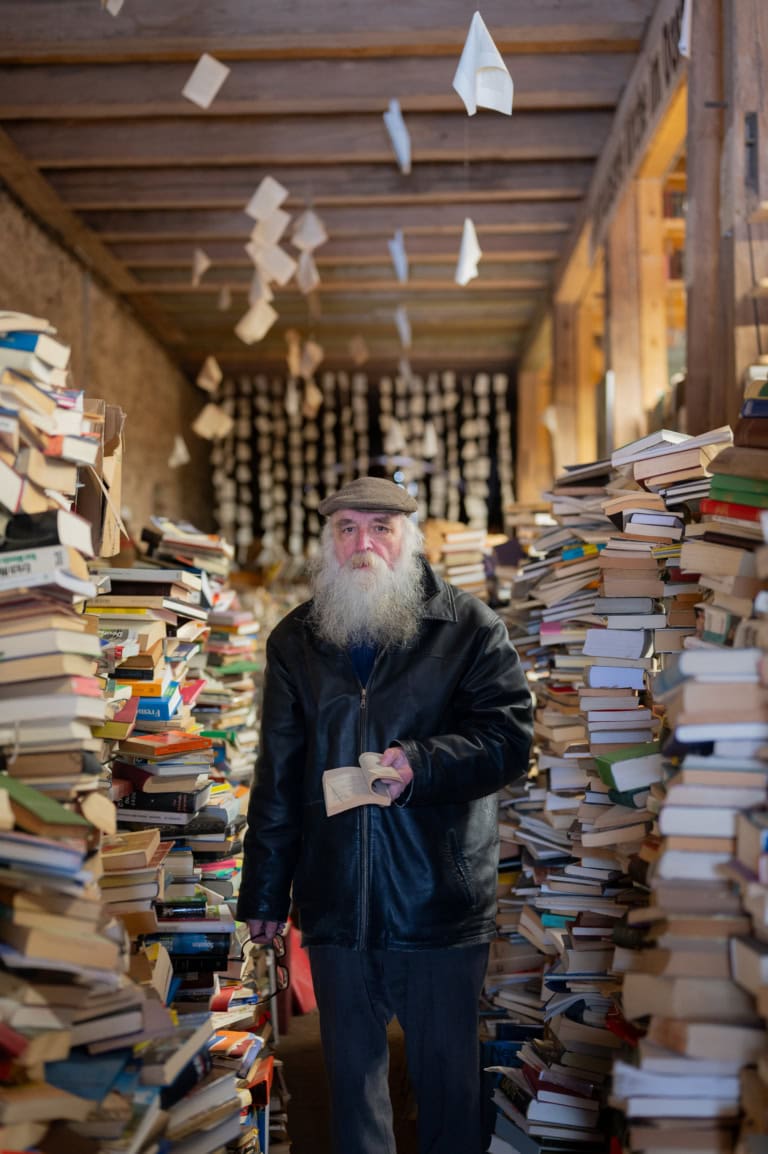
The Bücherburg in Katlenburg-Lindau is an archive of currently around 50,000 books. In the 1990s, the pastor Martin Weskott began rescuing books from being pulped – at first from the former GDR.

Under the motto ‘pass it on, don’t throw it away’, Weskott works to give these books a second life. Visitors to the Bücherburg can browse the archive themselves and take books home in exchange for a donation.
More than 50,000 books: a library against forgetting
Today the collection holds more than 50,000 works: specialist literature, textbooks, illustrated books and children’s books. A treasure that isn’t hoarded but shared. Anyone who drops by can browse, take books away and keep them. ‘Pass books on instead of throwing them away’ is the guiding principle – and a quiet rebellion against the throwaway society. At a time when culture is often measured in clouds and clicks, an analogue counter-world is growing here: tangible, lasting, surprising.
‘I have books that are more than 300 years old,’ says Weskott. ‘I can just take them off the shelf and read them. But digital storage media? You have to back up the data every ten years – if you can still find the software at all.’
Magnesium silicates and the road to Saturn
One of the rescued books shows particularly clearly why this work matters so much: a volume on magnesium silicates, printed in the GDR. It fell into the hands of a scientist from the Max Planck Institute for Aeronomy – purely by chance, when he was browsing the collection after a church service.
Magnesium silicates – hardly a thrilling subject. Yet in this book the scientist found crucial formulas for the mounting of a photospectrometer, an instrument that later flew to Saturn on board the Cassini probe. ‘It’s absurd and wonderful at the same time,’ says the book collector. ‘A book that almost ended up being burned contributes to space research. What does that say about the way we treat knowledge?’
The story made headlines around the world, with articles in New Scientist and The Times. A German book from East German stocks, found in rural Lower Saxony, became part of interplanetary research.
In a library you can find the things that broaden your horizons even further.
 Martin Weskott
‘That’s the encyclopaedia effect,’ he explains. It is the fundamental difference from searching online, he says: on the internet we only find what we can put into words – in libraries we find what broadens our minds. Many visitors come with specific requests: schoolbooks for their children, study material for teacher training. ‘Others just drop by because they’ve heard about us. Especially in spring, when people are clearing out or travelling – that’s when it gets really busy here.’

The collection is funded entirely by donations. A small circle of volunteers – around 25 people – helps with sorting, archiving and restoring.
In Sarajevo, Belgrade, Shanghai or Lviv, the books help people learn German or stock entire philology departments.
From rubbish tip to world library
What was once rescued from the GDR has travelled on: to Sarajevo, Belgrade, Shanghai and Lviv. There the books now help people learn German or stock entire philology departments. ‘These books don’t just have material value, they have cultural value too,’ he stresses. ‘They show perspectives, voices and content that would otherwise have been lost – for example from lesser-known East German writers who were never allowed to be published in the West.’
Books aren’t just memories – they’re raw material for new ideas.
Martin Weskott
The collection is funded entirely by donations. A small group of volunteers – around 25 people – help with sorting, archiving and restoring. Many of them are retired; some are new. And although the effort is considerable – every day, duplicates are re-sorted and books are accepted and checked for completeness – the purpose is greater still: ‘If we manage to help someone find a good book that would otherwise have been lost, then it’s been worth it.’
The outlook remains cautiously optimistic: the collection is now known throughout Germany, and people bring books from all over the country. ‘I hope this model catches on. In Switzerland, for example, there are the Brockenstuben – second-hand shops where even people who drive a Porsche buy used goods.’