Images in spite of all: photographic testimony from Auschwitz
In his groundbreaking study of images, ‘Images malgré tout’, Georges Didi-Huberman contradicts the thesis that the Holocaust cannot be represented. His approach to the photographic testimony from Auschwitz sparked a controversy.
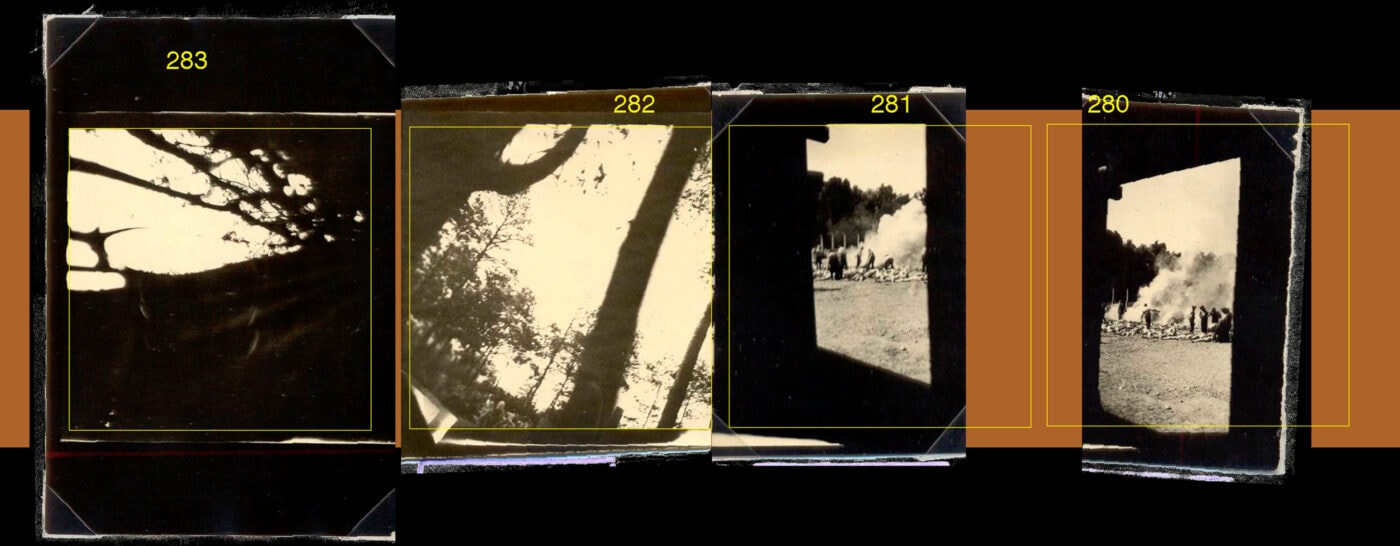 Reconstruction of the negative strip of the four photographs taken by the ‘Sonderkommando’ in Auschwitz-Birkenau, 1944
Twenty years after it was first published, the book’s concern is as relevant as ever: what do we see when we look at the four photographs taken by the Sonderkommando in Auschwitz? As simple as this question sounds, it is difficult to answer. For in order to know, we must imagine – we must make an image for ourselves. This image, it becomes clear, is by no means always identical with what is visible. In August 1944, prisoners of the so-called ‘Sonderkommando’ succeeded in taking a series of photographs intended to bear witness to the mass extermination in the Auschwitz-Birkenau concentration camp.
The ‘Sonderkommando’ (special squad) consisted of prisoners whom the Nazis forced to carry out the mass extermination in the concentration camps. Their work was to prepare the murder of the deported prisoners, take their belongings and finally carry the bodies out of the gas chambers into the crematoria and burn them. At the same time, the deployment of the ‘Sonderkommando’ also served to prevent anyone from bearing witness to the mass murder: its members were shot at regular intervals and constantly replaced by other prisoners, in order to stop any communication with other prisoners or with the ‘outside world’. The Holocaust survivor Primo Levi therefore called the invention and organisation of the Sonderkommandos ‘National Socialism’s most demonic crime’ , since their work consisted of ensuring the deaths of their own kind thousands of times over.
Out of these impossibilities – the imminent disappearance of the witnesses and the unquestioned unrepresentability of what they witnessed – the photographic image emerged. Although the pictures can probably be attributed to Alberto Errera, a Greek naval officer of Jewish origin who himself died in the concentration camp in 1944, taking them required an entire system of collective vigilance.
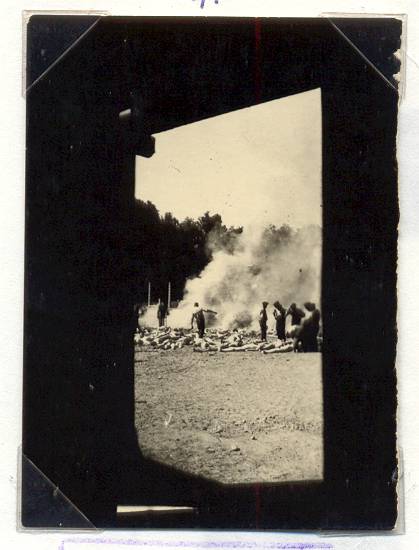 One of the four photographs taken by the ‘Sonderkommando’ shows the cremation of people killed in the gas chamber, in open-air incineration pits in front of Crematorium V in Auschwitz. August 1944. Oświęcim, Auschwitz-Birkenau State Museum.
In ‘Images in Spite of All’, Georges Didi-Huberman describes what this picture shows: the daily work of the rest of the squad, the hurried dragging and throwing of the heavy bodies, and the smoke rising from the incineration pits – concealing everything that the survivor Filip Müller reported. Behind it lies the birch wood.
While Alberto Errera took out the camera, hidden in the bottom of a bucket, and secretly photographed the ‘Sonderkommando’ burning bodies in one sequence (figs. 280 and 281), another member of the ‘Sonderkommando’ kept watch for SS guards on the roof of Crematorium V. After the first sequence, the photographer went outside and, in a second sequence (figs. 282 and 283), photographed undressed women on their way to the gas chambers of Crematorium V – and, probably by accident, the sky above the birch wood that screened the crematorium from view. The second, blurred sequence bears witness to the obvious danger and daring of the operation. The film was then hidden in a toothpaste tube, handed to a woman in the SS canteen and smuggled to the Polish resistance in Kraków, which circulated the photographs around the world as one of the few testimonies to the mass extermination of more than 1.3 million people in Auschwitz-Birkenau, in order to report on the ‘unimaginable’.
In his groundbreaking study ‘Images in Spite of All’, Georges Didi-Huberman reconstructs the paths by which the four images were handed down and examines the paradox of the unimaginable in these photographs from Auschwitz.
On the one hand, the four images address ‘the unrepresentable’; at the same time they refute it by representing ‘something’ after all. Didi-Huberman thus opposes the iconoclastic dogma of the ‘unrepresentable’ held by Claude Lanzmann – who did without any archive footage in his film ‘Shoah’ and, in a 2001 interview with the daily newspaper Le Monde, called Didi-Huberman’s study ‘unbearable interpretative schoolmastering’ – and by Gérard Wajcman, who commented on Didi-Huberman’s study with the words ‘There are no images of the Shoah’.
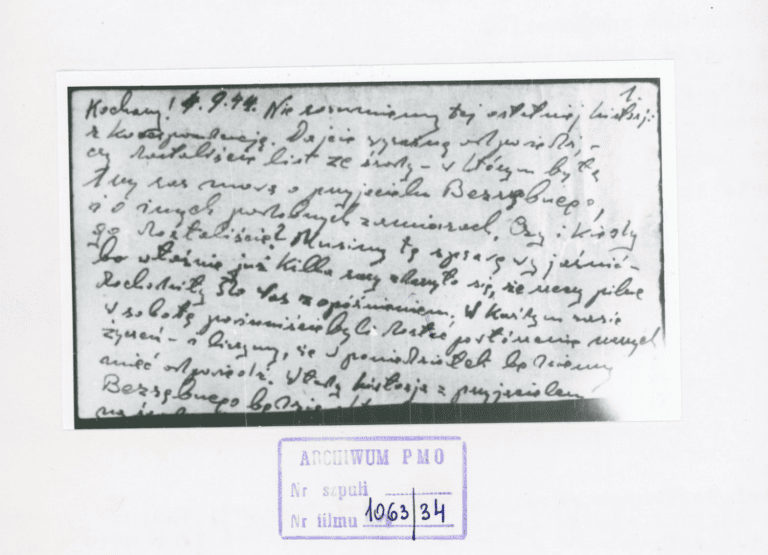 Didi Hubermann, Bilder trotz allem, Ausschwitz
‘Urgent. Send two metal rolls of film for a 6×9 camera as quickly as possible. Have the opportunity to take photos. Sending you snapshots from Birkenau – gassing operation. These photos show one of the pyres on which the bodies were burned when the crematoria could not manage to burn all the bodies. The bodies in the foreground are waiting to be thrown into the fire. Another picture shows one of the places in the forest where people undress before they “take a shower” – as they were told – and then go into the gas chambers. Send the roll of film as quickly as possible! Send the enclosed photos to Tell – we think you should pass on the enlargements.’
‘Images in Spite of All’ refuses to deny archive images any fundamental ability to report on historical events – but at the same time it warns against treating the images as a clear path into the past. Rather, the four photographs are fragments that contain traces of truth and whose complexity has to be deciphered.
Didi-Huberman’s examination of the question of images after Auschwitz breaks with the rhetoric of the unsayable, the unimaginable and the unrepresentable by trying to look at the photographs in a new way – one that runs counter to how images are read in conventional art-historical analysis of iconography. The aim is to make the ‘illegible’ visible: not only to analyse what is depicted and exposed on the film, but also to place in context and take into account the conditions under which the images were made – so as to rely not only on what is seen but, above all, on what cannot be seen. For the paradox of the photographs from Auschwitz reveals itself above all in their ‘indistinctness’ (the oblique angle) and in what cannot be recognised (the black shadows), which are in conflict with what can be recognised in the light.
The four photographs should therefore be seen neither as a purely historical document containing ‘the whole truth’ nor as ‘icons of horror’ in which the whole tragedy of what happened can be recognised. Rather, what is depicted unfolds within a ‘twofold order’ : the truth of what happened, and at the same time the opacity that makes it hard to recognise.
The photographs’ value as knowledge lies rather in their complexity as a montage. Not in the individual image – the focus of iconography, in which we believe we see everything and thus isolate the images from each other. Four images, two sequences, two moments of the same process of extermination. Montage as an archaeological way of looking that makes it possible not to view the images in isolation but to ‘mobilise’ them and set them in motion with one another, so as to ‘bring out the breaks, the analogies, the indeterminate and the overdetermined’.
Ultimately, Didi-Huberman’s study is not about whether what happened can be represented ‘as it was there’, but about the evidence ‘that it happened’. Especially in the first part of the book, Didi-Huberman’s ‘Images in Spite of All’ reads almost like a plea to commit the visual testimony of the ‘hell’ of Auschwitz to memory and to insist on looking at this material ‘in spite of all’.
Further works on representations of the Holocaust
In contrast to Wajcman’s and Lanzmann’s critical stance towards Didi-Huberman’s work, it is also helpful to look at Wendy Creed’s text ‘Representations of the Holocaust: The Grey Zone, Maus, and Shoah’. Creed argues that all representations of the Shoah should always be placed in context with one another. This results in a more multi-layered approach to imagining the barely imaginable events known as the ‘Holocaust’. The danger, especially for later generations who can no longer talk to contemporary witnesses and survivors, lies in elevating a single representation – however complete it may seem – to the definitive representation of the events. According to Creed, Didi-Huberman’s analysis of the images taken by the ‘Sonderkommando’ in Auschwitz-Birkenau should be seen as added value: as a work that takes its place alongside existing works such as Claude Lanzmann’s ‘Shoah’ , Art Spiegelman’s comic ‘Maus: A Survivor’s Tale’ or Alain Resnais’ film ‘Night and Fog’, and that refines and broadens our understanding – our idea – of the barely imaginable reality of the Holocaust.