Journalism internships: how to find a placement and write an application that stands out. How do you find the right internship in journalism, how do you make your application convincing, and what should you bear in mind during the internship? With concrete tips from professors and students.
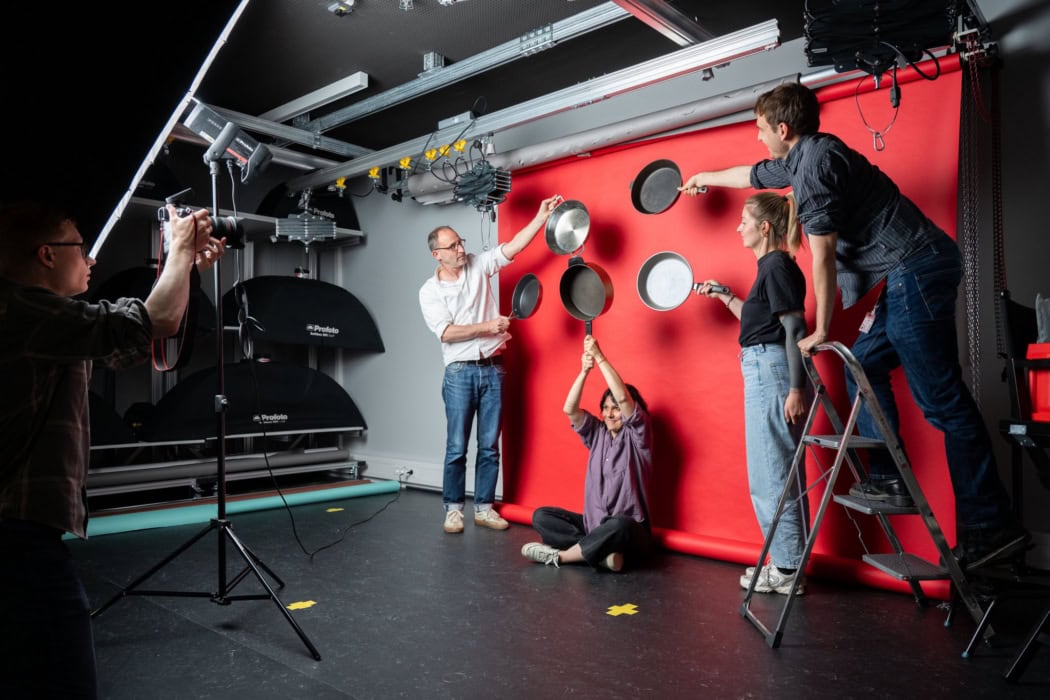 Photo: Stefan Nieland
Sophie Boyer and Stefan Nieland, students from Hannover, gain practical experience in the F.A.Z. studio. Also there: alumni Lucas Bäuml (far left) and Sabine Findeisen (seated), and photographer Frank Röth (second from left). The F.A.Z. has worked with Hochschule Hannover for more than 20 years.
‘A journalism internship has three aims,’ says Prof. Wilfried Köpke, journalist, author and until recently head of the journalism degree programme at Hochschule Hannover. ‘The first is to try yourself out in the job. Is this what I really want to do? Or did I have the wrong idea of what journalism is? Second, to test myself in an editorial environment, where different expectations come my way. I’m not just there for myself, but part of a collective. And third, to get to know the industry as a system of its own. Is this the industry I want to go into?’
Contents
1. Be clear about your goals for a journalism internship An internship in journalism? That can mean many things. What’s right for you?
2. Find the right placement in the media world The media landscape is broad. Get an overview so you can find the placement that suits you!
3. Pay and funding for your journalism internship How much will you earn as an intern? Everything you need to know about money.
4. Applying for a journalism internship. Tips for a great first impression.
5. The interview with the editorial team This is your chance! How to shine in the first meeting and what to look out for.
6. How to make a success of your internship day to day Everything you need to bear in mind during your internship.
7. Reflecting on your journalism internship After the internship: what you can take away from it.
1. Be clear about your goals for a journalism internship
Before you apply, get clear about your expectations and interests. A journalism internship can take many forms: arts or politics desk, television or online journalism, local paper or international magazine. Do you want to write, take photos, film or create social media content? Are you drawn to investigative research, daily news reporting or digital storytelling?
‘First you should ask yourself: what can I do and what do I already know? And then take the second, brave step and say: I’m not doing that again!’ says Köpke. ‘We always like doing what we can already do, because it brings quick success. But the exciting thing is actually getting to know something new.’
Prof. Christoph Bangert, photojournalist and internship coordinator on the Visual Journalism and Documentary Photography programme, stresses: ‘Look for an environment where you can take on responsibility. That’s challenging – but that’s exactly what makes you grow.’
Student Monja Nagel agrees: ‘I learned most when I was thrown in at the deep end – but had the chance to grow into the tasks.’
2. Find the right placement in the media world
Your journalism internship should suit you – in terms of content, organisation and personality. Think about it: which formats do you regularly read, listen to or watch? Which editorial teams work the way you can imagine working yourself? Where do you find exciting subjects, clear positions and good stories?
‘The very first step is to find out what you read and watch yourself. Which publications interest me? Are there publications or editorial teams where I’d say, they do great work, I can identify with that?’ explains Christoph Bangert. Questions Wilfried Köpke also thinks you should definitely ask yourself: ‘What are the media I’d actually like to work for? Just dream a little: where would I like to go? In my experience, it then works out.’
Large media companies usually offer structured internship programmes, clear contacts and professional workflows. Smaller editorial teams often allow you to work more independently, with flat hierarchies and more direct access to decisions.
Platforms such as newsroom.de or the careers pages of media companies can help you search. Speculative applications also make sense – especially to leading media outlets that don’t advertise internships publicly.
Partnerships with the F.A.Z. and the LVZ
The Visual Journalism and Documentary Photography programme at Hochschule Hannover has long-standing partnerships with renowned media outlets such as the Frankfurter Allgemeine Zeitung and the Leipziger Volkszeitung. Felix Posner, who did his journalism internship in Leipzig, says: ‘I was able to take pictures every day – that moved me on a lot in a short time.’
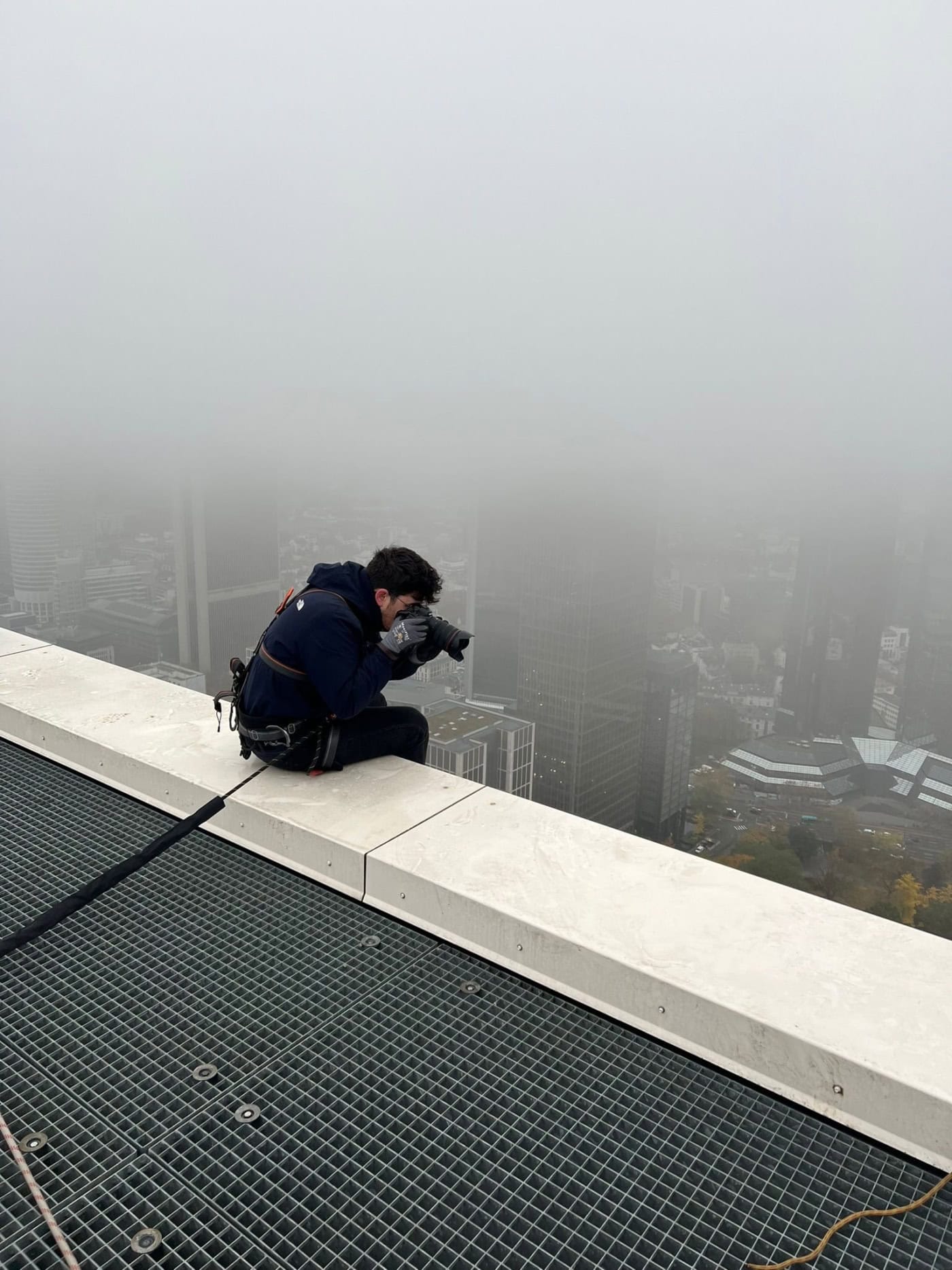 Student Jasper Hill at work for the F.A.Z.
Editorial teams are looking for committed interns – and you are looking for an environment in which you can learn. Both sides have expectations. ‘One thing is what you want. The other is what the editorial team wants,’ stresses Köpke. Being aware of this is important if you want to be happy with the internship in the end. ‘Choosing an internship isn’t a Tinder date. You’ll never have a 100 per cent match between your own expectations and what a company offers. If you notice that the differences are too great, it’s a good idea to simply ask again what’s possible.’
Choosing an internship isn’t a Tinder date.
 Wilfried Köpke
3. Pay and funding for your journalism internship
Funding a journalism internship is a big issue. Interns don’t always get paid at all, and when they do, it’s often too little. So think in advance about how you will finance your internship.
‘Where there’s no villa, there’s no way’ – that is how the author Olivier David sums up the internship situation in German journalism on Übermedien. Working on the side of a full-time internship is hardly possible. ‘I know people who save up so they can afford the internship. I’ve also heard of students who took out a student loan to do a really great internship. But that’s not how it should be,’ Bangert concludes.
A study by berufsstart.de shows that most editorial teams pay between 300 and 600 euros a month – some nothing at all. There is no legal obligation to pay for compulsory internships that are part of a degree. For voluntary internships lasting more than three months, the statutory minimum wage applies. A realistic look at your financial situation is therefore essential.
In 2024, ‘Berufsstart’ asked 59 companies how much they pay for a journalism internship. On average, journalism interns received 468 euros a month, which puts journalism in 79th place compared with other fields. But the differences within the industry are also large: some get nothing at all, others more than 1,000 euros.
The media outlet ‘Übermedien’ has also taken a closer look at how interns are paid, asking 16 media companies. It’s worth a look if you want to find out specifically how much you would get at particular companies. Their press enquiries show that pay can vary greatly from placement to placement. At the WDR, for example, you get 450 euros a month as an intern; the NDR pays nothing, except in exceptional cases an expense allowance of 300 to 400 euros a month; and Bayerischer Rundfunk pays 774 euros. The figures are from 2022.
So it’s important to find out before you start how much the placement pays. Sometimes it’s already in the job advert or mentioned in conversation. If not, don’t be afraid to ask. ‘There’s no shame in raising pay quite early on! Just ask,’ says Monja.
Wilfried Köpke also recommends: ‘If you do your compulsory internship abroad, you’ll get Erasmus funding very quickly. That pot hasn’t been used up for years. And an internship abroad looks good on your CV.’
4. How to apply successfully for a journalism internship
Many people rightly ask when they should apply for a journalism internship. Not so easy to answer, says Wilfried Köpke: ‘Before Covid, we always said: apply a year in advance. But Covid pretty much torpedoed that, because all editorial teams planned at such short notice. We notice that this short-term approach is still an issue.’ So it’s hard to give a concrete answer at the moment. But better too early than too late!
The most important thing is that your application makes clear you have really engaged with the editorial team’s content. ‘You have to show that you really want it by having looked very closely at the publication and your future employer. That you know what they do, what their style is, who writes and takes photos for them,’ says Bangert. Köpke agrees: ‘As an editorial team, I need to be able to see that this person has really looked into what we actually do here.’
As an editorial team, I need to be able to see that this person has really looked into what we actually do here.
Wilfried Köpke
So: ‘Beware of copy and paste!’ stresses Köpke. ‘It doesn’t look good if you apply first to the fashion magazine and then send the same application – with only the address at the top changed – to the football people, leaving the fashion references in.’
Monja always highlights direct references to the work of the editorial team in her applications. ‘I also always describe my motivation – why I in particular want the position and why I’d fit in well with the team.’ So think about what you can offer the editorial team and state it clearly in your cover letter. ‘That shows someone has thought not only about what they want but also about what the editorial team wants and how they can contribute to it. That lifts you above the average application,’ says Köpke.
An important part of every application: meaningful samples of your work. Three well-chosen texts, photo essays or pieces are better than ten unstructured projects. Pay attention to relevance, formal quality and variety.
Once your application is ready, of course, it still has to be sent – from a professional-looking email address. Ideally, send your application not only to the HR department but also to the editor-in-chief or head of the desk. Make sure you address the recipients by name. That comes across as much more personal than ‘Dear Sir or Madam’.
Once that’s done, it can take a while to get an answer. After ten days, you can call the editorial office and ask about your application. ‘A certain persistence and bite count in your favour, because the people in the newsroom then know that you’ll deal with people the same way when you’re researching on the ground. It won’t be held against you,’ explains Köpke.
Photography students often have too much material in their portfolios. You really should cut it down. Fewer projects, which can then be more extensive – in our case, that means 30 to 40 pictures per project. Put together a portfolio that is compact, precise and intense.
 Christoph Bangert
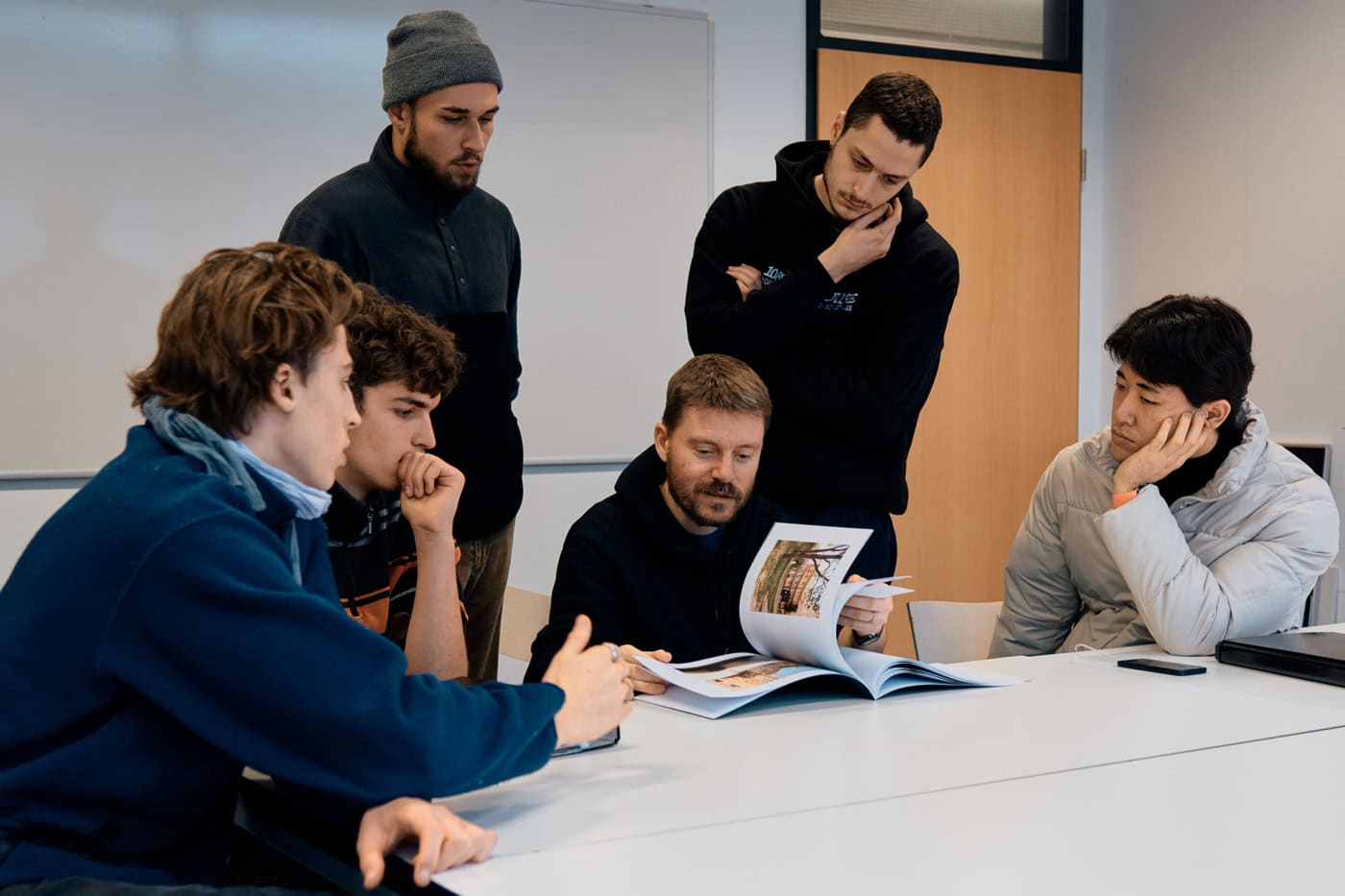 Portfolio review with Prof. Christoph Bangert. Photo: Vladislav Laptev
5. The interview with the editorial team: present yourself clearly
If your application is successful, an interview usually follows. It’s the perfect opportunity to find out more about what to expect during your journalism internship. Pay, responsibilities, working hours? Now is the time to clarify the conditions properly.
‘The most important thing is that the placement offers a clear structure,’ stresses Köpke. ‘The editorial team has to know what it wants from you. And if they can put that into words, you can also say whether you want it or not.’ Working at weekends, the occasional 60-hour week or a two-week filming trip – ‘not a problem at all, as long as it’s clearly defined in advance.’
In my experience, the interview and how I presented myself were even more important than the application.
 Felix Posner
To shine at interview, it’s important – as in your application – to show: ‘I know who you are.’ The first question is often: ‘How did you like yesterday’s programme, or yesterday’s issue?’ So it helps to have an answer ready. Having a view on the content, voicing criticism if need be and suggesting your own ideas are also important, according to Köpke.
‘In my experience, the interview and how I presented myself were even more important than the application,’ says Felix. His tip: ‘Don’t beat about the bush – show clearly who you are and what you can do, so people get a clear impression of you.’
Bangert’s tip for journalism interviews: ‘Feel free to ask questions, too. Sometimes you forget that when you’re nervous. But the people you’re dealing with are often interesting, and you can ask them a few questions as well.’
Monja also advises getting to know your own CV well. Sounds obvious, but think again beforehand about what you want to say about each stage you’ve been through so far. What have you already learned that you can bring to this company? What do you still want to learn? ‘They like to bring up everything that’s on your CV. So you should be able to say something about it.’
6. How to make a success of your internship day to day
Once the internship starts, everyday life begins – and with it the real learning. See yourself as part of the team and take your tasks seriously. People who think ahead, show initiative and ask for feedback are remembered positively. ‘With a longer internship, the company also wants to check whether you might be a suitable employee. It’s like a long casting show,’ says Köpke. So dare to take on responsibility and grow with the tasks.
As an intern, you are a full member of the team, and that’s how you have to see yourself.
Christoph Bangert
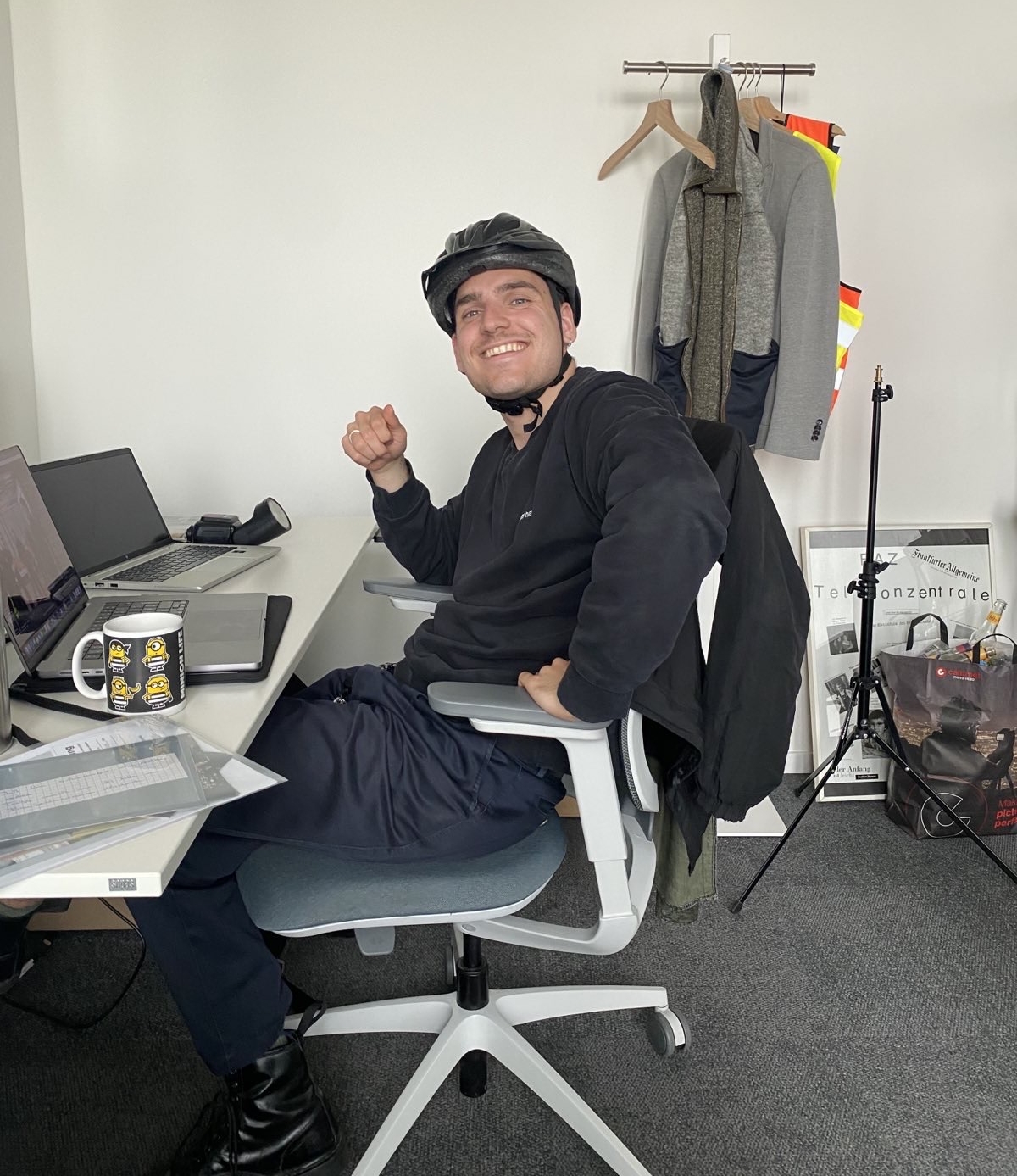 Student Stefan Nieland during his internship at the F.A.Z.
Of course, things may not always go smoothly. What then? ‘Don’t wait – raise it immediately,’ says Bangert. ‘It’s important that you have a clear contact person during the internship. That has to be settled, and if it isn’t, you need to sort it out yourself fairly quickly, in the first week,’ says Köpke. That way, any little problems can be cleared up straight away.
If people are unfriendly, tasks are unclear or criticism is vague, the rule is: ‘Always ask – first the person themselves, and if that doesn’t get you anywhere, feel free to involve your internship contact,’ says Bangert. ‘On some points, you really shouldn’t hesitate to contact institutional points of contact.’ In cases of sexual harassment or unagreed overtime, for example, that could be the works council, the editor-in-chief or an equal opportunities officer. On matters like these, make yourself heard!
7. Reflecting on your journalism internship
When the internship ends, the reflection begins. Ask for a reference. Note down important contacts. Think about what you’ve learned – and what you missed. Monja Nagel takes one thing above all from her internships: ‘Connections only hurt those who don’t have any.’ A journalism internship is a great opportunity to make contacts for future working relationships. ‘You never know when you might need contacts or points of call again later in life. Keeping certain doors open has really paid off for me.’
For Felix, too, the internship was an important experience: ‘Above all, I came away with confidence in my work. Being taken seriously and realising what you can do – the internship was a good experience that now helps me talk to people as an equal and not feel so small.’ That confidence is important for holding your own in working life. ‘We all have something to offer, and we shouldn’t hide it.’
Your journalism internship is more than a compulsory stage. It opens doors – for your personal and professional development.
Conclusion
A well-chosen journalism internship moves you forward – professionally, personally and strategically. Make the most of it!