The world’s largest Playmobil collection: 400,000 figures
It all began in a child’s bedroom – today Oliver Schaffer owns the world’s largest Playmobil collection, with more than 400,000 figures. A visit to his high-bay warehouse.
By Jakob Wolf (text), Felix Kaspar Rosić (photos)


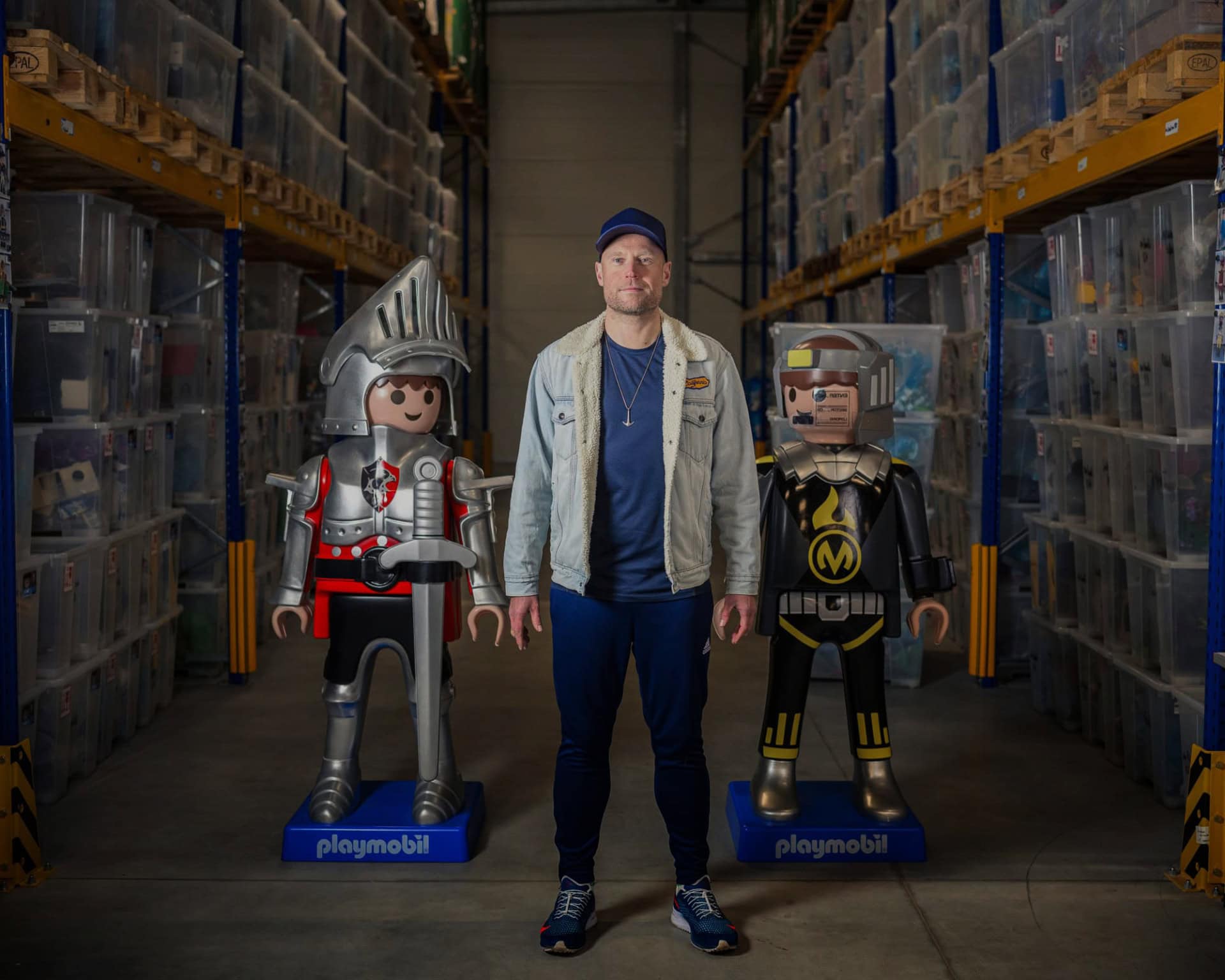
It’s a cold winter’s day in the north of Hamburg. Even in the car park outside the building you can see your breath. And the cold doesn’t let up when you step into the high-bay warehouse. The Playmobil diorama artist and collector Oliver Schaffer seems unaffected by the temperature; dressed in sportswear, he shows us round his realm. The first things you notice are the five-metre-high shelves to the right of the entrance. Around 1,500 boxes are piled up here, full of all kinds of individual parts, such as bushes and trees or pieces of castles and palaces for his dioramas. This is where the world’s largest Playmobil collection is kept.
On the very top shelf sit some impressive XXL figures – among them a builder, a gardener and a knight. To the left of the entrance are boxes of smaller figures, and right next to the big entrance door are the animals: animals that have lived in German children’s bedrooms for decades, such as horses, dogs and giraffes. Schaffer is particularly taken with one exotic specimen: a Playmobil anteater with a thin tongue that slides out.
English subtitles: switch them on manually with the CC button in the video player.
The world’s largest Playmobil collection
The further Schaffer moves into the depths of his warehouse, the clearer it becomes just how big the collection is. And the entrance area makes one thing obvious: his collection is still growing. A whole row of boxes and unopened parcels stands tightly packed here. Some have come back from past exhibitions; others are brand-new sets, such as an exclusive kitchen set from a supermarket chain that Schaffer bought only recently.
All in all, the Playmobil artist’s collection comprises more than 3 million individual parts and over 400,000 figures. Only part of it is kept here in the warehouse, though. The rest is travelling in changing exhibitions all over Germany and in some other European countries. As a Playmobil diorama artist and collector, Schaffer creates scenes depicting historical events and stages fantasy worlds. He shows the history of cities and life in the Stone Age or in ancient Egypt. Using toy figures gives the whole family a playful, easy way in. And it works: several million people have visited his almost 100 exhibitions.
But even this man in his mid-forties started small: his story begins in a child’s bedroom in Kiel, his home town. He is given Playmobil for the first time at the age of three. As a child he plays with his ‘Zirkus Oliver’ – a circus he named himself – and regularly puts on shows for his parents. As a teenager, he packs everything away in twelve removal boxes in the loft. Schaffer becomes a musical theatre performer and works in Hamburg for ten years.
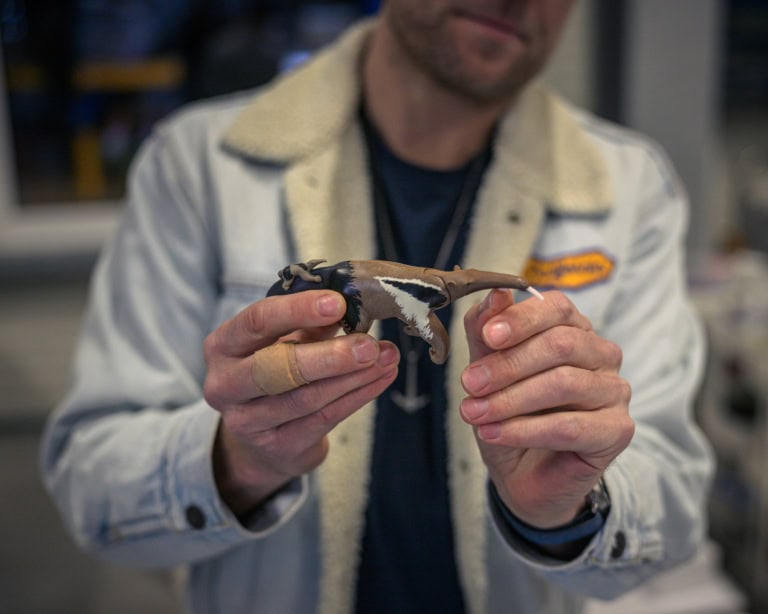
Oliver Schaffer’s favourite Playmobil piece: the mother anteater with her baby on her back. Asked why, he simply says: ‘Just look at her! She’s absolutely adorable.’
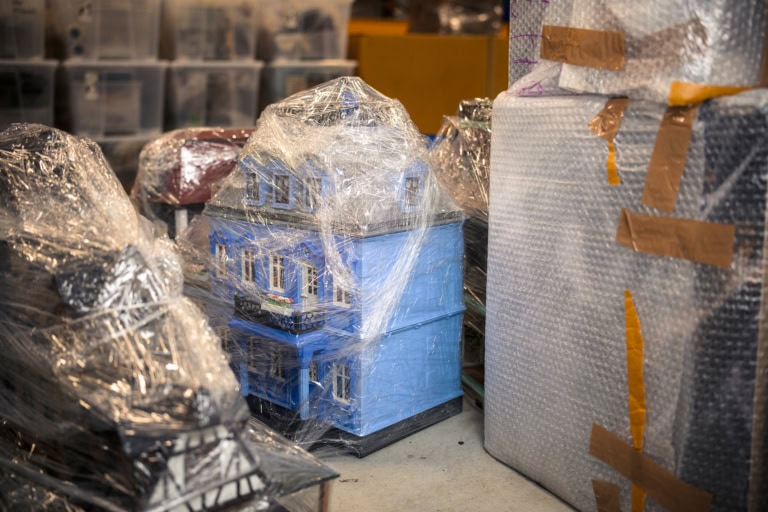
It’s often the buildings that make the difference and bring the Playmobil dioramas to life. The artist can recreate almost any scene, building whole streets like film sets.
His connection with Playmobil only returns around 20 years ago: in 2004 Playmobil invites him to its 30th anniversary at the Historisches Museum der Pfalz in Speyer. The Kiel native exhibits his ‘Zirkus Oliver’ for the first time; the exhibition is a success and goes on to tour Germany. In 2009 it is shown in the decorative arts department of the Louvre in Paris. ‘Of course it was something very special that the circus tent my father built for me in Kiel was on display a hundred metres from the Mona Lisa,’ Schaffer recalls. From then on, one thing leads to another. For the past five years he has been a self-employed solo artist and a Playmobil brand ambassador.
A warehouse full of Playmobil stories
Schaffer carries on through the aisles of his Playmobil warehouse. Every so often he stops to point at figures and accessories. The anecdotes come pouring out: ‘I’m especially proud of this figure – I was allowed to design it myself for Playmobil’s 50th anniversary,’ says Schaffer, pointing to a silver Playmobil figure holding a blue heart and a blue balloon. ‘This castle, I remember, was in the medieval diorama at the museum in Hameln only recently.’
At the end of the shelves, it becomes clear that success comes with hard work. Schaffer points to a mountain of blue bags. They contain countless individual parts that were used in the exhibitions and now have to be sorted back into the boxes on the shelves. Schaffer says there’s usually no time for that. But now he grabs a few parts and searches the labels on the boxes. Half-timbered houses stand next to the water zoo, the safari next to the Stone Age – or gladiators next to supermodels.
What you need most is often the furthest away
 Oliver Schaffer
But Schaffer keeps track of it all: he reckons he has developed a photographic memory by now. He finds the workshop hall straight away; the campsite he looks for in vain. ‘What you need most is often the furthest away,’ Schaffer jokes, and turns to another piece in the meantime. The Playmobil builder admits that his system takes some getting used to, but he doesn’t see any alternative: ‘Sorting it wouldn’t make sense. Whatever comes back from the exhibitions just goes on the shelf.’
To reach the higher shelves, he has even got a forklift licence. To prove it, he brings down a pallet with two large figures wrapped in bubble wrap. Slowly and carefully, he manoeuvres the forklift along the aisle, making sure he doesn’t touch anything. He steers meticulously, always with short, simple movements, and brings the pallet down without a hitch.
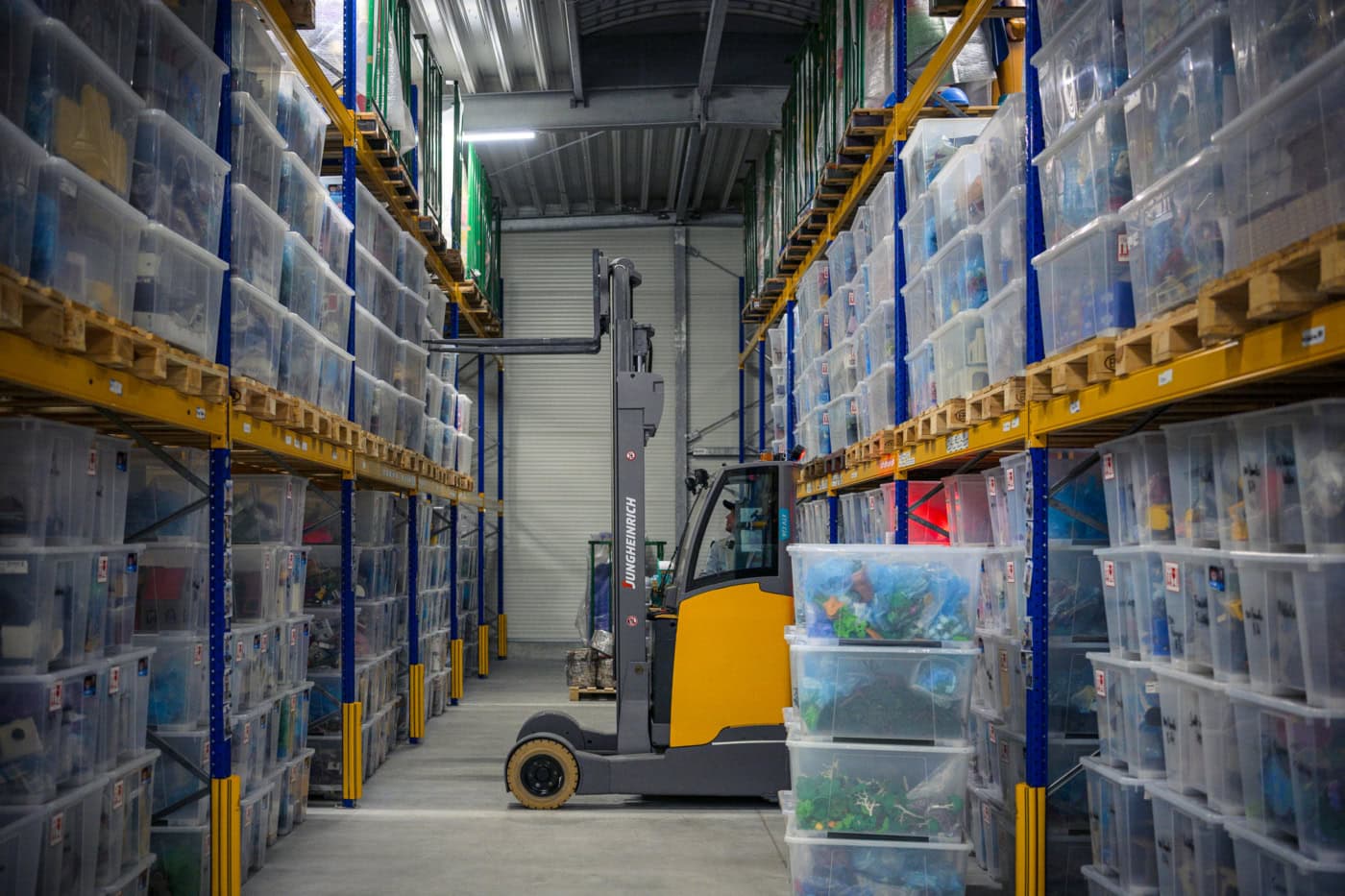
To store and retrieve his countless Playmobil figures and parts, Oliver Schaffer has rented a high-bay warehouse and got a forklift licence.
Keeping the passion alive: the balance between work and creativity
For all his professionalism, it matters to the Playmobil diorama artist and collector to keep his passion alive. To do that, Schaffer says, he sometimes needs a bit of distance. Unlike other collectors, he doesn’t have a single Playmobil figure in his flat. ‘That may sound harsh, but Playmobil is part of my job, not my life,’ says Schaffer. Keeping the two apart helps him look forward to his work and exhibitions again and come up with new ideas. But the Kiel native also knows that turning your passion into your job can’t be taken for granted.
He is all the more grateful that he was able to go his own way, with the support of family and friends: ‘I mean, they know me. They know Oliver has always done what he’s passionate about.’ But the diorama artist regrets that people with a passion are often laughed at at first. He argues the opposite: ‘If someone is enthusiastic and their enthusiasm is infectious, that’s fantastic – and we need more of it.’ Schaffer had to earn general recognition for what he does, too: at first, many people looked at his work with a fair bit of mockery. But over time he won over museum directors and visitors. He admits that things can get stressful two weeks before an exhibition, and that the sun doesn’t shine every day even in the life of a Playmobil professional. In most cases, though, he can decide whether to build the riding stables, the world around 1900 or the princess castle first. He sees that as a big advantage of his work.
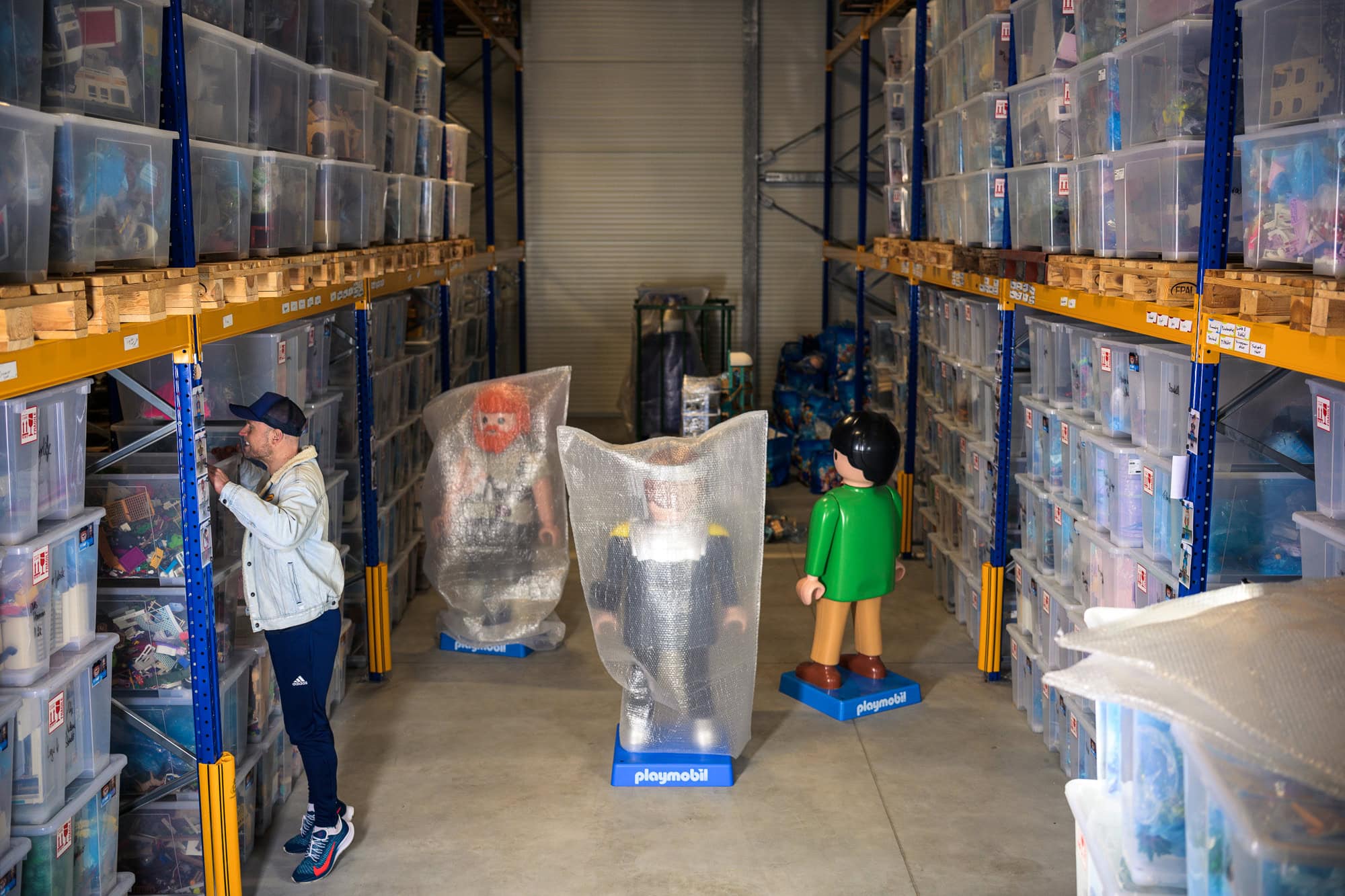
In one corner, Oliver Schaffer keeps unsorted Playmobil toys: again and again he takes one of the big blue plastic bags and brings a little more order to his chaos. Most of the time, though, he says, he finds what he’s looking for.
More than toys: how Schaffer turns Playmobil into art
As he continues through the world’s largest Playmobil collection, the Playmobil artist explains that every single part he uses in his dioramas is made by Playmobil – ‘I’m a purist about that,’ Schaffer adds with a smile. To this end, he regularly takes whole sets apart, combines them and puts parts together in completely new ways. But he would never dream of making individual parts on a 3D printer, Schaffer insists.
A few steps further on, it turns out he does make one small exception: on a table lie several bags filled with sand and grass; he sometimes uses materials like these for the ground in his dioramas. Each bag has a different shade. Details like these matter to the diorama artist: ‘I don’t compromise on that.’
The mix of colours, figures and buildings in his exhibitions has to be right. That’s why he always takes extra boxes with him when he sets up in a museum, Schaffer says. Even if he only needs 30 out of 100 boxes, it’s always good to have more with him. He compares it to an artist’s palette, which also has to offer enough variety. That shows how he sees himself: ‘I don’t see myself as a collector – more as a director.’ Schaffer says he wants to depict ‘stories from life’.
The Playmobil diorama artist and collector also gathers inspiration for his exhibitions in everyday life. He takes pictures of different places and situations and develops ideas for making his dioramas as true to life as possible. But Schaffer says many people have to understand that first: he remembers exhibitions where visitors came up to him and said they had three more elephants than he did, so why couldn’t they exhibit too? But this man in his mid-forties makes it clear that that’s not the point for him. He wants to depict something, not just show off his collection.
I don’t see myself as a collector – more as a director.
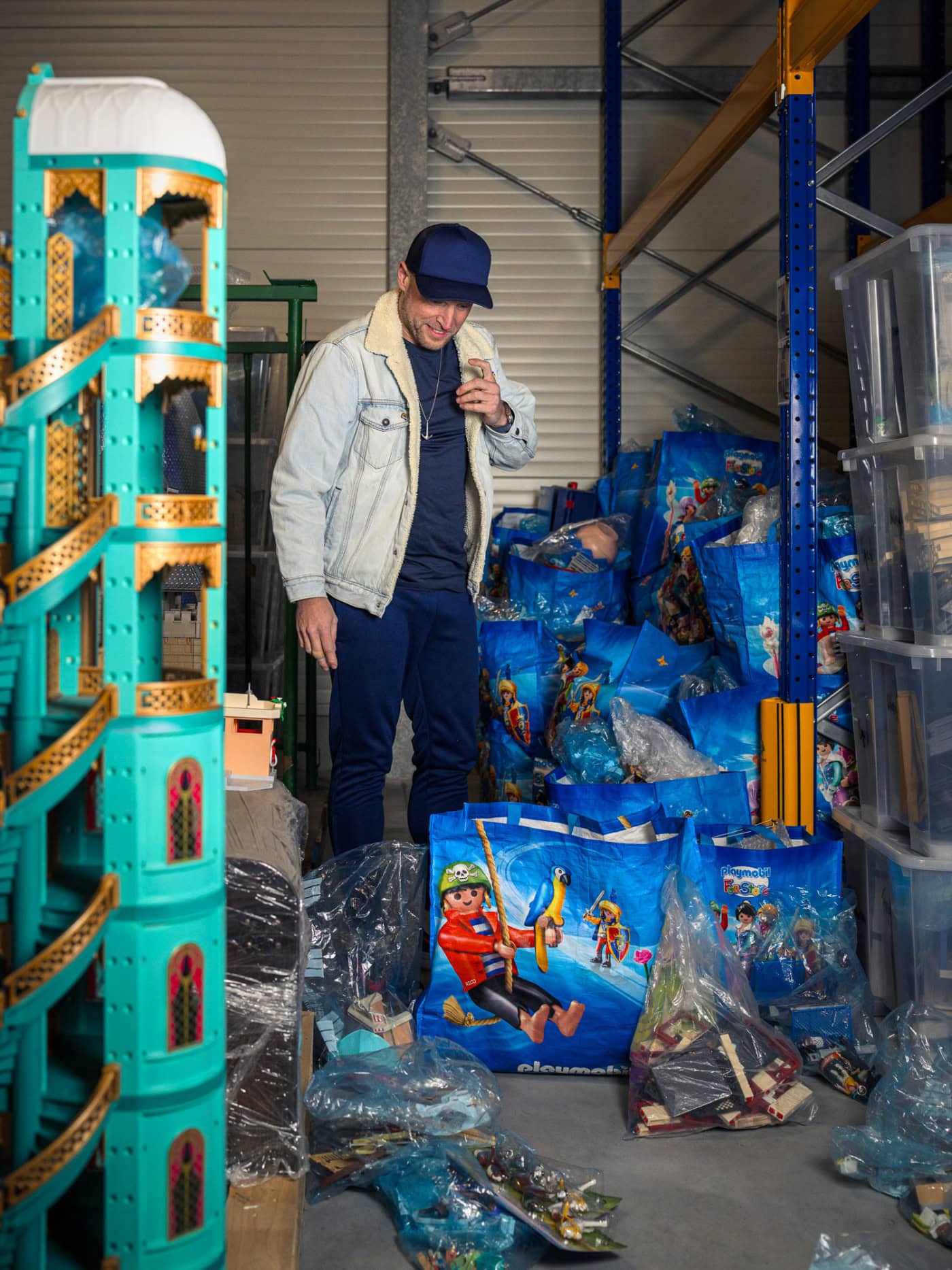
A visit to Oliver Schaffer’s high-bay warehouse: he designs and builds dioramas from Playmobil toys and owns the world’s largest collection.
Almost 100 exhibitions – and no end in sight
Each year Schaffer designs around ten to twelve exhibitions. Each one is different. He particularly enjoys archaeological and historical exhibitions. One example is the story of the Bremen cog, which he showed at the German Maritime Museum in Bremerhaven. Or he creates artistic perspectives, as at Wilhelmshöhe Palace in Kassel, where the Playmobil builder recreated paintings by Rembrandt, among other things. A project close to his heart was the Playmobil world tour at Eberbach Abbey. Here Schaffer depicted the world’s cultures and religions, with a mosque next to a synagogue. ‘For me, that was a symbol of understanding between peoples,’ he says.
Playmobil simply shows an ideal world. The figures always smile, and in my world there’s no war and there are no dead figures.
Oliver Schaffer
In a way, peaceful messages like this are also what makes working with the toys so appealing for Schaffer: ‘Playmobil simply shows an ideal world. The figures always smile, and in my world there’s no war and there are no dead figures.’ As the exhibition ‘We Love Playmobil’ for the 50th anniversary in Speyer showed, the artist is now taking his exhibitions in a different, more modern direction. This time he was allowed to design the exhibition on his own and, among other things, hung a Playmobil forest from the ceiling. Visitors can lie on the floor and feel as if they have shrunk to miniature size. It is just one example of his attempt to create immersive art worlds with Playmobil. Schaffer also works with experts who specialise in projecting light onto Playmobil buildings – again to give visitors a more intense experience.

‘The motto “Life is a circus” reminds me always to stay a bit of a child and to stay open to new things in life.’
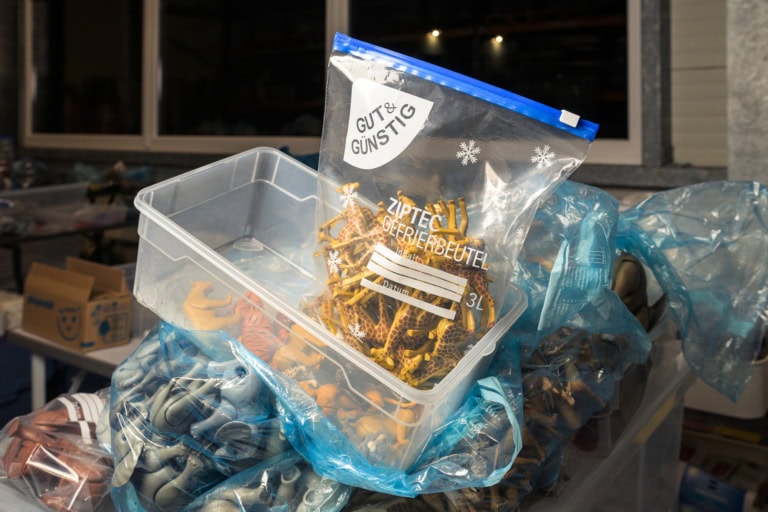
Bagged up in plastic, the Playmobil zoo waits for its next exhibition. Even of the rarer animals, Schaffer can draw on a sizeable ‘population’ to build his dreamscapes.
At the end of the tour of the warehouse, Schaffer rolls up the sleeves of his denim jacket, revealing the tattoo on his right forearm: ‘Life is a circus’. A nod to ‘Zirkus Oliver’ – and, for the Playmobil diorama artist and collector, a motto for life. As a child, the circus was a fantasy world he could escape into, the diorama artist says. That’s more difficult these days, but the saying still shapes him: ‘It reminds me always to stay a bit of a child and to be open to new things in life.’
Schaffer wants to keep a lightness of touch in his life, take things as they come and see what happens. The same goes for his career. He doesn’t approach museums himself but waits to see who is interested and gets in touch. One goal is to take his exhibitions further abroad. He could well imagine Singapore, New York or Sydney. ‘I’m not one for ten-year plans – we’ll just see what happens,’ says Schaffer, and goes back to tidying and sorting his collection.