Gathering, not hunting: a new story of humankind
What if humanity began not with the spear but with the bag? Ursula K. Le Guin turns history on its head and makes the bag a symbol of what it means to be human.
By Antonia Bretschkow (text) and Simon Deppe (photos)


What if the story of humankind were the story of a bag? If we didn’t tell it through daggers, knives and swords, perhaps it wouldn’t be the story of the heroic hunter but of the woman who gathered. Perhaps it would be about curves instead of points – about containers whose purpose is to keep rather than to destroy.
In the beginning was the bag
At least, that is what the author Ursula K. Le Guin suggests in her essay ‘The Carrier Bag Theory of Fiction’. She draws on the feminist writer Elizabeth Fisher, who argues in her book ‘Woman’s Creation: Sexual Evolution and the Shaping of Society’ that one of the first human tools was the container. In the beginning was the bag. People created artificial spaces that could be filled: baskets, nets, slings. They made it possible to carry more than would fit in two hands – everything people lived on in Palaeolithic, Neolithic and prehistoric times: seeds, roots, sprouts, shoots, leaves, nuts. So why is the story we tell about our history so pointed and brutal? Why isn’t it round?
So why is the story we tell about our history so pointed and brutal? Why isn’t it round?
At school we cram dates and facts about war and violence. Absolutism, the French Revolution, the First World War, the Second World War, the Holocaust, the building of the Berlin Wall, the Cold War, the Vietnam War, 9/11. Not that these things don’t matter – and it would certainly do us good to stop turning a blind eye to the colonial era, too. But is that really all? My history teacher could easily have told us something about how children were brought up in the Middle Ages, about what music people liked, about their fears and worries, about what they ate. I’m sure I’d have paid more attention in class.
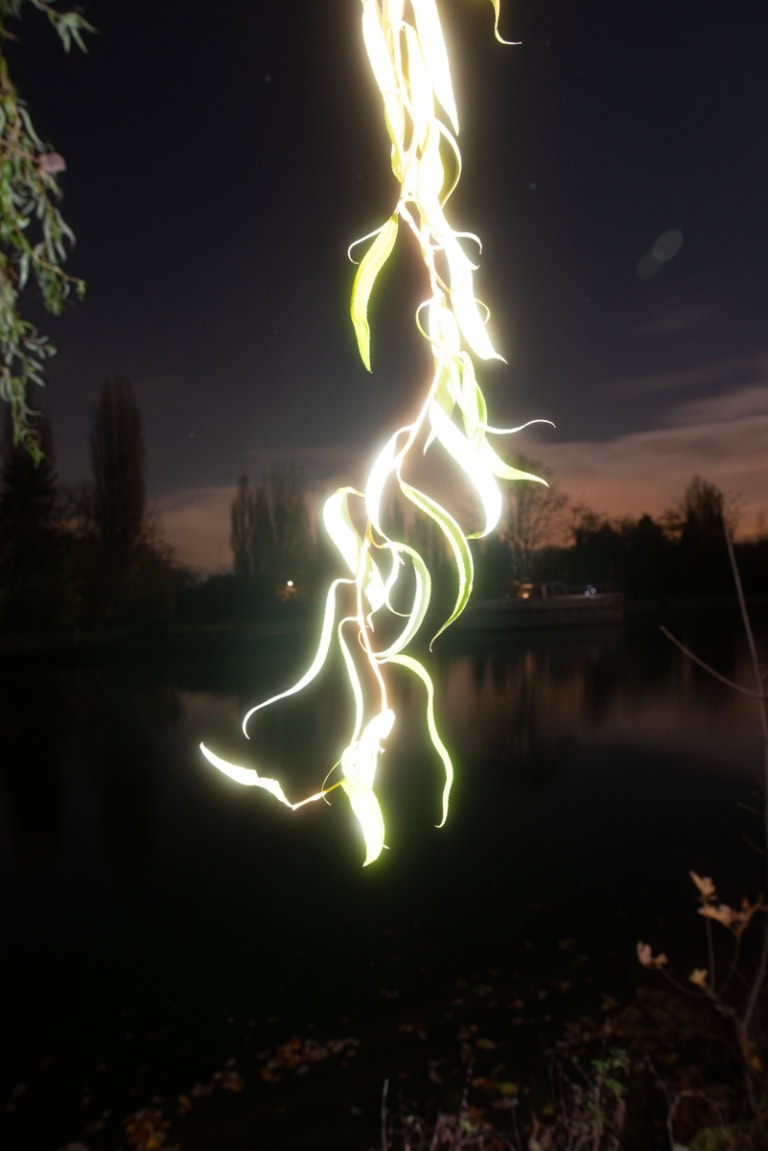
The first human tool was not the knife but the container.

People gathered plants in baskets, nets and slings to feed themselves.
About the photographs in this piece
Simon Deppe describes his work on the project ‘Carrier Bag’, which draws on Ursula K. Le Guin’s essay ‘The Carrier Bag Theory of Fiction’, like this: ‘As a photographer, I can choose which practice to follow: hunting or gathering. With that idea in my luggage, I spend night after night fighting my way through the undergrowth of the woods around Hannover. I bring light to places where there is normally none. The light is the tool: the carrier bag that gathers things that carry meaning. It is a photographic experience and, at the same time, a fundamentally human one: gathering, taking possession, telling stories.
Over three weeks, I get closer to the idea of the carrier bag. There’s something satisfying about the constant search for the next object. I come face to face with the practice that tells us where we come from. And I learn something about the urge to collect and sort. Night after night, my carrier bag fills up as if by itself. At some point I spread all the photos out in front of me, sort them, let them talk to each other and ask myself: is this series more than a collection of overexposed plants?’
Of sabre-toothed tigers, mammoths and oats
Attack and defence are also what my doctors like to talk about whenever they advise me, yet again, to reduce my stress. Out come the wild animals and sharp teeth: if you never get any rest in everyday life, your body is in a permanent state of alarm. That used to help humans when they had to flee from a sabre-toothed tiger – but being in flight mode all the time is, unfortunately, not healthy. Fair enough. But seriously, the sabre-toothed tiger? If Ursula K. Le Guin is to be believed, humans and sabre-toothed tigers didn’t actually run into each other all that often. After all, people lived mainly on plants. They rarely went hunting, and when they did, it was more for the adventure.
Perhaps we’ve all watched too much Ice Age – otherwise why do we still tell stories about sabre-toothed tigers and mammoths? Ursula K. Le Guin has an answer: a day spent gathering simply doesn’t make a gripping tale. Prising one wild-oat seed from its husk, then another, and another, and another; scratching your gnat bites; laughing at a joke from Ool; wandering down to the creek for a drink and watching the newts for a while; then finding a new patch of oats… Yawn.
It is hard to tell a really gripping tale of how I wrested a wild-oat seed from its husk, and then another, and then another
 Ursula K. Le Guin
Of course it’s more gripping when Ool tells of his daring fight with the mammoth – how he drove his spear deep into its huge flank, was almost gored by a tusk and rolled in the animal’s blood before finally killing it. After all, ‘The Old Man and the Sea’, a classic of literature, only works as a story because Hemingway sends his hero into battle with a giant fish. Who would sit through a hundred pages about an average fisherman’s daily routine?
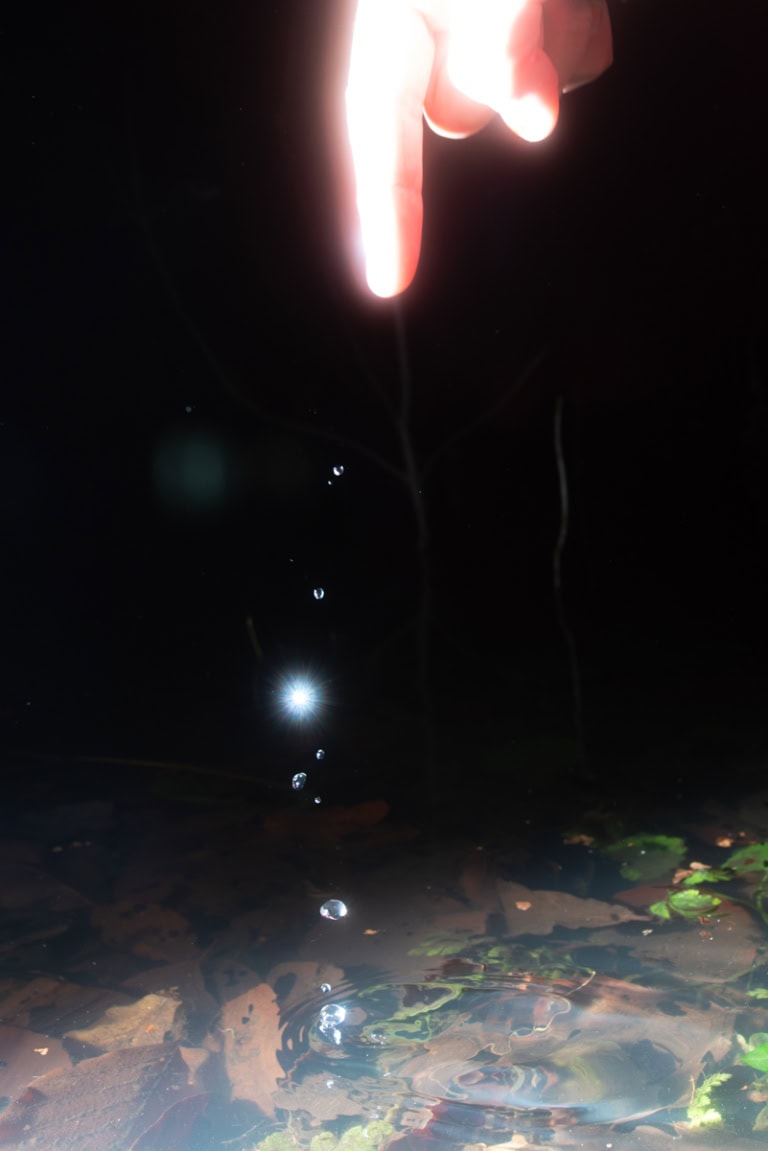
It’s easier to tell stories about hunting than about gathering.

But what would a story of humankind look like if it were round rather than pointed?
The Carrier Bag Theory of Fiction
Even so, Ursula K. Le Guin, who died in 2018, was a champion of ‘the carrier bag theory of fiction’ – a cyclical, rounded kind of narrative that doesn’t put conflict at its centre. In her work, much of it science fiction, she deliberately tried to free herself from the male hero’s journey as a narrative technique – and it was only by doing so that she discovered her own humanity.
If becoming human means making a weapon to kill with, she writes in her essay, then she was either a thoroughly defective human being or not human at all. So she went looking for proof of her humanity – and discovered the round: if it is a human thing to put something useful into a bag, a basket or a curl of bark, then she is human after all.
So she went looking for proof of her humanity – and discovered the round.
If it is gathering that makes women – and ultimately people of every gender – human, why not tell stories about it? The bag points to a different kind of life, one that needn’t resemble the heroic hunter’s journey but may follow the cyclical process of the gatherer: she picks things up, carries them and keeps them.
‘The Carrier Bag Theory of Fiction’ is more than the outline of a new literary genre. Ursula K. Le Guin’s essay is a plea for writing, thinking and acting beyond utopias of growth and progress. It sketches a creative life without the urge to dominate anything or anyone.

‘The Carrier Bag Theory of Fiction’ by Ursula K. Le Guin is a feminist blueprint for a creative life without domination.