The image of women – who actually decides? An interview with photographer and author Franziska Gilli about being a woman in Italy.
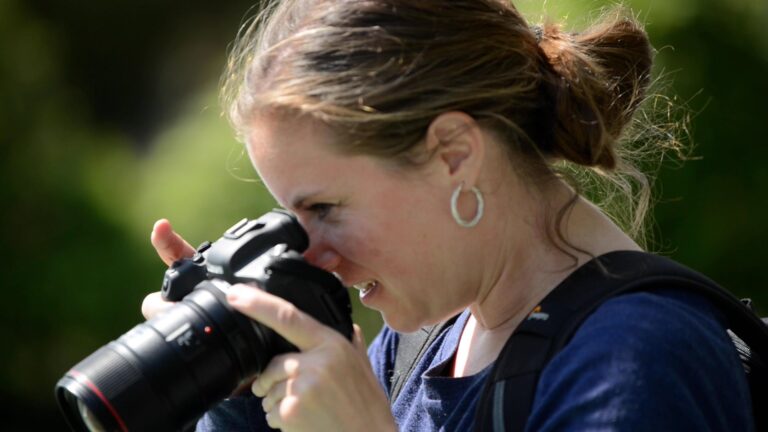
 Photo: Daniel Pilar
Franziska Gilli was born in Bolzano, Italy, in 1987. She completed her bachelor’s degree in Visual Journalism and Documentary Photography at Hochschule Hannover, writing her final project on the image of women in Italian entertainment TV. In 2021, together with Barbara Bachmann, she published the book ‘Hure oder Heilige – Frau sein in Italien’ (Whore or saint – being a woman in Italy). For it, the two travelled through Italy for several years, conducting interviews and portraying women and men. In seven chapters, the book shows how strongly the image of women in Italy is still shaped by the Church, the media and stereotypes.
The two stereotypes of the ‘whore’ and the ‘saint’ are nothing new; women’s rights activists have been denouncing them for a long time. As a woman*, you can end up in one of them very quickly.
 Franziska Gilli
Your book ‘Hure oder Heilige’ (Whore or Saint) is pretty provocative. Can you tell me more about how it came about? How did the book start, and why that title?
I was doing research for my bachelor’s thesis, which later also found its way into the book. Shortly before, Barbara Bachmann had written a story about Tiziana Cantone, a woman from Naples who took her own life after private sex videos of her were put online without her consent. During her research, Barbara noticed that the comments under the articles were often only about Tiziana Cantone being a ‘whore’ who ‘had only herself to blame’. Nobody talked about the man having done something wrong.
Around that time we met for a coffee and realised that this was really just the tip of the iceberg and that there was much more to tell. So we decided to make a book. The two stereotypes of the ‘whore’ and the ‘saint’ are nothing new; women’s rights activists have been denouncing them for a long time. At first, ‘Whore or Saint’ was just our working title. They are simply the two boxes you get put into – either both at once, or one or the other. As a woman*, you can end up in one of them very quickly.
Your book is divided into seven chapters, modelled on the seven deadly sins and their antitheses. How did that come about?
The terms continue the Catholic dichotomy of the title and served as a source of inspiration while we were working. There is so much to report, and of course a book gives you more space than a newspaper article or a magazine piece – but we still had to limit ourselves.
The book’s subtitle is ‘Frau sein in Italien’ (Being a woman in Italy). What does it mean to you?
It was extremely important to us. We didn’t want to put women* into boxes and reproduce clichés; we wanted to show what effects these boxes, these stereotypes, have on women* and their lives.
The book was made over several years, and you visited a great many women* for it. How did you find your protagonists?
In many different ways. We wanted to show as diverse a picture as possible. We found some women* through targeted research, others through chance encounters or acquaintances. We wanted to show what keeps the stereotypes alive – for example the image of women on television, or the views on child-rearing held by nuns who run their own nurseries and schools. At the heart of the book, in the middle section, we portrayed twelve different women who are not extremes but, so to speak, the ‘real’ women*. We visited women* aged 18 to 99, from people who cannot read or write to university lecturers, women* who were born female and women* who define themselves as such, from Sicily as well as from Piedmont. These women* describe their everyday lives in first-person accounts, and suddenly you understand why the other chapters matter so much and how everything is connected.
For you, the book began with your bachelor’s thesis and the image of women in Italian light-entertainment television. To picture it better: can you compare it with German TV and shows like ‘Germany’s Next Topmodel’?
No, I’d say there are still big differences. Of course, here in Germany things are still far from equal, too, but at least there are alternatives. We also have channels like RTL and programmes like GNTM, which are similar and just as misogynistic. But unlike Italy, Germany has alternatives in channels such as ZDF, ARD, Arte and 3sat. That also has to do with Silvio Berlusconi. Even before he became prime minister, he bought up almost all of the private television channels, and later he was also able to call the shots at state television. Since then, the two have become very similar.
I grew up without a television. I knew that the veline* – the TV showgirls – existed, but I wasn’t clear about what exactly happens on television. Many Italian households have four or more TV sets, and they are often on all day. The image of women on television is a very specific Italian story; the closest comparison is perhaps with the USA or Brazil.
*Veline is the general term for female figures on television who have no substantial role in the content.
Your book also deals with the veline, those particular TV showgirls. I especially remember Francesca Fiaschen, a contestant in the Miss Italia pageant. She features heavily in the very first chapter, and you visited her several times. Did you notice among your protagonists and in your research that the television image of the ‘perfect women’ has left its mark on women*?
Role models usually leave their mark. At the Miss Italia casting, many young women told me that becoming a velina had been their childhood dream. So it isn’t a career wish that develops in adulthood. When I first visited Francesca, she was eating just 80 grams of rice a day and drinking ten espressos. Eating disorders can be triggered by many things, such as family background or other psychological factors. As a child, Francesca watched television for five hours a day without supervision, and when I met her she was trying to get a first foot in the door of the TV show business through Miss Italia.
Can you give me an example of how women* appear on television?
On the news show ‘Striscia la Notizia’, the two veline perform a short opening dance and then sit cross-legged on the desk next to the mostly male presenters, clapping and smiling. They are not allowed to speak, not even when they are addressed.
You also devoted a chapter to advertising. Why was that so important to you?
We wanted to bring in a historical dimension. For that, we collected print adverts from the past 100 years that play on the cliché of women’s love – love for their children, their partner, themselves. The most frequently used cliché is probably that of the mother who closely resembles a Madonna.
Reflection is a very important issue: checking your privileges, questioning things. How did you deal with the ‘male gaze’ in the book – that is, the internalised cis-male view of the world? Especially with this subject, as you said yourself, it is very important not to reproduce things further but to break with stereotypes.
At first I tried to follow my own gaze. And when you engage with this subject so intensely, you automatically question that gaze all the time. For me, or rather for us, it was very important for the book to achieve a change of perspective and to be as non-judgemental as possible.
Does it sometimes happen in your photographic work that you realise you are reproducing stereotypes?
Of course, again and again. It’s good, naturally, if I notice it while I’m photographing and can change something straight away. But sometimes you only notice when it’s already too late. That doesn’t only happen in photography; it applies to every area of life. We all grew up and were conditioned in a patriarchal society. It is a constant process before you can change your habits of seeing, speaking, thinking and so on.
You are a self-employed photographer and make your living from it. Do you feel that something is changing in photography – that picture desks, for example, are giving more women* a platform?
Something has definitely happened in recent years. I notice that picture desks are deliberately commissioning more women*. But it’s still happening too little and very slowly. We also have to wait and see whether they commission more women* because they have to or because they want to. That will only become clear in the long run. At the moment it’s still like the quota for women: definitely not an ideal tactic, but temporarily necessary to break up old habits – in the hope that at some point it will work by itself and the quota will no longer be needed.
You are currently also a member of the Hannover group of the Female Photoclub. Can you briefly explain what the Female Photoclub is and who it is for?
The Female Photoclub is an association active throughout Germany that campaigns for the visibility of women* and diverse perspectives in the photography industry. It is about working with each other, not against each other. The association not only wants to connect women* photographers but also to draw attention to important issues such as their lack of representation. The Female Photoclub is open to anyone who, regardless of biological sex, skin colour, sexual orientation, origin, status, disability or religion, defines themselves as female, inter*, non-binary, trans* or agender and works professionally in commercial photography.
What is special about the Female Photoclub?
We are a non-profit association, not a company. True to the motto ‘We rise by liking others’, one of the things we want is not to see each other as competitors, as women* have always been taught to do. We share information on every aspect of our profession and support each other in our careers. The ‘Fotografin finden’ (Find a photographer) tool on our website is particularly helpful. It makes it very easy to find a woman photographer for a particular genre or in a particular area anywhere in Germany. Picture desks already like to use it.
In your daily work as a photographer, are you confronted with prejudice or stereotypes?
Sometimes I have the impression that I get certain commissions because I’m a woman. But far more often I notice while I’m photographing that I’m taken less seriously. When I assist male colleagues, I see that clients often treat them quite differently.
Does it ever work to your advantage, and can you make use of that?
Sometimes I have the impression that I get certain commissions because I’m a woman. But far more often I notice while I’m photographing that I’m taken less seriously. When I assist male colleagues, I see that clients often treat them quite differently.
In your view, what else would need to happen for women* and diverse perspectives to become more visible?
Networking well among ourselves is only a start. We share and like each other’s work a lot on social media. Men could join in to speed up the process. It’s still quite rare for men to share their women* colleagues’ work on social media and say: ‘Look at the great work my colleague has done.’ Clients can become more aware of why they commission more men and deliberately look for more female and more diverse perspectives. At the same time, we women* have to learn to put ourselves forward more, to trust ourselves more, to overcome learned insecurities and to build self-confidence – and also to push our own ideas more and carry out less of what others come up with. Especially after graduating, it’s essential to build a network straight away, one you can draw support from again and again and give back to.
Do you have any tips or tricks you can pass on?
Network, stick together, back each other up. Besides the Female Photoclub, there are many other institutions in the industry. When your studies are over, keep spending part of your income on workshops, further training or coaching.