The patriarchal obsession with virginity
Older men’s fascination with teenage girls runs deep in our culture. The Wecker case recently brought it back into the headlines. Films, music and the internet fuel hypersexualisation – with far-reaching consequences. By Elena Jaekel

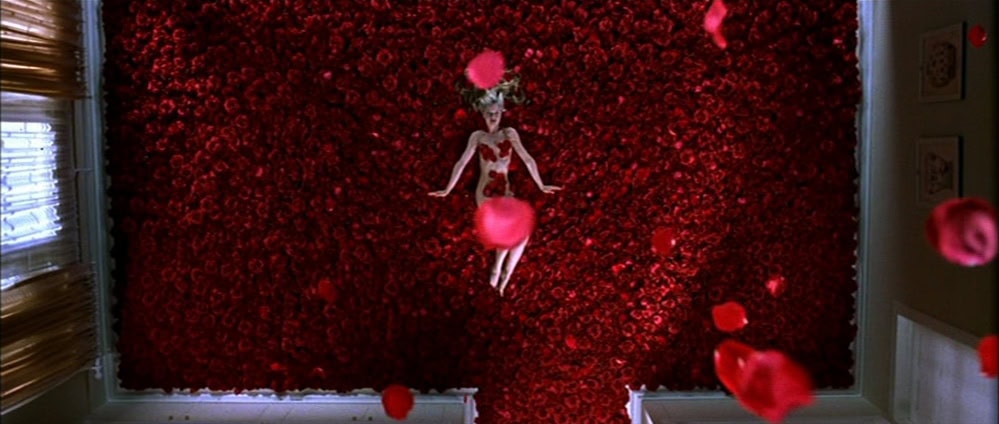
He wants sex with her. Lester knows it the moment he first sees Angela, his daughter’s friend, dancing at a high school game. The 42-year-old American suburban father in the throes of a midlife crisis, played by Kevin Spacey, begins to fantasise about Angela, played by Mena Suvari. In his mind’s eye, she stretches her naked body languidly in a heap of rose petals, covered only by a few scattered petals – just for him.
Angela brings Lester back to life: he gets into shape and starts asserting himself at work and in his marriage – because, as he sees it, his wife has been robbing him of his masculinity for far too long. But Lester’s fantasies are not about Angela herself, about her as a person, let alone her character. They are solely about Angela’s body. The body of a teenage girl.
Men’s fantasies about young teenage girls are not confined to the fiction of ‘American Beauty’.
From Konstantin Wecker to the dark corners of the internet
Late last November, the singer-songwriter Konstantin Wecker made headlines in exactly this way, having had an intimate relationship with a minor. He was 63, she was 15 – and yet he insisted that the relationship had been consensual and between equals. She had wanted it too, after all. Not unusual. Hardly surprising.
But where does these men’s craving for young bodies come from? Go looking for answers and the dark corners of the internet open up. A Google search turns up no sociological analyses unpicking the issue. Instead, it produces porn sites with titles so violent that I don’t want to reproduce them here. Words such as ‘submissive’, ‘young girls’ and ‘use’ come up, ‘inferior’, ‘very small’ and ‘slut’. When teenagers appear in pornographic material, it is clearly sexual exploitation – the rape of minors on camera. Accessible to anyone who looks for it.
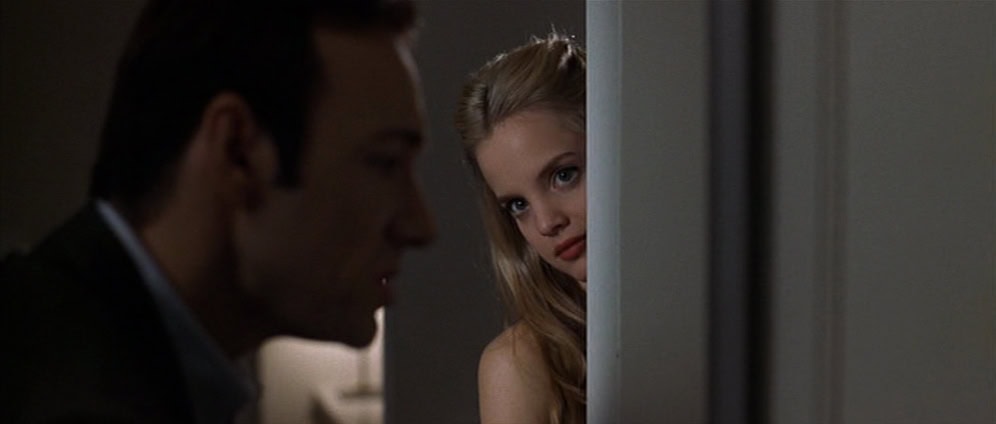 Screenshot: American Beauty
Popular categories: ‘Teen’, ‘Youth’ and ‘Schoolgirl’
Human trafficking is huge business not only in the red-light world but also in the multibillion-dollar porn industry. Women, girls and others are pressured into making these films and then blackmailed with the footage. Michael Pratt, who ran the platform GirlsDoPorn, and his employees lured countless women into making porn through misleading adverts, concealing from them that the videos would be published on the major platforms. He was looking for ‘young, pretty women who look like high-school girls’, according to Rolling Stone. Those who tried to fight back were threatened and silenced.
The market supplies what demand requires. According to a data analysis from 2015, ‘Teen’ was the most searched-for porn category among male users. It has since been overtaken by the category ‘MILF/Mature’. But ‘Teen’, ‘Youth’ and ‘Schoolgirl’ are still among the most popular search terms. And the question remains: where does this hypersexualisation of teenage girls actually come from?
Hypersexualisation starts in childhood
You may get a little closer to an answer by typing the words ‘boy’ and ‘girl’ into Google Images. Type in ‘boy’, and you get portraits of tousle-haired boys grinning cheekily into the camera, gaps in their teeth. One is shouting, another is delighted with the huge ball tucked under his arm. Kids, in other words.
Type in ‘girl’, and your jaw drops. Young girls pose in underwear and bikinis in full-length photos, hands on hips. One girl has been photographed from behind on a swing, in a backless swimsuit. Back arched, bottom on display. The child is probably no older than five or six. Another poses on a rock in a skirt so short it barely covers her bottom. She is wearing white fishnet tights. The picture is titled ‘pretty little girl’ – echoing the porn search terms ‘very small’ and ‘young girls’.
So in Western countries, the hypersexualisation of girls begins while they are still in their infancy. Even today’s prevailing ideal of beauty – shaved legs and smooth skin – is one that resembles young girls. Growing up with such images, and being exposed to them every day in advertising and the media, leaves its mark. We act on them, we live by them, without questioning them. Subconsciously. The idea that girls should look pretty and that their appearance is what counts most becomes our reality early on.
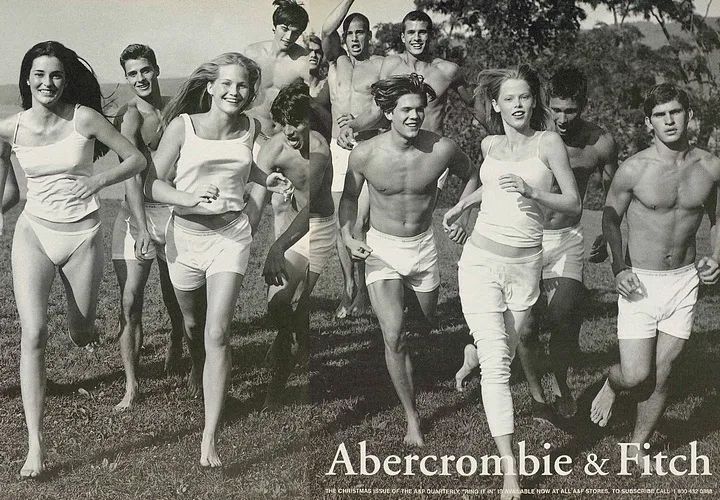
Abercrombie & Fitch advertised, especially in the 2000s, with extremely thin, white and very young people, and came in for growing criticism as a result – including in the Netflix documentary ‘White Hot: The Rise & Fall of Abercrombie & Fitch’.
Women as objects
One is not born a woman, Simone de Beauvoir once wrote, ‘but becomes one’. Socialisation inevitably begins at birth, through family and immediate surroundings. After all, we need categories and codes to find our way through the chaos of our world and to place people.
Without realising it, we are pressed by our environment into particular moulds, in which we are assigned the attributes that stand for femininity and masculinity in our society. Passive equals woman, active equals man. In fairy tales, after all, it is not usually the heroic princess who rescues the prince. She is left to her fate, powerless to act. ‘Submissive’, ‘inferior’.
If we don’t fit these categories, we are often punished socially. A woman who is too loud is seen as rude or even disruptive. A man who is too vulnerable is seen as weak and emotional. Even back in the playground, ‘You girl!’ was used as an insult. We devalue femininity. ‘Slut’.
In the music industry, women’s bodies are a conventionally attractive and easily consumable resource
 Sonja Eismann
Films or music – pop culture also socialises us in particular directions. All our lives, we watch films that are mostly written and shot from the perspective of a white, heterosexual man. We internalise the male perspective and certain patterns of behaviour. Laura Mulvey once called this the ‘male gaze’. He, the man, is the subject, the one who acts.
Women, by contrast, are mostly portrayed and viewed as objects. Parts of their bodies are shown in tightly cut sequences or in a camera pan from foot to head. How they feel or what they think is irrelevant. In ‘American Beauty’, too, events are seen through Lester’s eyes. He is the subject. Angela, on the other hand, is merely an instrument of his fantasy, his lust. She is interchangeable, nothing but a projection screen for his desires. The object of his desire. ‘Use’.
Candy Girls
In the music industry, too, women are available as a ‘conventionally attractive and easily consumable resource’, writes Sonja Eismann in her book Candy Girls. A resource, she goes on, on which ‘the male gaze that everyone has culturally learned feasts’. And the girls and women need to be as young as possible. Britney Spears was just 16 when she danced as a provocative, seductive schoolgirl in her music video for ‘…Baby One More Time’ – a song whose line ‘Hit me baby one more time’ can be read as a call to violence.
Men, Eismann continues, are older, and therefore wise and powerful. ‘They therefore have the right to take possession of the powerless bodily existences of women and young girls, who are regarded as stupid and naive, for their own advantage, whether sexual or financial, and ultimately to destroy them.’
 Photo: Juliette Moarbes; Hebbel am Ufer
Britney Spears’ 1998 teen-pop hit led straight into the 2000s, when advertising by brands such as Hollister, Abercrombie & Fitch and Victoria’s Secret did much to shape our visual habits and ideals of beauty.
 Photo: Wikipedia
The cover of the North American edition of the album ‘…Baby One More Time’
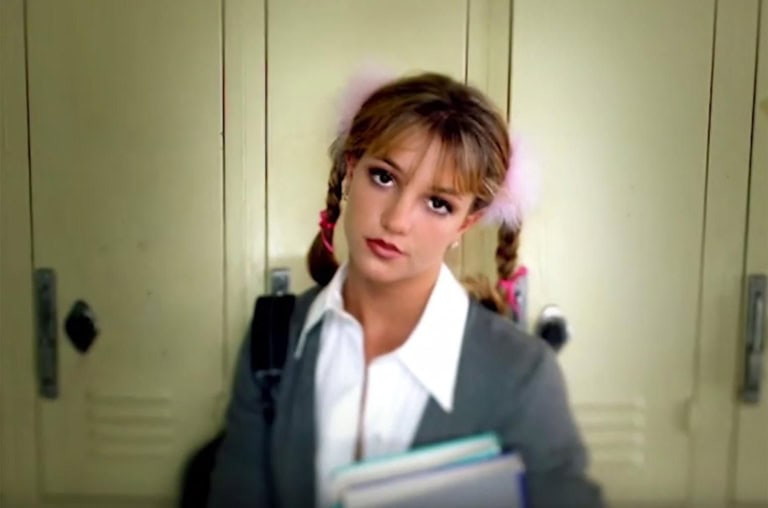 Photo: YouTube
Britney Spears dressed as a schoolgirl in the music video for ‘…Baby One More Time’
The fetishisation of virginity
Angela, too, behaves the way she has been socialised to. She flirts with Lester because, in our society, his desire gives her value. Shortly before the end of the film they kiss, Lester tears open her top, and the camera films the actress, 19 at the time, from above as she lies on her back. Exposed. The male gaze is the camera. Like a predator. This moment, this scene alone, feels like rape. Only when Angela admits that she is a virgin does Lester let her go.
And there we have it: the patriarchal obsession with virginity. Because suddenly Lester realises how young she is. Seriously – only now? So if she hadn’t been a virgin, the teenager wouldn’t have deserved protection? The fetishisation of virginity, of purity and innocence, goes hand in hand with power and control over female bodies. With, as Eismann puts it, ‘fantasies of taking possession, of the violent opening of the female body through phallic piercing’.
At the same time, the film feeds the notion that a man must follow his urges, while the woman – the girl – is credited with a power of seduction she does not really have. In the end, he leaves the field as a hero who resisted the seductive virgin. And she is, and remains, a child. The film was a hit at the time. Articles about it did not say a single word about the age difference. That is how normal the dehumanisation of young girls is in our society.
This article was first published in the weekly newspaper ‘der Freitag’.
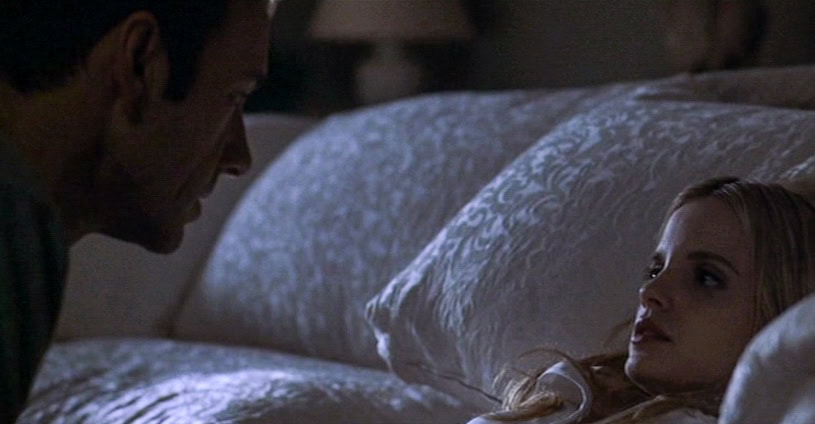 Screenshot: American Beauty