Thin on top
TikTok routines, rosemary oil, transplants: the market for hair-loss treatments is booming. Hair may be just hair in the end – but it’s never quite that simple. By Noah Hermann (text and photos)


Hair loss often comes with shame or insecurity, and many men find it hard to talk about. For some, it is a visible sign of ageing – which is exactly what makes it such a sensitive issue. Social media is increasingly full of content promising to slow it down.
In countless TikTok videos, content creators explain what the right ‘hair routine’ looks like if you want hair to grow back at the temples: a daily massage with a derma roller, rosemary oil dripped onto the bald patches in the evening, Alpecin in the shower. If that doesn’t work, there’s always minoxidil – a drug that can genuinely help, though not without side effects. And if even that fails? Then it’s off on a flight to Turkey: all-inclusive packages with return flights, a transfer in a smart car, a hair transplant and a starred hotel. It’s a booming market.

Around 80 per cent of all men experience hair loss at some point in their lives.
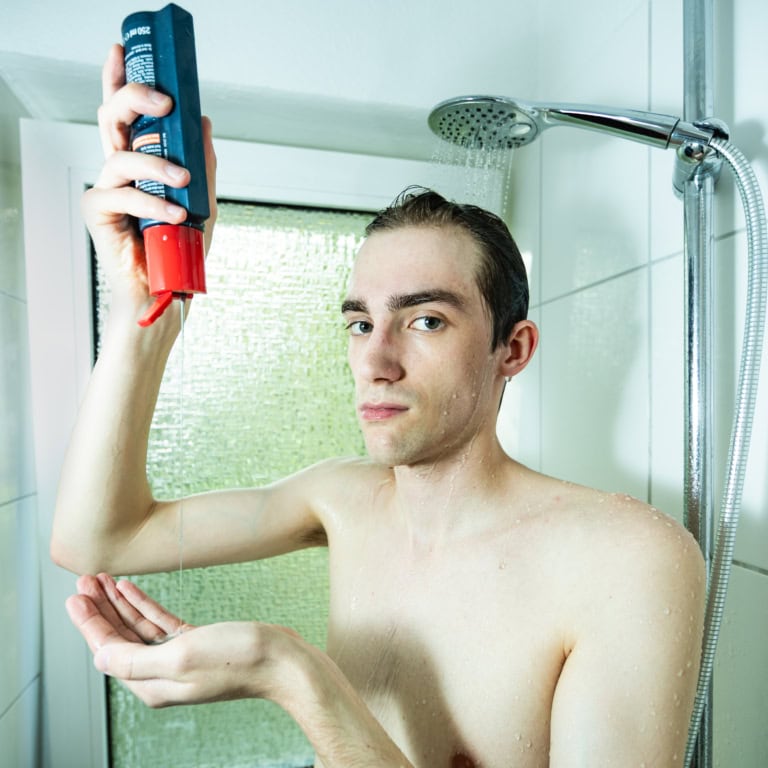
Self-portrait of the author with ‘caffeine shampoo’, which promises to strengthen the hair roots.

The ‘hairline’ is still easy to hide when you’re young. But the hairdryer tells you: something is shifting.
Hair loss can take a real psychological toll, particularly on younger men. In a study from 2005, more than 70 per cent of respondents said they saw their hair as an important part of their appearance. The survey covered 1,536 men aged 18 to 45 in five European countries: Germany, France, Italy, Spain and the United Kingdom. Almost 47 per cent said they were affected by hair loss; 62 per cent said it could damage their self-esteem. Nearly a quarter said hair loss had a negative effect on their social life, and a similar number described low moods linked to it. These are self-reports rather than standardised psychological measurements, but the picture is clear enough: just because hair loss has no direct health consequences doesn’t mean it leaves men untouched.
At the same time, many men meet the subject with humour and self-irony – perhaps as a defence mechanism, but perhaps also because it simply isn’t as dramatic as some people think. In the comments under an article in Die Zeit on ‘Die Kahlwerdung des Mannes’ (‘Man going bald’), one reader writes: ‘For about five years now, parts of my hair have been saying goodbye, and I couldn’t care less. I always knew that things like hair loss can come with getting older. And now it’s happening! So what? I can only advise everyone to accept the inevitable with dignity. It takes the pressure off enormously. When your hair’s gone, it’s gone – and if you don’t accept yourself with your little flaws, why should anyone else?’
Another reader writes: ‘I wear my bald head with confidence – the world can’t touch me. I just always feel sorry to see that not everyone can handle it that way.’ In the end, hair is just hair, even if it says a lot about how society deals with masculinity, about self-image and about ageing. Hair loss doesn’t have to be a drama. It can just as well be met with composure and a wink.
About the photographs in this piece
With ‘Thin on top’ I wanted to approach a subject that affects many men and weighs on them, yet is rarely talked about openly. So I asked myself whether the visual language I had in mind could do it justice. Is it acceptable to approach the subject with ‘humour’?
I wanted to make pictures that are absurd and funny at the same time – photos that say: ‘Yes, it is what it is, and that’s absolutely fine.’ So I staged scenes in which the missing hair takes on a new starring role: rubbing sun cream into a gleaming bald head in the sun, watering a head like a houseplant, or blow-drying, where an oversized forehead becomes the centre of attention. These situations are a deliberate mix of real moments and simple symbols. A little absurd, but never exaggerated to the point of making the men look foolish.
I’m convinced this approach does the subject good. The point is not to arouse pity or to encourage self-pity, but to show a more relaxed way of dealing with an inevitable process – one that sooner or later affects a great many men. Of course, not everyone will like this approach. But it may just as well help to break the taboo and to see self-irony as a ‘resource’.
Photographically, I deliberately opted for bright, friendly colours and harsh light. I wanted to create a ‘dramatic’ effect, then tip it into the absurd with wide-angle lenses – until it no longer looks serious. The pictures aren’t meant to be ‘thought-provoking’ in the classic sense; they should come across as tongue-in-cheek observations of everyday life. At the same time, it was important to me that the men look self-assured – not as ‘victims’ of their baldness, but as people who can laugh about it. My points of reference were the photographers Martin Parr and Nikita Teryoshin.
Above all, I didn’t want to make fun of the men in the pictures. So I talked to them beforehand: which images feel right? What would be uncomfortable? And why were they willing to be photographed for this project? I also included a self-portrait, to make sure the view comes from the inside rather than from the outside. After all, hair loss is a personal issue for me too.
Including the self-portrait was a key decision – but not an easy one. On the one hand, it meant showing openly that the subject gets to me. On the other, choosing to shoot it in the shower brought in other aspects, such as build or weight, which have nothing directly to do with hair loss but still preoccupy me and are visible in the picture. Seeing myself among the other pictures in the exhibition showed me what it feels like to be part of a project like this. It’s an experience I’ll carry with me into future work.