Mineral water marketing: how water turns into gold
With bold promises and designer bottles, companies turn a basic foodstuff into a luxury good. An investigation.
By Andreas Blauth (text and photo)


There is something about the romanticised idea of how mineral water gets into the bottle. You want to believe that, in harmony with nature, something pristine and pure is bottled with care, love and passion, one bottle at a time. You want to believe it, even though you know it is complete nonsense, of course. In an industrialised society that increasingly longs to regain a sense of the primordial and of harmony with nature, manufacturers and their marketing agencies have evidently pulled it off: they turn the idea of clear, cleansing, sacred, healing and primordial water, deeply rooted in our cultural history, into bizarre selling points.
More than ever, choosing the right bottled water is now a lifestyle decision too. Yet science has long confirmed that tap water in Germany is generally all you need for a healthy life – and, contrary to the claims of greenwashing advertising campaigns, it is many times more environmentally friendly than mineral water. Water, say the manufacturers, is not just water.
There is hard water, soft water, tap water, spring water, mountain water. And every brand seems to think it has to offer its own very special water that exists in only a few places in the world, is unique and is tailored to a very particular target group: there is water for athletes, water for men, ‘living water’ for people who believe in it, healing water, water that supposedly protects nature when we drink it, and of course sparkling water, Germany’s favourite. And because the water companies’ clever marketing quickly leaves consumers unable to see the wood for the trees, there are now water sommeliers who guide the rich and beautiful through the thicket of luxury water brands. An overview of the most bizarre ways of marketing water.
1. Pure ice-crystal water
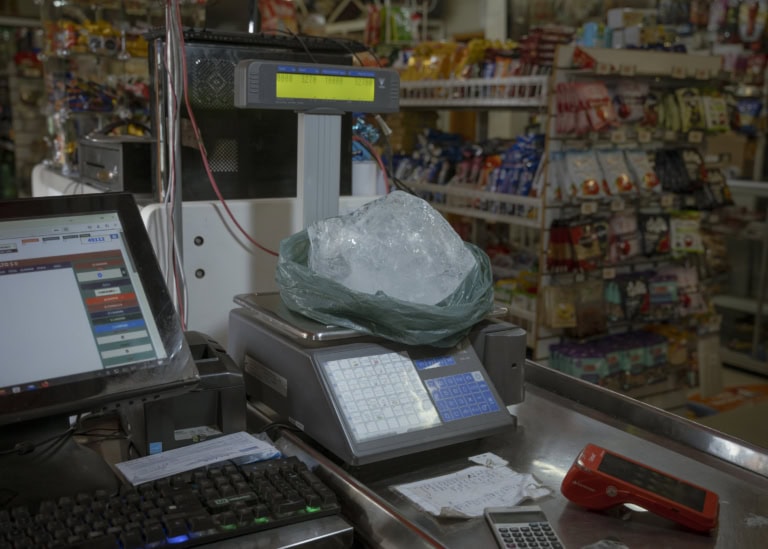
A popular selling point: melted ice-crystal water. The brand ‘10 Thousand BC’ markets its water as especially pure because it has supposedly ‘never touched the ground’. A bottle costs 20 euros. Even more expensive, at 65 euros per 0.75 litres, is ‘Svalbarði’. The water is taken from a Norwegian iceberg in the Kongsfjord near the North Pole. It is melted and supposedly bottled by hand.
2. The more expensive the bottle, the more precious the water
The brand ‘Filico Roi’ shows that water quality is above all a matter of packaging: a Japanese water advertised as particularly soft that supposedly flows through a granite mountain range. Only when you see the packaging does it become clear that consumers are paying the roughly 200 euros per litre not so much for the water itself as for the bottle, decorated with so-called Swarovski crystals and a golden crown.
3. Purifying and revitalising water
Manufacturers of water treatment devices claim that tap water, for example, loses its ‘vitality’ not only through pollutants but also through ‘subtle’ influences such as ‘electromagnetic’ interference. Producers of so-called ‘osmosis systems’, which cost up to 2,000 euros, use quality seals they have made up themselves to promise that they can clean such damaged water first physically and then on a ‘subtle’ level, and then ‘revitalise’ and ‘energise’ it again using, among other things, certain vortex techniques. There is no scientific proof that such devices work. According to the idea of so-called ‘hexagonal water’, water can store information which ordinary water supposedly loses. A vortex device, it is claimed, can put this right.
4. Light-infused water for spiritual free spirits
The brand ‘St. Leonhards’ is available in many organic shops and so is not in the extreme luxury segment, but at around 2 euros it targets the market for fairly well-off free spirits with a penchant for esotericism as ‘revitalised’ water. The Bavarian producer shows that all you really need to stand out is imaginative fairy tales and a few myths: its ‘moon water’ is said to be bottled only at full moon – on the premise that it then has particularly high ‘energy’. According to the producer, ‘bioenergetic frequency measurements of the full-moon bottling found 61 positive frequencies’ that ‘can support body, soul and spirit’. St. Leonhards also advertises other product lines with such barely legal promises of healing: the ‘Lichtquelle’ (source of light) promises, with all ‘7 frequencies of light’, to help you ‘preserve your inner light’ even in low moods. Another water, labelled ‘Ich bin die Quelle’ (I am the source), is supposed to let ‘sensitive’ people enter into ‘resonance’ with the water through ‘89 positive frequencies’.
5. Volvic’s water for men
The French water producer Volvic launched a particularly absurd advertising campaign: in 2007, during the Rugby World Cup, the company marketed a still water and a lemon-flavoured one under the product line ‘Quinze de Volvic’ as water just for men. What exactly is male about the water remains a mystery to this day. At any rate, no testosterone was found in it.
6. Water from the other side of the world
While most people in Germany drink water from springs in their own country and regional origin is the selling point, Fiji Water has managed to spread the story that it is worth shipping water from the Fiji Islands halfway round the globe to Europe and the USA. In doing so, the producer has brought luxury water into the mainstream. The water, which is particularly soft thanks to the silica it contains, can be seen in American TV series and films. On social media there is real hype around it. Water from the Fiji Islands has thus established itself as a lifestyle drink, as if it were a lemonade or a cocktail. After all, whatever the rich quench their thirst with, everyone else wants too. Fans of the water – among them many Hollywood stars – describe it as soft, pure and pristine. It is, they say, water that really does still come from the untouched ‘nature’ of the Fiji Islands, before being bottled just as naturally in small plastic bottles and sold for almost five euros a litre.