Expo observatory in Melle: the world’s largest amateur telescope
When estate agent Bernd Schröter set out to build the world’s largest amateur telescope, many people thought he was mad. But in time for Expo 2000, he really did open his observatory.
By Nele Cumart (text), Lucas Tuan-Anh Nguyen (photos)


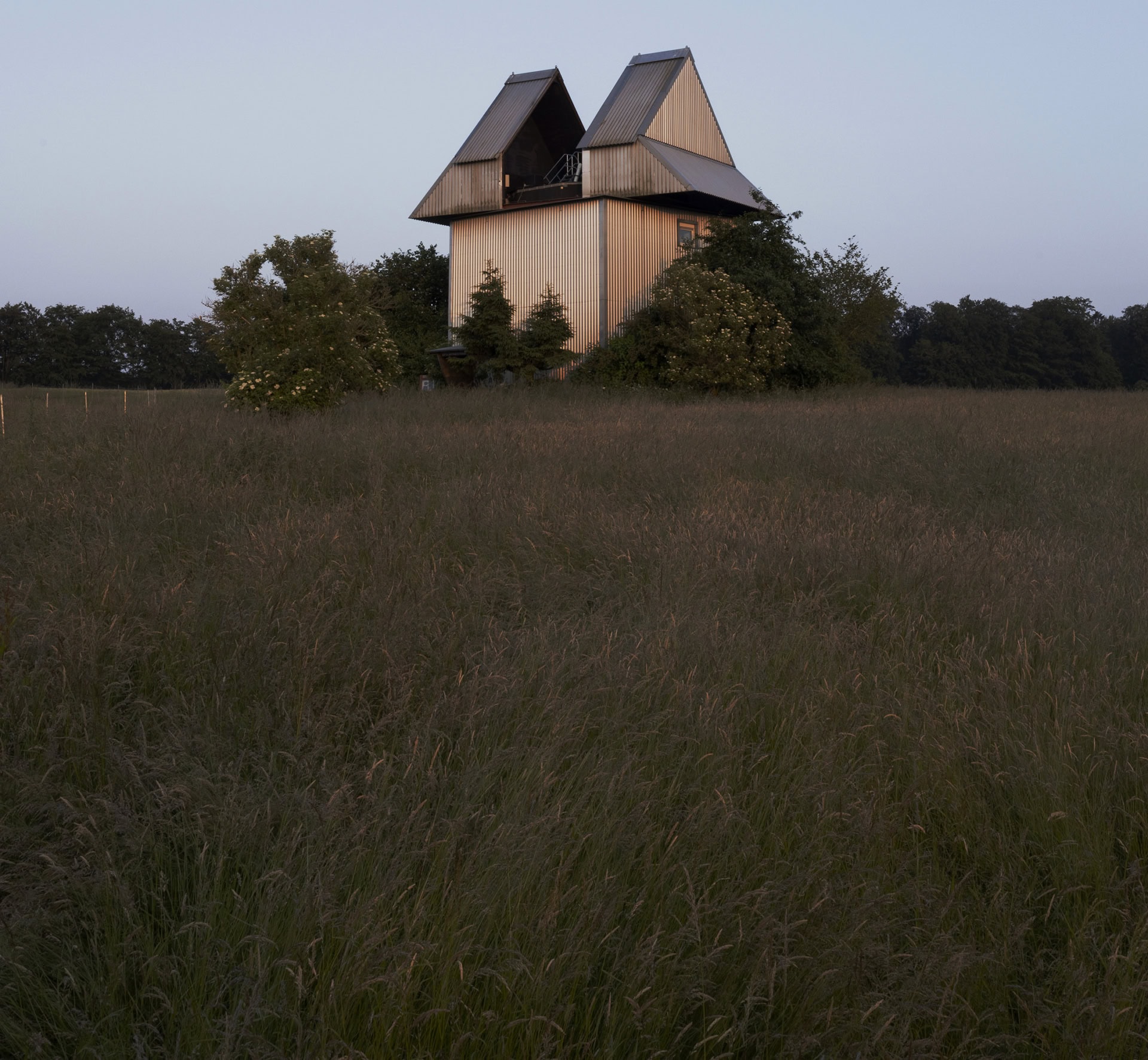
‘Welcome to my penthouse,’ says Bernd Schröter, opening the door of the almost windowless grey metal building with the oddly shaped roof – which looks so out of place among the fields on the edge of Melle, near Osnabrück. Inside it is cold and dark. Just a few old school chairs stand in rows, facing a white wall. Schröter doesn’t bother switching on the light but heads straight for a narrow staircase. ‘Other people have a yacht or a villa – I have my observatory,’ he says on the way up.
At the top, he stops in a round room with a high ceiling. It looks no more luxurious here than downstairs. In the middle of the room, a metal structure points towards the sky. ‘The world’s largest amateur telescope,’ Schröter explains proudly. It’s still so dark that only the metres-high shadow of the telescope can be made out. He doesn’t need light up here, he says – it only gets in the way of stargazing.
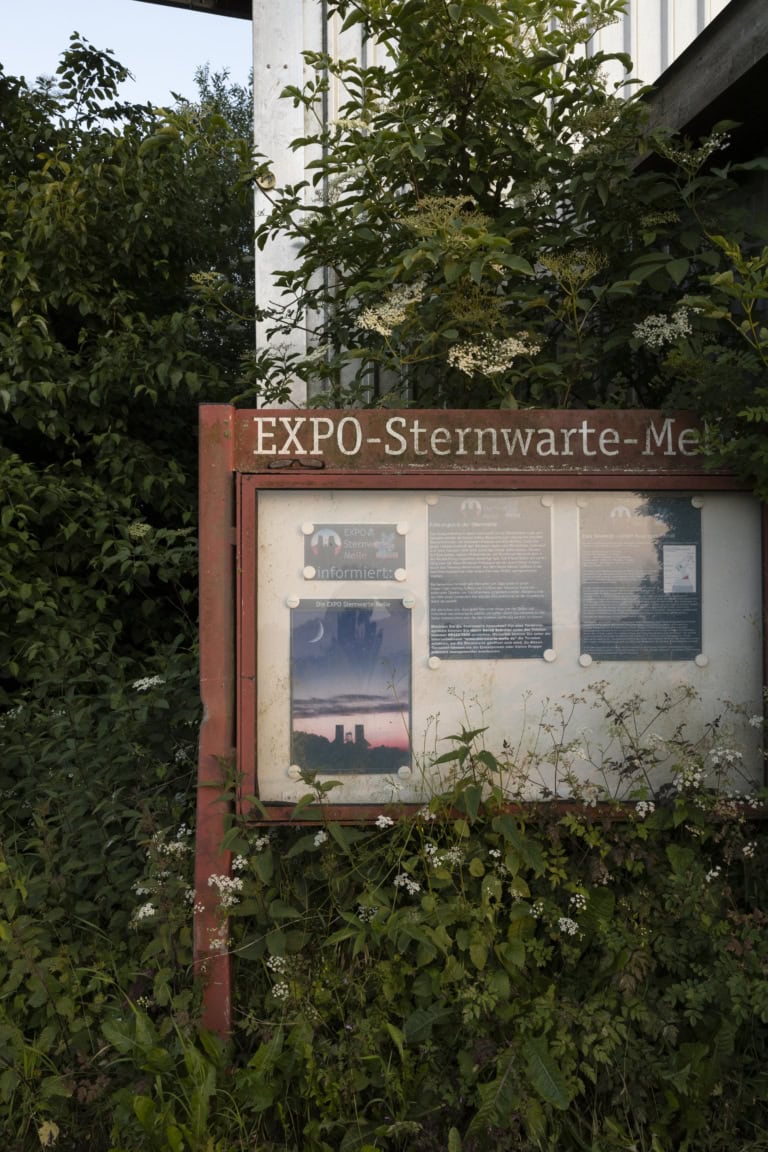 Melle, June 2023
The observatory’s entrance is still a reminder of the Expo 2000 world’s fair.
How is an observatory built?
He opens a control panel and presses a button. Slowly and with a creak, one half of the roof begins to separate from the other. The further the dome opens, the more the evening sun falls on the huge black metal telescope. ‘We can slide the two halves of the roof four metres apart to get an unobstructed view of the night sky,’ says Schröter. What’s more, the dome is mounted on a circular turntable. It can rotate through 360 degrees, allowing a view in every direction. For the unique rotating frame, he found a company that normally builds mixers for the chemical industry. The large mirror in the telescope came from Russia and was originally made for military use, Schröter says. Over five years, he gathered the individual pieces of the puzzle for his project.
 Melle, June 2023
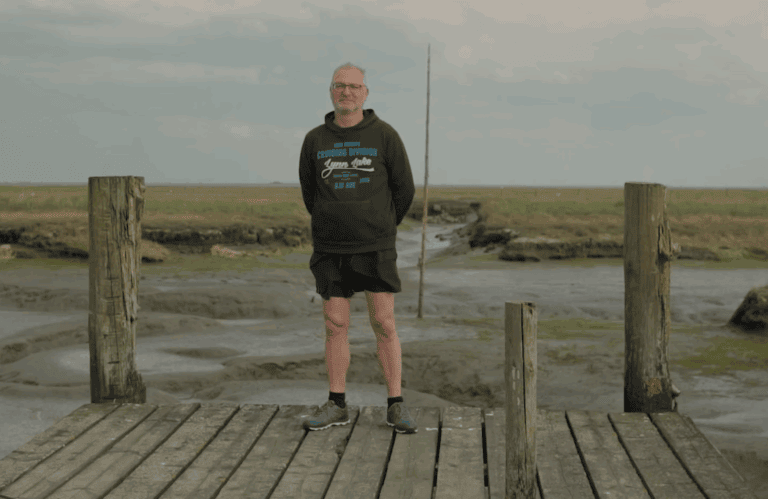
Bernd Schröter in front of his Newtonian telescope, which is especially popular among amateur astronomers worldwide.
‘All I did was find the right people to build the observatory and do a lot of motivating,’ recalls the now 64-year-old amateur stargazer. When he took his plans for a Newtonian amateur telescope with a 1.12-metre mirror and a focal length of 4.40 metres to astronomy clubs, people were astonished. ‘A mirror more than a metre across? Schröter’s lost his mind – nobody in the amateur scene has ever done that,’ he recalls the community’s reaction, laughing.
But Schröter saw his plan through. An estate agent by profession, he is well connected and persuasive. He travelled around Europe inspecting observatories to gather ideas for his own. In the end, the 2.5-tonne telescope was mounted on a massive concrete pillar before the metal building was completed around it.

The telescope frame in the observatory shows just how enormous Schröter’s telescope is.

The world’s largest amateur Newtonian telescope: every year, Schröter uses it to show the stars to large numbers of visitors.
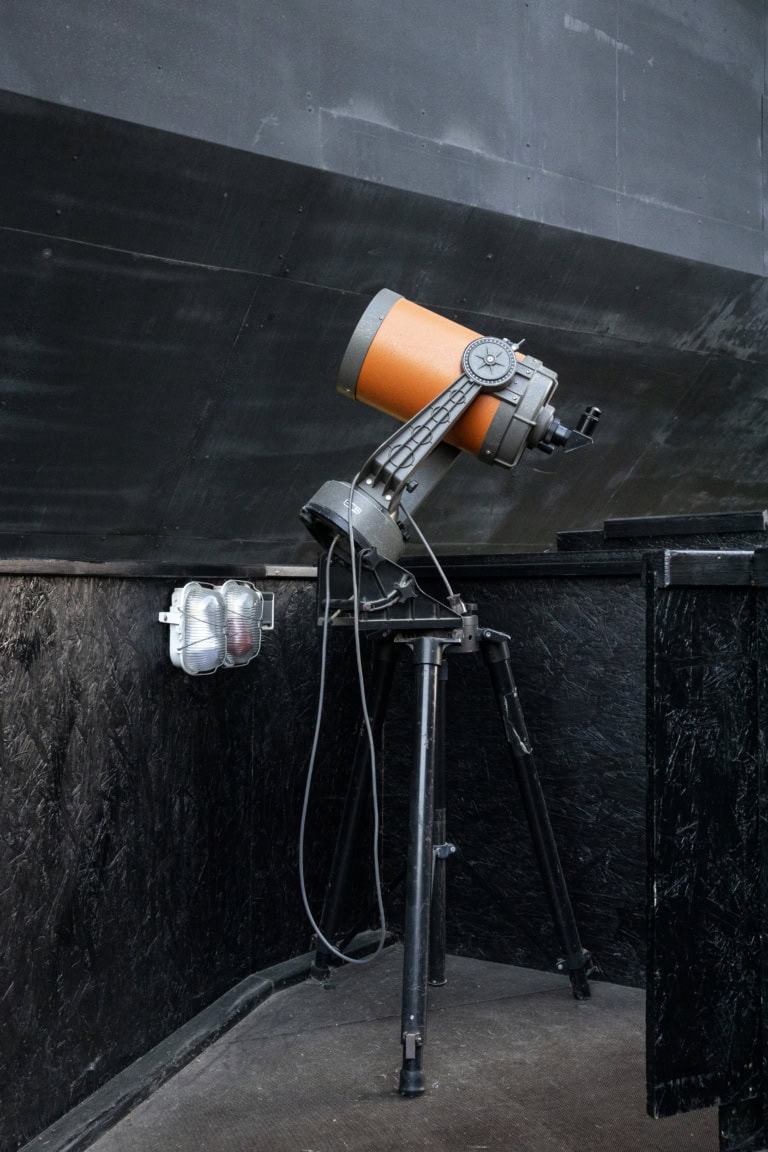
Smaller telescopes can also be found in the observatory. Each has its own special features.
How the Crown Prince of Nepal came to Melle
His efforts paid off handsomely: just in time for the Expo in June 2000, the observatory opened its doors for the first time to visitors from all over the world. Schröter’s highlight of the Expo period: an unannounced guest of honour. ‘One evening a limousine pulled up at the observatory. A chauffeur got out and accompanied a family to the entrance,’ says Schröter. Like every other family, they looked through the telescope with great interest and enthusiasm and were given a short tour. When asked, the father said the family came from Nepal. After several hours at the observatory, the guest gave the team a small silver dagger as a token of his gratitude. ‘We did think: this must be a very wealthy family,’ Schröter recalls. The next day, Schröter and his colleagues spotted the man again – this time on the news. They learned that Dipendra Bir Bikram Shah Dev, the Crown Prince of Nepal, had been standing in their observatory in Melle the evening before.
Who do the stars belong to?
But it isn’t only royalty who find their way to Melle: the observatory has also seen marriage proposals, children’s birthday parties and pensioners’ get-togethers. Schröter is happy to welcome every visitor. Only one thing annoys the retiree: a few years ago there was a real craze for naming and even buying stars. When people come to the observatory to see their supposed own stars, Schröter humours them. But his view on buying stars is clear: ‘It’s simply wrong. You can’t buy stars or give them away, because they don’t belong to anyone,’ he says.
Schröter likes looking through the telescope with young people best. After all, he discovered his own fascination with the stars as a child. He found his first telescope in a ‘Was ist was’ children’s book, which he bought with his pocket money at the age of six. Since then there’s been no stopping him: he has travelled to the US to stargaze, built his first observatory in Namibia in his early twenties and is already planning his next trip to the equator, to observe the night sky at a right angle from there.
He travels alone: his family want nothing to do with his hobby. ‘My wife waits at home when I go off stargazing, and my son isn’t particularly interested in the observatory either,’ he says. But that’s fine: at the observatory he has the support of five volunteer colleagues. For all six of them, it’s important to keep the observatory open to the public. Looking at the sky on your own is lovely, says Schröter, but sharing the experience with others is even better.
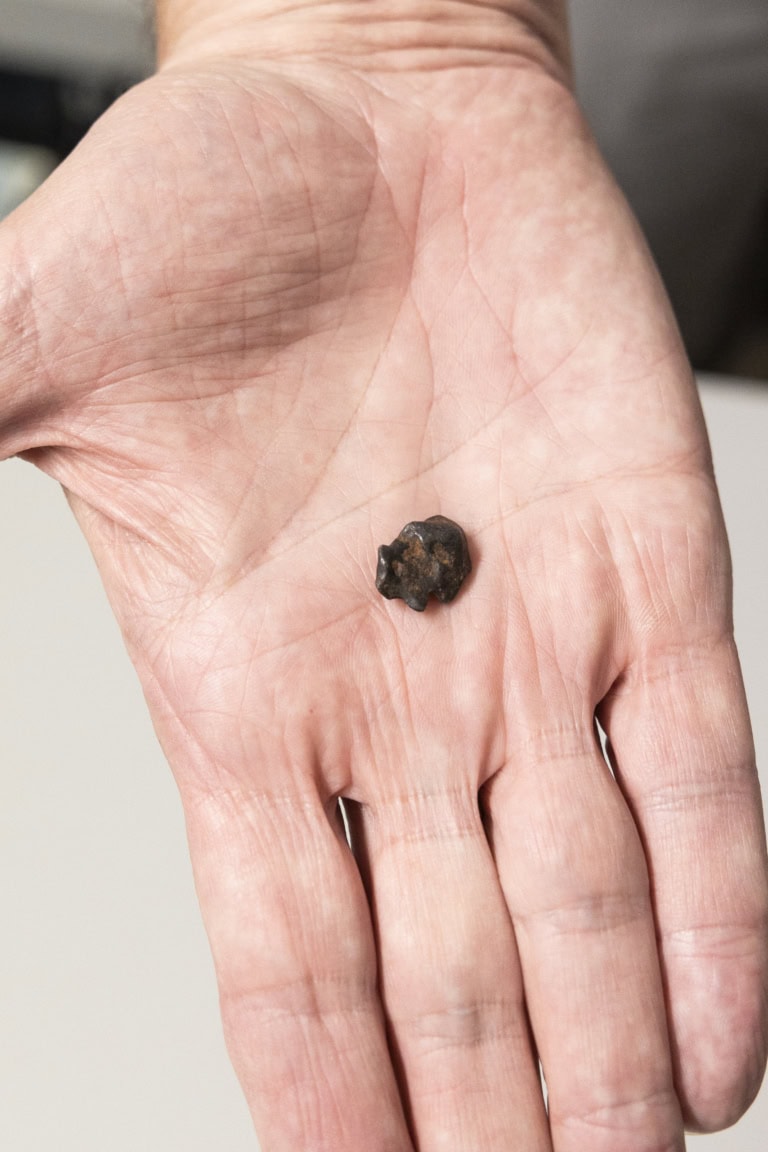
A fragment of a meteorite found in Russia: it is rare for stones from space to be found.
A shooting star for your pocket
But today, despite the late hour, it’s too light to look at the stars. ‘We’re in summer hibernation at the moment: until October you can’t see anything in the sky, because at our latitude the sun doesn’t sink low enough,’ Schröter explains.
He can show one celestial body despite the lack of darkness: from a drawer in the observatory’s entrance he takes a small piece of rock, barely bigger than a pea. The little lump looks utterly unremarkable. But it is actually part of a shooting star that fell to earth over Russia and found its way to the observatory in Melle as a gift. ‘I think this one still has a wish left,’ Schröter smiles as he puts it in his trouser pocket, switches off the power and locks up his observatory.