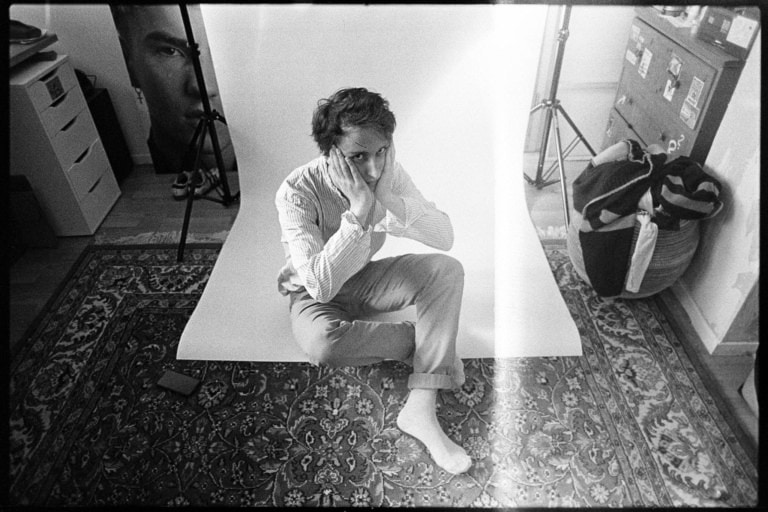
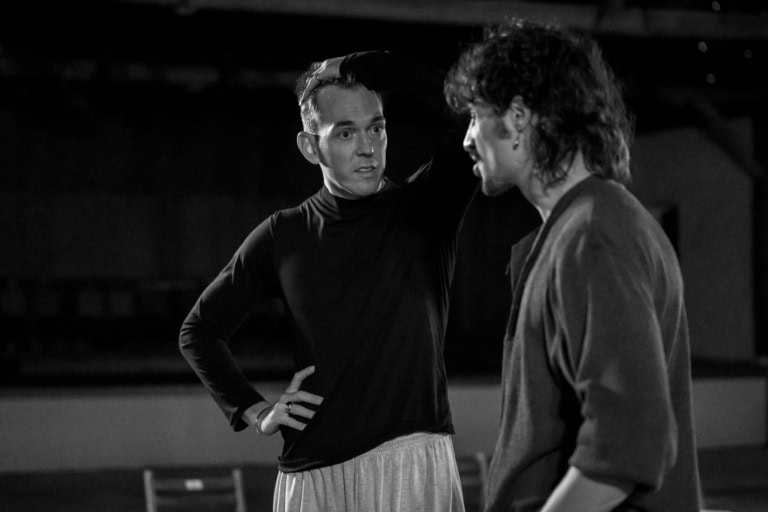
‘Das Günther’: a band that invents its songs live
Three musicians, zero planning: how pure spontaneity creates something new every night.
By Isabel Reda (photos), Raik Schache (text)


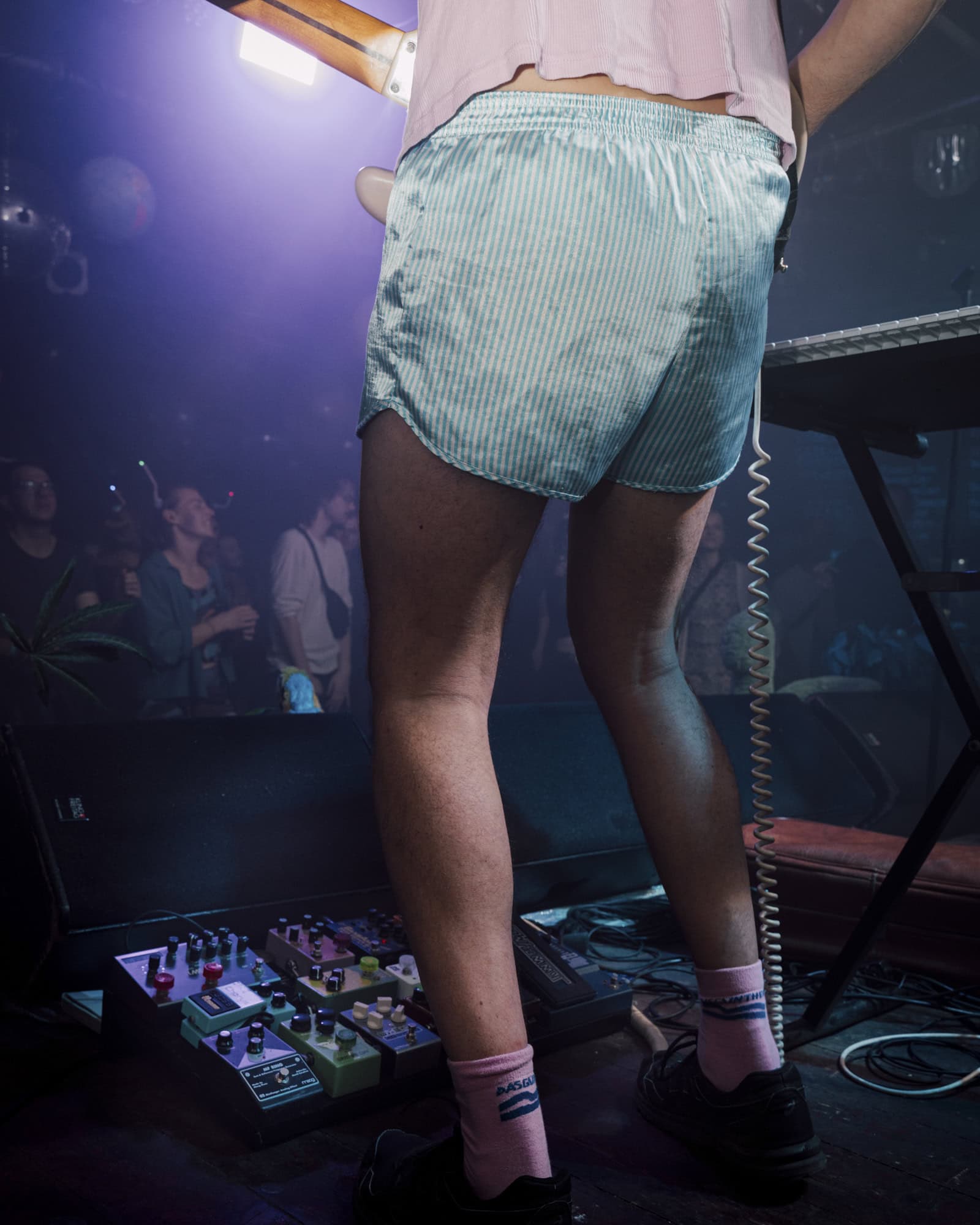
The ring at the Hafenklang slowly fills up, right in the heart of Hamburg’s fish market. After 7 p.m. it’s pitch dark out here. Inside the Hafenklang, by contrast, everything is bathed in a warm red light, and the walls are covered in stickers reading ‘Still loving vinyl’ and ‘Arte Ultras’. The first drinks are being served at the bar. Fifteen minutes before the show, the mood backstage – an office of the venue turned into a dressing room – is relaxed.
Among cable drums, a satchel full of drinks tokens and posters of former punk legends on the walls, Albrecht, the drummer of ‘Das Günther’, bites into his last slice of pizza. Alex, the troupe’s voice, pulls on one layer of costume after another, while Till, the bassist of this little chaos orchestra, takes orders for one last round at the bar. Five minutes before the start, everyone is changed and ready to go, and Alex asks the other two how they want to open the show tonight.

‘Das Günther’ has been performing since 2017. Till (left) plays bass and synthesiser, Alex (centre) sings and Albrecht (right) plays the drums. The band members met while studying music at the Hannover University of Music.
Having no concept is what sets apart the three musicians, who met while studying jazz in Hannover. The band started as a fun project, and after the first gigs none of them knew that the line-up would last. They simply felt like trying something new and jamming. Today, seven years after their first concert, ‘Das Günther’ stands for a colourful spectacle among its loyal fans and wants to be a projection screen for many alter egos that are often seen as a bit problematic and difficult. In their performances they allude specifically to patriarchal structures – badly aged white men who deny climate change and embody a widespread aversion to change and the diversity that comes with it.

The bassist Till waits backstage at the Glocksee to go on. Warming up his fingers is all the preparation he does.
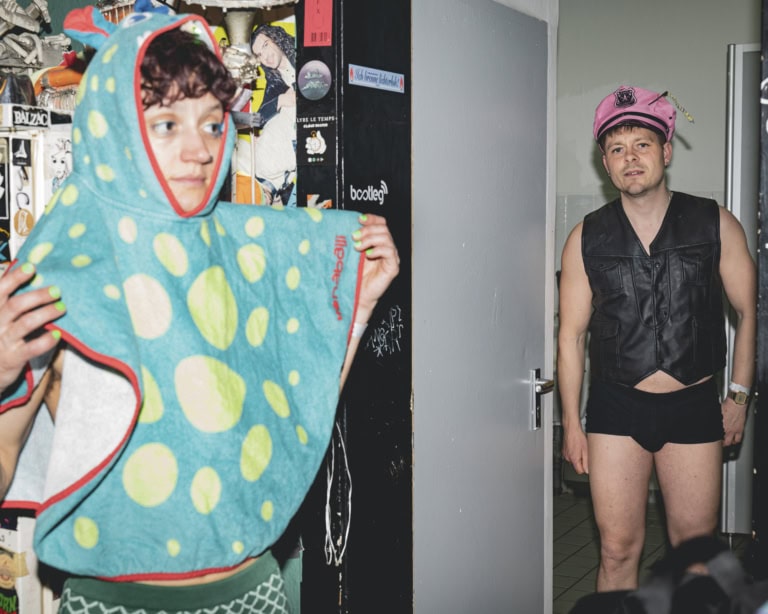
Frontperson Alex and drummer Albrecht have finished changing – now it’s showtime. ‘Das Günther’ is known for its outlandish costumes.
Grubby deals glimpsed, gentrification, grisly goings-on, Günther glimpsed, good times, grooved.
‘Grubby deals glimpsed, gentrification, grisly goings-on, Günther glimpsed, good times, grooved’ – with this, Alex opens the evening. In a ringmaster’s costume, Alex addresses the colourful, mixed crowd. It’s reminiscent of a poetry slam: an alliterative chain on ‘g’. It’s a first – they have never started a concert like this before. They have probably never started two concerts the same way, because ‘we only rehearse live!’, as Albrecht said before the show. The instruments slowly join Alex’s free-flowing monologue, and the prologue fades out. The cluster of about 60 people starts to move. The band gets the crowd going and underlines its attitude with ironic reworkings of lyrics: Scooter’s ‘Hyper Hyper’ becomes ‘Heißer, Heißer, es wird immer heißer’ (‘Hotter, hotter, it’s getting hotter’), and Rainald Grebe’s song ‘Brandenburg’ mutates into ‘Lassen Sie mich Arzt, ich bin durch’ – a scrambled ‘Let me through, I’m a doctor’.
‘Das Günther’ wants to ruffle feathers, rub salt in the wound and address everything that preoccupies the younger generations. Their music sits somewhere between Nina Hagen and Kraftwerk – political, electronic and punky. They give the audience provocative lyrics carried by synthetic melodies, in time with analogue instruments. They don’t just play for the audience but with it. ‘And if they want to dance, you let them dance. That’s simply how it developed that we keep turning up the heat. The dictate of the dance.’
While Albrecht is already launching the second act of a piece on the drums, Alex peels off the first costume. The ringmaster turns into a diva. The artist appears in a sequinned dress – and a new headpiece is conjured out of the first hat while the music keeps rolling. It’s a beret, to match the dress. The costumes let Alex take on different roles and confront their own stage persona with irony. The band plays around with props, as if from a box of Christmas decorations, on stage and even in the audience. A childlike lightness fills the air.
Alex sings: ‘Mother Earth, Father State, the relationship is broken! Topple the state! Topple the patriarchy!’ Like a DJ in a club, the musicians let one song spill into the next. They weave fragments of lyrics into ever-new beats, invent their music live on stage and adapt to each audience. So of course, a bit of disharmony creeps in here and there. But it’s exactly this willingness to make mistakes that makes the show.
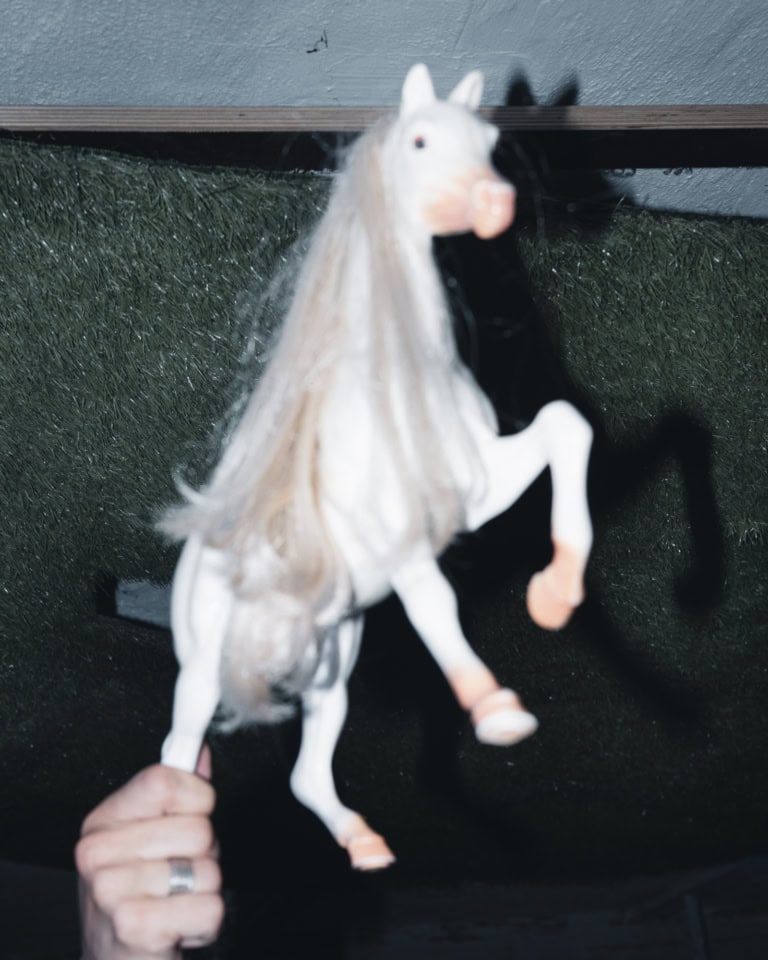
Alex stands in the crowd holding a little white horse up in the air – one of the few props that evening.

There’s a lot of skin on stage. Even so, it matters to the band members that male nipples are taped over too, to draw attention to the censorship of women’s breasts.
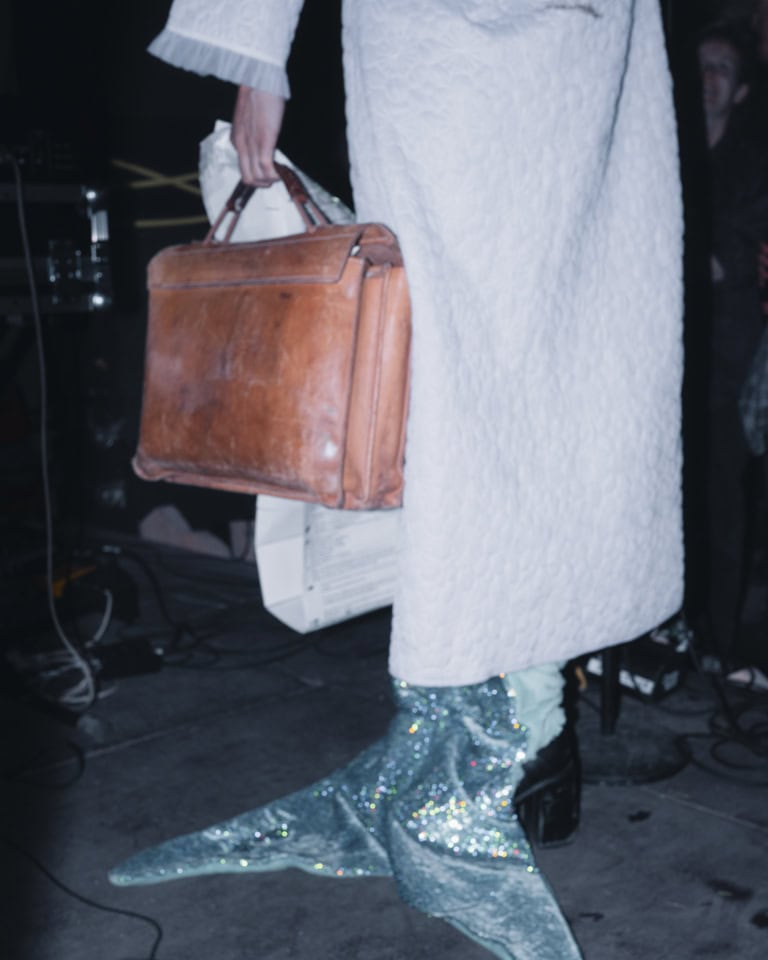
As frontperson, Alex keeps slipping into new roles, shaping the band’s performative character.
Tripping over yourself is somehow part of Günther – breaking yourself open.
And so ‘Das Günther’ stumbles into the third and final act of the band’s debut concert at the Hafenklang. One last change of costume, one last deep breath, and the instruments start up again. The tempo has picked up over the last two acts, and so has the temperature in the room. The warm red light and the urge to dance now reach even the stiffest limbs. The mood is carried by fast kicks, rhythmic shouting from Alex in a 1990s aerobics outfit, and synthetic sounds. It gets more electronic, faster and crazier. Alex gets lost in the performance, fiddling with a small keyboard and playing it with the tip of their nose, before putting the instrument on their head and massaging the keys with their skull.
Anyone looking for consistency in this band will probably never find it – not in the playing, nor in the ‘how’ or the ‘where’. As well as conventional gigs at established venues and festivals, the three also turn up on the line-ups of electronic music events. They have played the 7 a.m. closing set at the former MJUT in Leipzig, livened up Berlin’s party weekend with a set at Club Sisyphos, and taken the stage at Indiego Glocksee in Hannover at 2 a.m., the most coveted slot for any DJ – at a techno night, of course. In settings like these, the three have to go full steam ahead from the start. The crowd is usually already completely lost in the flow of the music, and the break of suddenly having a band with real instruments on stage is break enough. On an ordinary club night, the focus is on the dancing individual who wants to let go, lose themselves and feel the bass. So how does the concept of ‘Das Günther’ fit into a setting like that?
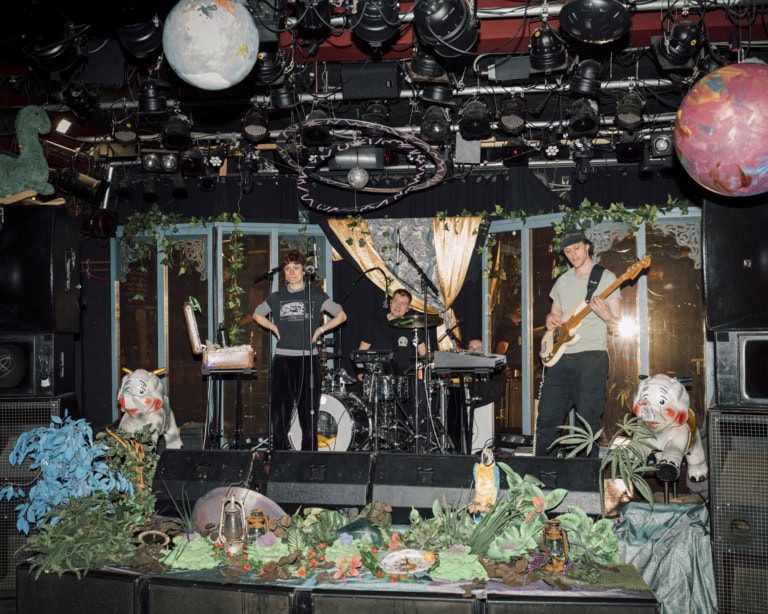
‘Das Günther’ at a soundcheck at the Glocksee. That evening they are playing as a secret act at a techno party.

At times, a concert by ‘Das Günther’ feels more like a play than a conventional music performance.
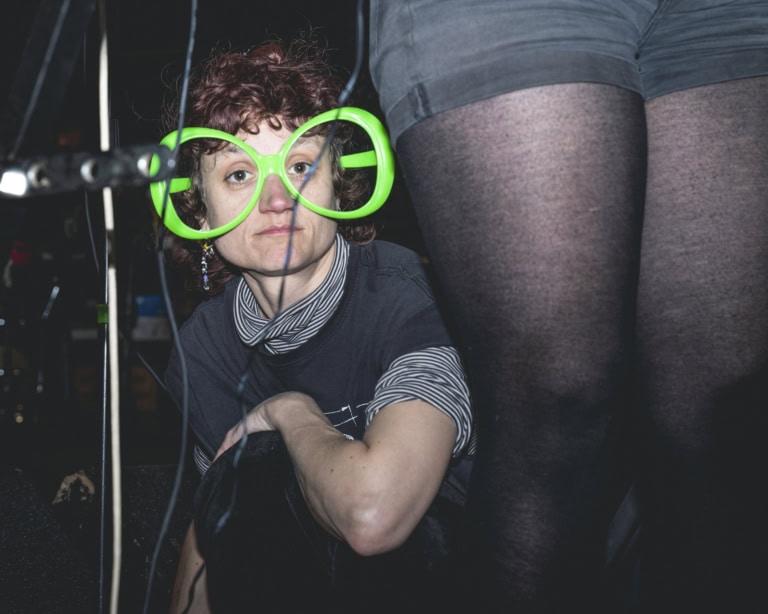
The later the evening gets, the wilder and more unconventional the performances of ‘Das Günther’ become.
Party! Party! Downer! Downer! Some people need therapy after Günther; for others, Günther is the therapy. Like a shabby clown, Günther leads not only the audience but also itself up the garden path. Günther is punk, clown and mum all at once.
Albrecht answers jokingly: ‘Most of the time the dancers have another floor they can go to.’ But above all, the band’s performance is meant to feel embracing, which is why in these contexts it’s especially important to be fast, danceable and empowering. It should be fun and not pull people out of their flow. ‘At the same time, it can briefly break with the hedonism – while still being hedonistic, just with a bit more substance.’ Besides, clubs are now much more than hedonistic spaces. To quote DJ Gigola from her podcast ‘Our House, Clubs und ihre Geschichten’: ‘Clubs are meeting places, free spaces, safer spaces, breeding grounds for creativity, places of resistance, lived utopias.’ And really, that’s everything ‘Das Günther’ lives out in its performances too. They always come with a big, uncompromising mouth, put on shrill shows and invite you to become part of their little family.
And so this evening at the Hafenklang comes to an end too, after almost 120 minutes of ecstasy on and in front of the stage. To finish, there’s just one question left: how would Günther’s mother describe her child in her own words?
‘Party! Party! Downer! Downer! Some people need therapy after Günther; for others, Günther is exactly that. Like a shabby clown, Günther leads not only the audience but also itself up the garden path. Günther is punk, clown and mum all at once.’