‘The wolf is a problem that can be solved’
Protect or shoot? How farmers and conservationists are struggling over the right way to deal with the returning predator.
By Betty Einhaus (text), Annabel Karmelk (photos), Saskia Stöhr (videos)


A century after it was wiped out, the wolf is roaming Germany’s forests again. No longer just a figure from fairy tales and legends, but an animal that enlivens our landscapes and affects the relationship between people and nature. Wolves have been returning naturally since 2000, according to the Federal Environment Ministry. Their numbers are growing steadily, especially in Brandenburg and Lower Saxony. But their return brings challenges: conflicts with livestock farmers, the need for protective measures and tensions between different interest groups.
What do livestock farmers say?
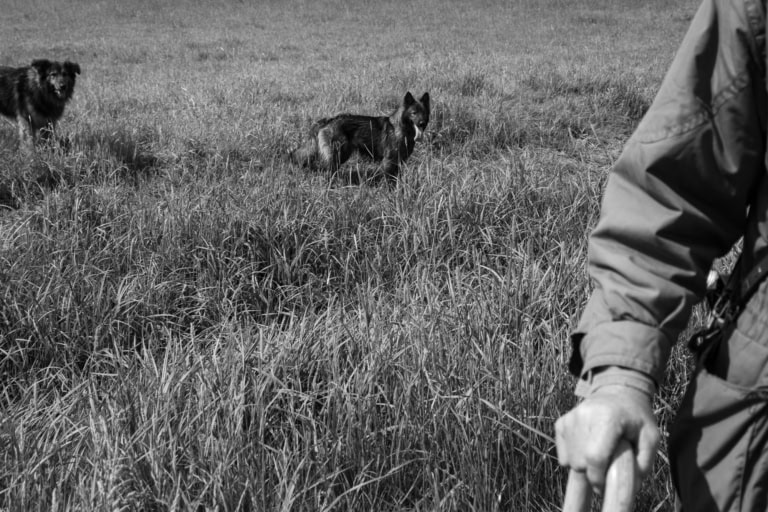
Wiebke Wehrs and her husband run an organic dairy farm near a wolf territory in Lower Saxony. Their farm is home to dairy cows, sheep, horses and pigs. Despite living close to wolves, she remains relaxed: ‘The wolf is a problem that can be solved.’
After two unprotected calves were killed in a neighbouring village, the family decided to protect their animals better. They installed electric fences and got a livestock guardian dog. ‘Putting up a fence like that isn’t rocket science, and you have a responsibility towards your animals,’ she stresses.
We put 400 hours of work into three and a half kilometres of fence.
 Wiebke Wehrs
Holger Heese lives near the Ostenholzer Moor north-west of Celle. He keeps sheep close to a wolf pack. ‘At first it was very nerve-racking,’ he says. To protect his animals, he too relied on livestock guardian dogs. ‘We started with one male. It’s a lot of work.’ Over time the team grew to four dogs.
Applying for funding for wolf-proof fences and guardian dogs, however, is complicated and time-consuming. Wiebke Wehrs describes lengthy application procedures: ‘It took four and a half months for the application to be processed. We put 400 hours of work into three and a half kilometres of fence.’ The owners pay for the dogs’ food and care themselves.
No need to fear the wolf – an expert reassures
Christian Berge, 58, has been fascinated by wolves since childhood and breeds wolfdogs. ‘There is no reason to be afraid of wild wolves,’ he insists. Young wolves are curious, he says, and may stop and watch. ‘My advice: stay calm, keep relaxed.’
He is active in wolf conservation and gives talks to break down prejudice. ‘We have to get used to them again,’ he says. ‘Wolves were only extinct here for 150 years.’ Many attacks could be avoided if animals were properly protected: ‘In Lower Saxony, 88 per cent of the grazing animals killed were not protected or poorly protected.’
The main points of conflict
• Conflicts with livestock farmers: attacks on sheep and calves cause financial losses and emotional strain.
• Costly herd protection: wolf-proof fences and guardian dogs take time and money.
• Bureaucracy and delays: complicated, slow funding applications make protection harder.
• Social tensions: differing views on the wolf lead to conflicts between farming and conservation.
• Lack of information: ignorance and fear in dealing with wolves increase the need for education.
Source: Federal Ministry for the Environment, Nature Conservation, Nuclear Safety and Consumer Protection, own research
Tracking with the wolf monitor

Robert Franck on the trail: the wolf monitor and livestock-kill assessor regularly roams the Ruppin forest and lake district. Tracks such as paw prints and droppings tell him whether a wolf has been nearby. In snow especially, the fine details of wolf tracks are easy to see.

Besides livestock such as sheep, fallow deer are also favoured prey for the wolf. The question of how effective electric fences really are remains open.
Robert Franck is a wolf monitor in Brandenburg and knows the wolves like hardly anyone else. ‘Our work helps us understand better how the wolf lives and how we can avoid problems,’ he explains. Every day he roams the Ruppin forest and lake district, collecting data and tracking the animals’ movements. ‘In winter the paw prints in the snow tell us whole stories.’
He documents their movements with camera traps and GPS trackers. ‘More than 90 per cent of our data comes from camera traps,’ says Franck. This knowledge helps to develop strategies that minimise conflict and support coexistence between people and animals. ‘Selected animals allow us to track movement patterns and territorial behaviour precisely. That way we can monitor wolf populations and protect livestock.’
But Franck also sees a need for political action: ‘Politicians should have reached out to people and brought them on board much earlier. People in rural areas feel abandoned by politicians when it comes to the wolf. There are funding programmes, but they are often too cumbersome and slow. Some farmers still haven’t heard anything back after the third kill.’
Robert Franck sees monitoring as an opportunity to reduce conflict. ‘It’s important that we find ways to coexist.’ He stresses that education and cooperation are crucial to achieving a balance between people and animals.
People in rural areas feel abandoned by politicians when it comes to the wolf.
 Robert Franck

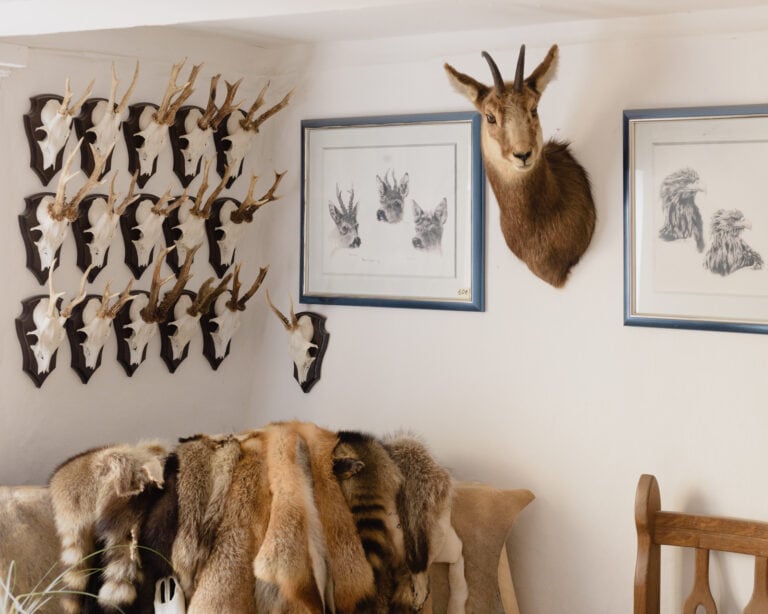
Evidence in the study: Robert Franck keeps wolf skulls and paw prints in his study.