MS Norröna: by ferry across the North Atlantic to Iceland
From Denmark via the Faroe Islands to the far north: a passage through the rugged beauty of the sea.
By Stella Meyer, Sarah Schneider (text), Lisa-Maria Gruber (photos)


Since 2003 the MS Norröna has linked the remote Faroe Islands and Iceland with mainland Europe. From Hirtshals, a picturesque port on the northern tip of Denmark, via the Faroe Islands to Seyðisfjörður in Iceland, she carries countless travellers and goods. The crossing takes about 48 hours and usually involves two nights on board. With a capacity of up to 1,500 passengers, the MS Norröna is one of the largest ferries in the region.
The historical importance of this sea route goes back to the Viking Age, when the Norsemen crossed the Atlantic in their knarr trading ships. This tradition is continued by 57-year-old Faroese captain Bogi Peterson, who has been navigating the high waves for 40 years. ‘My father was a seaman, my grandfather was a seaman – it’s in my blood,’ he says.
Almost 170 metres long and broad in build, the MS Norröna is ideally equipped for the harsh conditions of the North Atlantic. She has space for 800 cars and cabins for around 1,500 passengers. The ferry carries vital goods to the Faroe Islands, especially timber, which is scarce there because of the barren, rocky landscape and salty winds. In return she brings fresh fish, above all salmon, back to the mainland – a significant part of Faroese exports.
But the MS Norröna is more than just a means of transport. She offers an oasis of calm in our hectic world. ‘At sea there is nothing to stress you,’ says chief engineer Eyðun Djurhuus. ‘Being on board is all we have to deal with here.’ Twenty-four-year-old Daniella Lykke also finds comfort in her work on board: ‘Whenever I go up on the top deck and see the open sea, it calms me down. All the problems on land disappear.’
With cosy cabins, restaurants, a sauna and entertainment such as a PlayStation room, a nightclub and a casino, the MS Norröna offers her passengers everything they need to escape the hustle and bustle of everyday life and drift in the vastness of the ocean.
At sea there is nothing to stress you. At home the phone is always ringing and demanding your attention. Being on board is all we have to deal with here.
 Chief engineer Eyðun Djurhuus

Sometimes the waves can be up to six metres high. Then the stern lifts out of the water and the ship’s propeller spins freely. That can cause the engine to over-rev and the machinery to fail. The crew then has to act quickly to fix the problems.

‘Whenever I’m on board, I go out on the top deck and actually see nothing. Just the open sea. And that calms me down. All the problems on land disappear.’ Daniella Lykke (left, 24) is Danish and has worked in the mess for two years. Pauline Gibbas (right, 23) is from Poland and came to the ship through her uncle. She funds her music studies with her work on board.

Head chef Martin Vágoy has been part of the ship’s crew since 2016. By his own account, last year he fried his one-millionth pancake.

‘I’m responsible for all the engines on board and manage the budget for the machinery. I oversee the purchase of all spare parts for the engine room and the old ship. Down there I lead a team of 24 people – 12 on board and 12 at home. We work a four-week rotation: four weeks on board, then four weeks at home.’ Eyðun Djurhuus, 54, is originally from the Faroe Islands and works as chief engineer on board the Norröna.
My father is a seaman, so I grew up at sea and feel a deep emotional bond with it. While some see life on a boat as just a job, I find fulfilment in it.
 Lovisa Duvander, head waitress

Helmut Zimmermann likes to look back on his experiences as a seaman – a chapter of his life marked by a deep appreciation of the vastness of the sea. Even today he finds happiness in the expanse of the ocean.

The crew works hard to keep up a positive mood and atmosphere on board. That matters, as many of them are far from home.
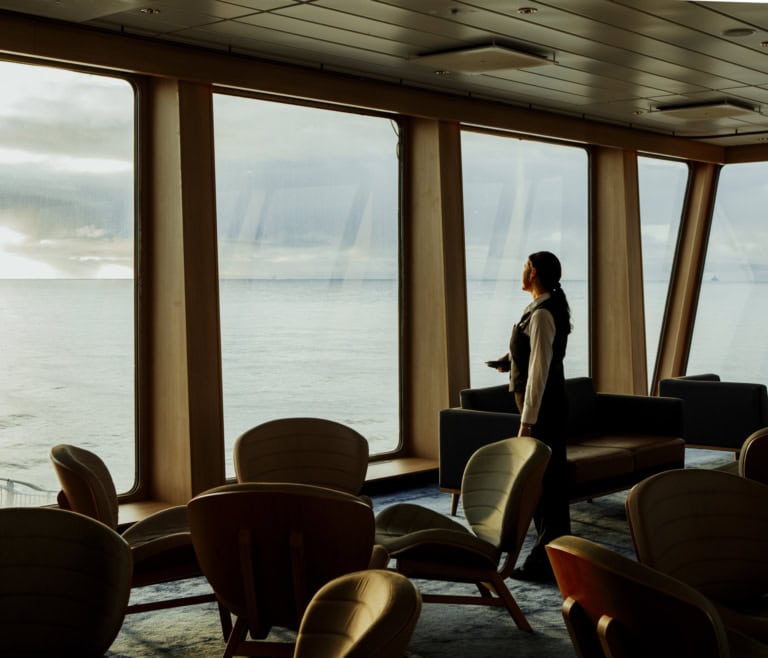
After around 24 hours the ferry passes the Shetland Islands, where the North Sea meets the North Atlantic.

‘I learned to sail when I was seven. My grandpa and I sailed in small boats together. I grew up close to the sea, so I feel a strong bond with it.’ Bogi Peterson, 57, is originally from the Faroe Islands and is the captain of the Norröna.
When I’m on the ship and looking out at the ocean, it’s as if I can feel my soul.
 Daniella Lykke

The Faroese word ‘Norröna’ means ‘northern sea’. The journey between Denmark and Iceland takes around three days.

During the journey from Tórshavn to Hirtshals, passengers play a dice game. On the way to the Faroe Islands you can experience all four seasons in a single day.

The rugged landscape is characterised by lush green meadows, steep waterfalls and high cliffs. The remote location, the cloud-shrouded mountains and the changeable weather give the place a mystical atmosphere.

‘When I’m on the water, I feel a deep sense of calm. It’s as if I could disconnect from the world and simply exist in the middle of nowhere.’ – Rakul Mikkelsen, waitress

D

The rough North Sea in a moment of calm. The evening sun turns the surroundings a deep orange.
My father was a seaman, my grandfather was a seaman, and so on. That’s why as a child I often dreamed of being a captain myself and going to sea. So it’s almost in my blood, or in my DNA.
 Captain Bogi Peterson