What some people see in a picture – and others miss
Transcultural perspectives show how differently people read images – and which hidden clues only some can see.
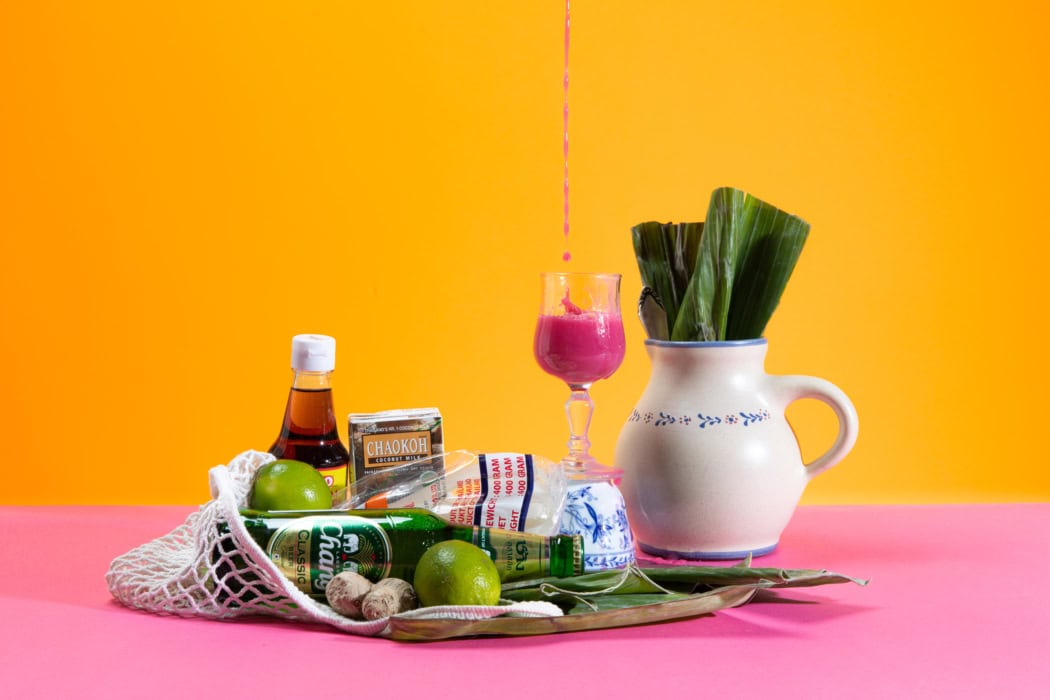 Photo: Hannah Kord, Arlette Weiland
Cultural clues in photography are visual elements that point to the cultural context, norms, values or identity of the people or places depicted – or of the photographer themselves. They enable viewers to understand the story, social dynamics and background of a picture.
Photographs often give the impression of capturing a moment directly. But what we recognise in a picture depends heavily on our own experiences. Some details go unnoticed by outsiders, while for others they open up memories, meanings or entire cultural contexts.
I explore the connection between personal experiences and collective cultural experiences and ask what role photography can play in this. It can not only depict reality but also create spaces in which different cultural perspectives become visible and enter into dialogue with one another.
The term ‘culture’ has many layers and is defined differently depending on the context. Here, culture is understood above all as a web of customs and traditions, art, clothing and cuisine – the elements of everyday life that connect people and give them a sense of belonging and identity.
Transculturality in this case means that German and Thai culture intertwine and mix. This can give rise to new hybrid forms in which Thai culture exists within German culture and is part of everyday life. I use the term deliberately here to show that cultures mix and should not be seen as rigidly separate.
Transcultural ‘Transcultural’ describes the mixing and mutual influence of different cultures, without regarding or classifying them as rigidly separate from one another. Cultures are not clearly demarcated from each other, and they do not exist side by side untouched.
Thai ‘cultural clues’ are perceived as Thai by the majority society in Germany, but through their presence in Germany they also find a place in German culture. So this is more than just two cultures meeting: a new, shared space emerges.
Between documentation and belonging
When I started my new photo project ‘Soft Power’ about people with a Thai migration background in Germany, I asked myself why I was doing it and for whom. There were various answers, but one motive was the need to show and explore these people’s realities, their culture and their sense of cultural belonging. With the project I wanted to reach people with a connection to Thailand and also to offer those without one new insight and a different perspective.
My mother moved from Thailand to Germany more than twenty years ago, and living with Thai culture in Germany is also a very personal subject for me.
In the course of my work I found that the older protagonists in particular maintain a strong connection to Thailand. Each person gave different weight to the importance of Thai culture in Germany and their personal connection to it. What can be said, however, is that the Thai diaspora in Germany is very large and that there are many places where Thai culture is lived in Germany. That is what I wanted to show. I wanted to find a way of depicting the culture – and above all the ‘insider’ objects, the food and the customs that are also lived here in Germany – so that Thai viewers would smile and understand what I was trying to show.
This made me think of Bieke Depoorter’s work ‘As it may be’. For it, she photographed people she did not know in Egypt, in whose homes she spent the night. A few years later she travelled to Egypt again and had other people comment on the photographs of these people. The result was a written dialogue between Egyptians from different cultural and social backgrounds.
This kind of interaction opens up a new layer that people without an Egyptian connection or background would probably not understand. I found this aspect interesting and wondered how, in photography, we can create spaces that invite people from different cultural backgrounds to explore new ways of seeing through photography – while also addressing the fact that we, as viewers, are outsiders.
Photography often gives the impression of having been there at the moment it was taken. That is the nature of the medium. We look at a picture, and however surreal the situation in front of the camera may have been, there is an image of it – so the impression can arise that we were ‘there’.
The layer behind the picture – on context and cultural signs
But this raises the question: what about context? Context here means not only when, where and under what conditions the picture was taken, but rather which symbols, customs or even products can be seen in it that are meaningful or historically relevant for this place or these people.
If you like, a photograph can be like a huge hidden-object picture full of elements that each have their own story and open up another layer. In painting this aspect is perhaps even more obvious, because the person who painted the picture actively decided to add each element – and with it the microcosm of its context.
While shooting my project, I increasingly photographed things such as fabrics or flowers that I associated with Thailand: flowers that reminded me of my childhood in Thailand, or fabrics that my Thai grandmother wears. It was the context that created the deeper meaning for me.
But I wondered whether other people could develop a connection to them as well – whether I was alone in how I perceived them. In a way, we are always alone to some extent, since everyone has their own experiences; but there are also collective experiences shared by people who belong to a particular culture.
To create another layer, start a shared dialogue about these cultural ‘clues’ and add a personal and collaborative dimension to my project, I decided to show the pictures to the protagonists and let them comment on what they saw. It turned out that many of the things – such as the traditional Thai garment I had photographed at a Thai market held in a car park in Hannover – brought back memories for one protagonist.
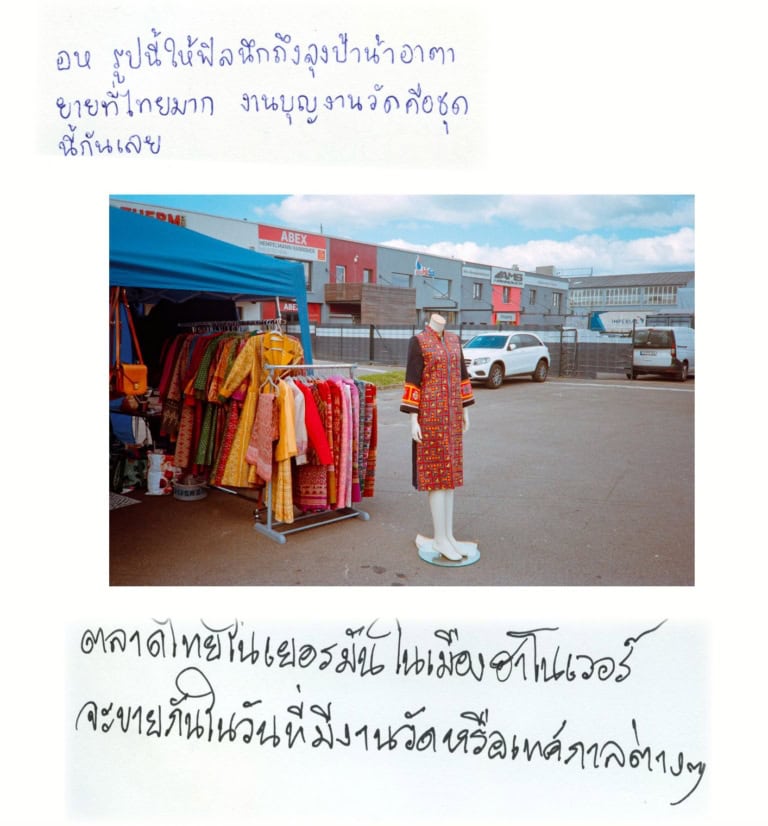 Hannover, April 2024. Photo: Pha Croissant
At a market stall at the Songkran festival in Hannover, lots of colourful traditional Thai garments hang on a clothes rail. Next to the stall is a mannequin in a patterned traditional dress.
The protagonist wrote: ‘OMG, this reminds me of the aunties and uncles back home. You see outfits like this everywhere at every ceremony.’ So it turned out that these cultural ‘clues’, as I call them here, are shared experiences of these objects – or, in this case, garments. For people who do not have this cultural background or have no experience of Thai culture, this may be a new insight and convey new knowledge.
However, I also found that focusing on these cultural ‘clues’ can lead to exoticisation. Showing only ‘traditional’ garments can give the impression that the focus is solely on the ‘other’, creating ‘othering’ – in the sense of: Thai culture is so different and so ‘exotic’.
What matters, then, is to recognise that different cultures are lived in one country and that they can mix and overlap. Perhaps the task of photography is to capture exactly that, unconsciously. And the task of photographers is to provide and establish context.
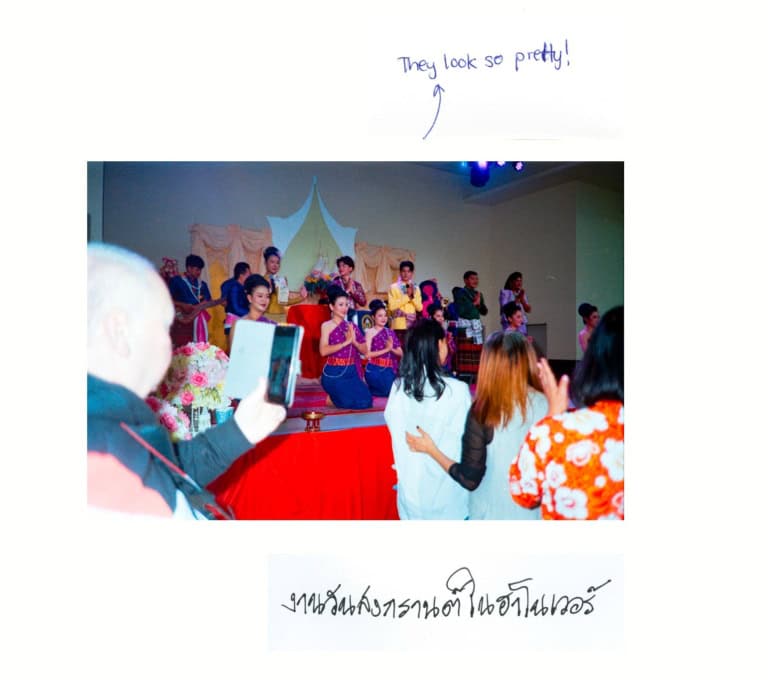 Songkran festival in Hannover, 2024. Photo: Pha Croissant
At the 2024 Songkran festival in Hannover, Thai dance groups in traditional costume perform the ‘Ram Thai’ dance on stage while people dance along.
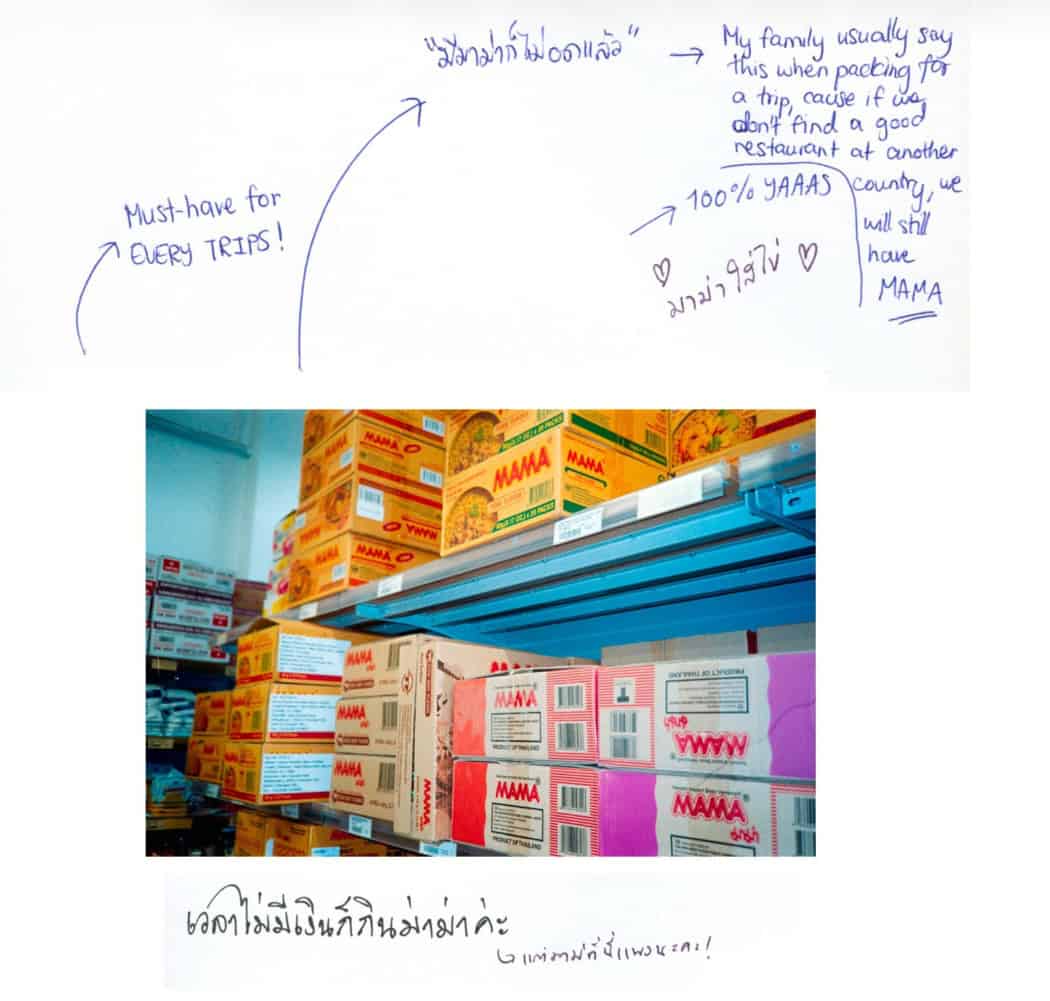 Hamburg, 2024, Asiasupermakt
The protagonists commented that MAMA is an important companion for their families, especially when travelling or when no good food is available. The noodles are considered reliable and indispensable on any trip. They are cheap – though not in Germany. This noodle brand is very popular in both Thailand and Germany.