Dülmen wild horses: truly wild or just a show?
The annual round-up in the Münsterland draws thousands – and raises awkward questions about how we treat animals.
By Greta Martensen (text and photos), Sören Pinsdorf (text)


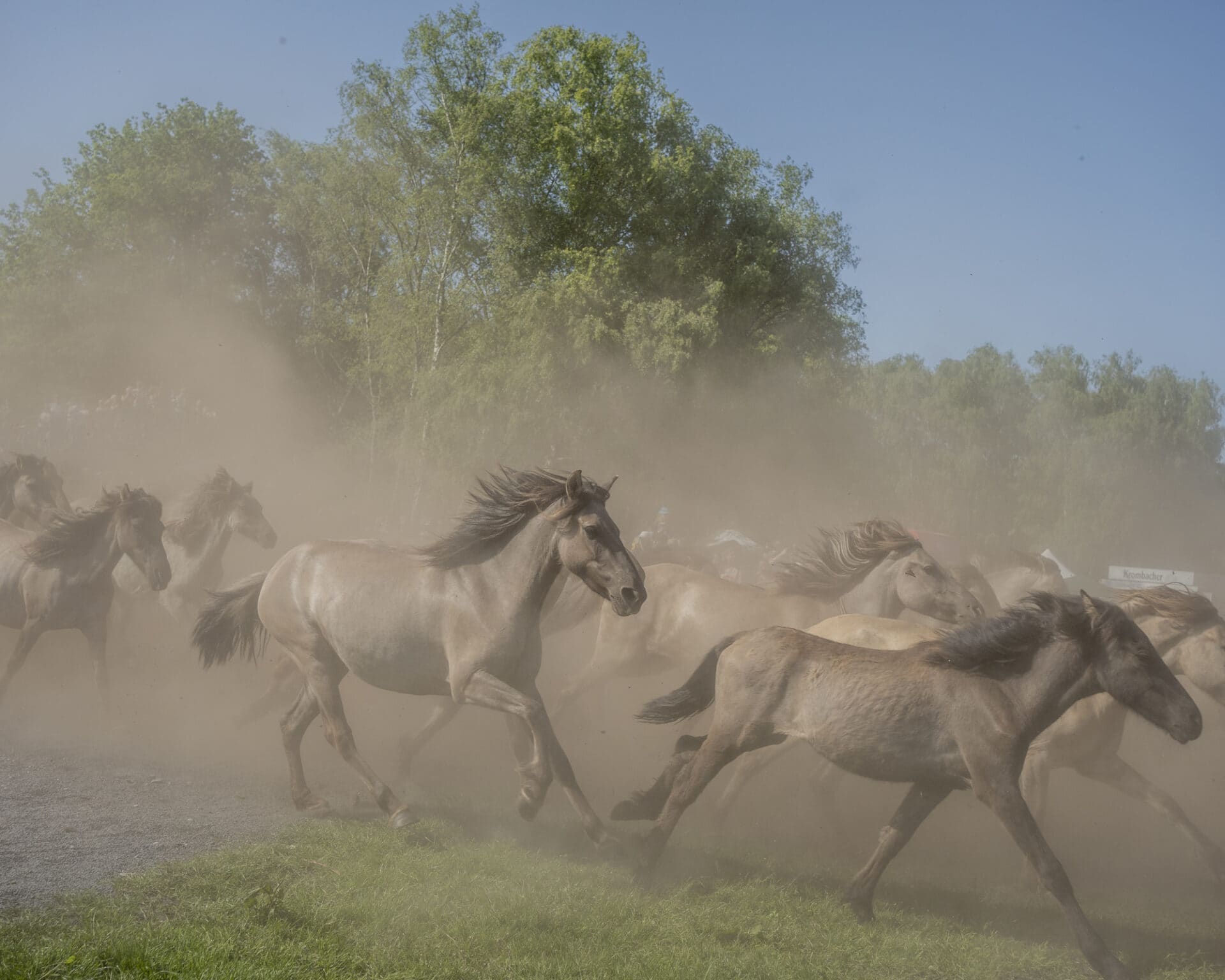
In the distance, hooves thunder. Dust swirls up. The wild horses are approaching the arena where their foals are about to be auctioned. An announcer tells the visitors to stay in their seats and keep quiet. Nothing must go wrong: if the lead mare decides to turn back, the auction day is over. A sea of mobile phones is pointed at the animals.
South-west of Münster, in a nature reserve in Westphalia, the Dülmen horses have lived for several centuries. Around 70 foals are born every spring. For one year the colts may run with the herd and enjoy the life of a free horse. Until, on the last Saturday in May, they are separated from the herd at the annual round-up of young horses and auctioned off.
In 2023 there are 34 colts. They are not yet fully grown, and their coats are shaggy. The first five wild horses are raffled among everyone who bought a ticket that morning. The rest are auctioned for between 800 and 3,000 euros.
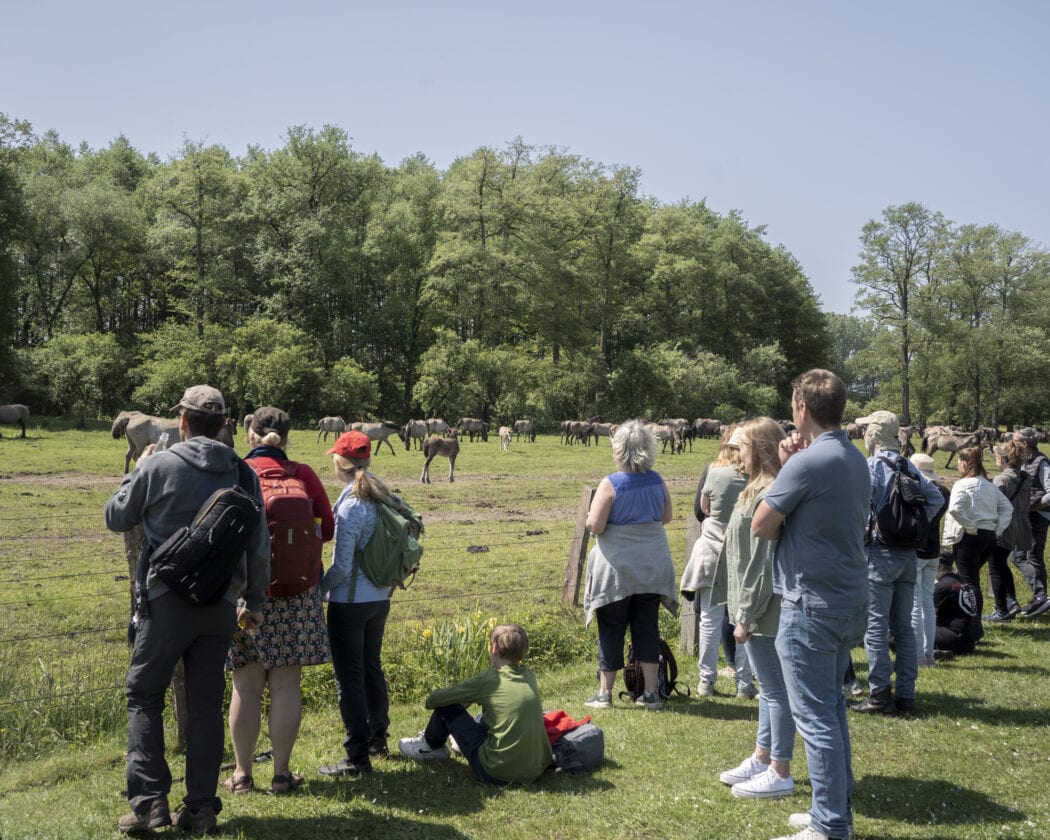
Normally the Dülmen wild horses live undisturbed in an area of 360 hectares. Here, visitors can watch the animals grazing before the round-up begins, before the organisers drive the herd together and chase it into the arena.
The annual round-up is a tradition – but a controversial one. Critics say the wild horses suffer stress and that both people and animals are put at risk. There are other ways of separating the colts from their herd, they argue. Without some 15,000 spectators, without the chase, without the crush.
Much of this event is show. Like the carriages carrying high society. The paying spectators crowd round the eight horses, while the others sit on top of the carriage in magnificent hats, laughing as they open their champagne. Five birds of prey sit chained to tree trunks. One of them tries several times to fly away while dozens of people stand close around it. It is not only the wild horses that are put on display on this day, but plenty of other animals too. The visitors keep their distance.
Before the spectators see the herd of wild horses in the arena, the colts caught in previous years are presented: how have they developed? Of the roughly 15 young stallions, at most three seem relaxed. The rest tug at their halters. They have to cross obstacles such as bridges, are led under a blue tarpaulin or through a trailer. Then the catchers take up their positions. They all come from the three villages around the wild horse enclosure: Merfeld, Maria Veen and Lette. It has always been that way and it is meant to stay that way. An older man of about 70 stands at the gate. His son and grandson are also driving the horses around. Several generations stand in the arena – the right to catch colts is inherited.
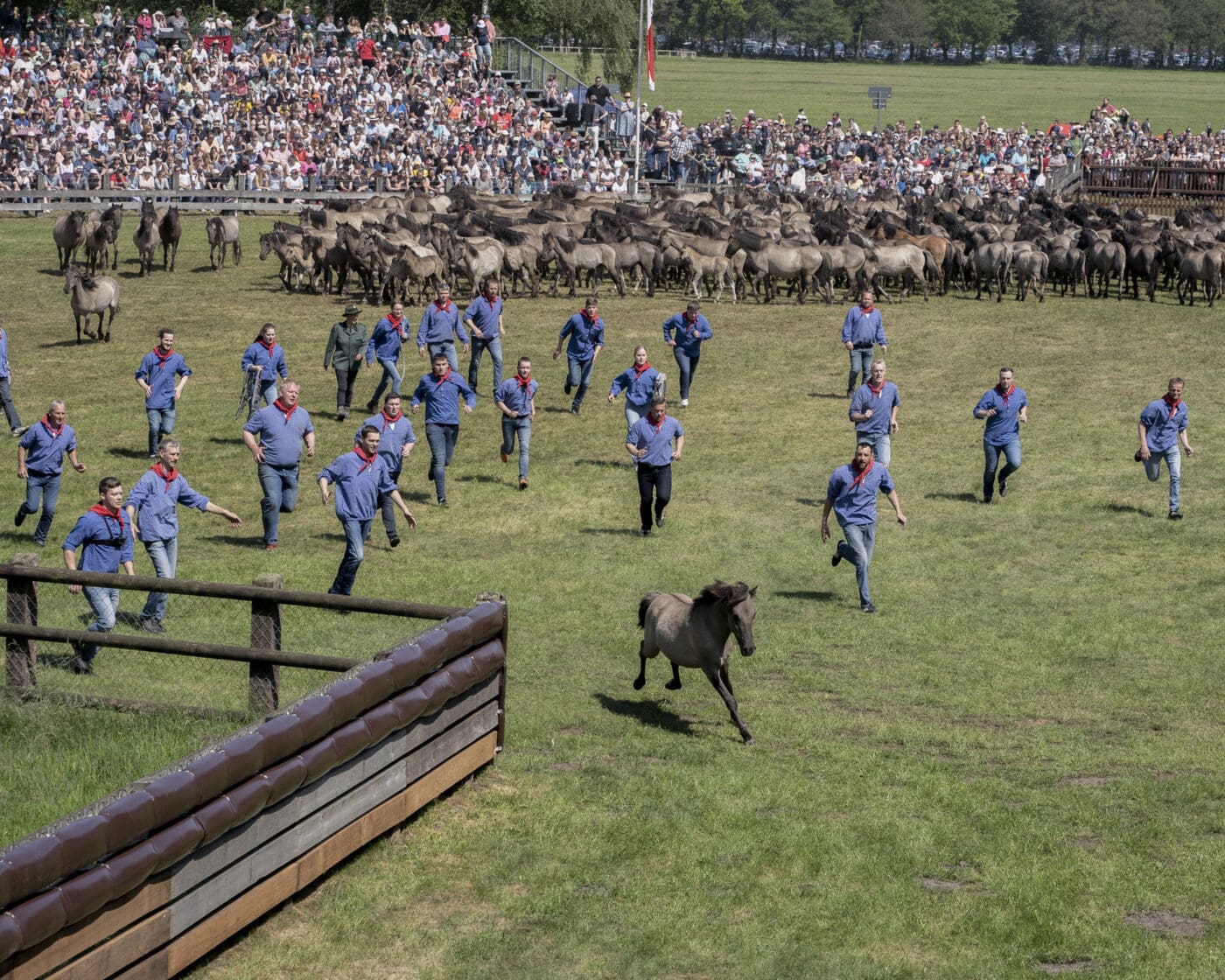
Once the herd of wild horses has been driven into the arena, the catchers start separating smaller groups, or a single yearling straight away, from the herd. These are driven into a fenced-off part of the arena.
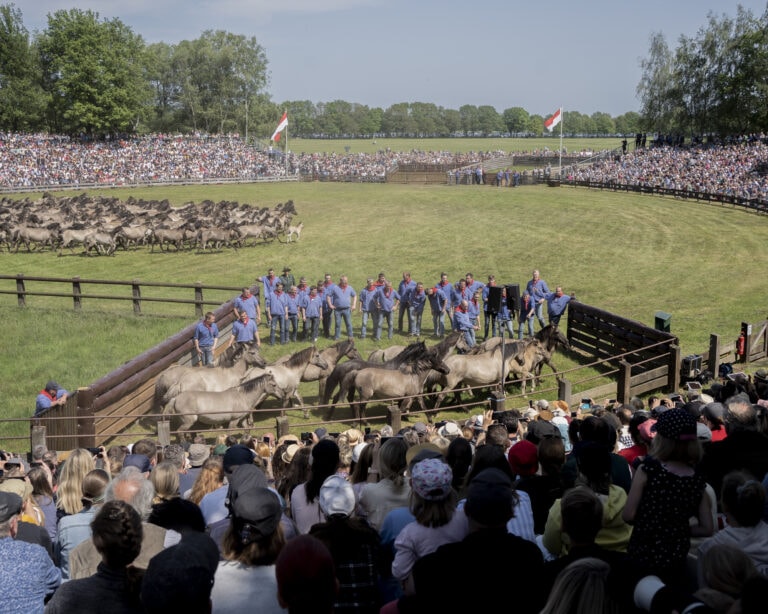 Die erste Gruppe wird separiert
Once the catchers have managed to separate a group from the herd, it is penned into a small area of the arena. Some of the catchers form a chain at the exit to stop the animals breaking out, while the rest pick out and catch the colts. The mares and young animals are then moved into the fenced area on the left of the picture.
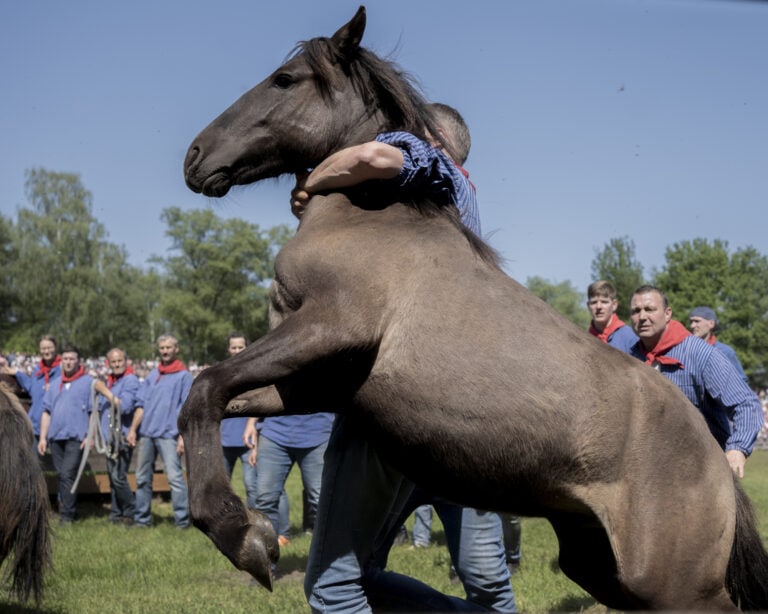 ein Hengst wird gefangen
Catching the colts can get rough. Throwing their whole bodies into it, the catchers try to drive a colt into a corner and slip a makeshift halter over its head. It is then led out of the arena by the halter.
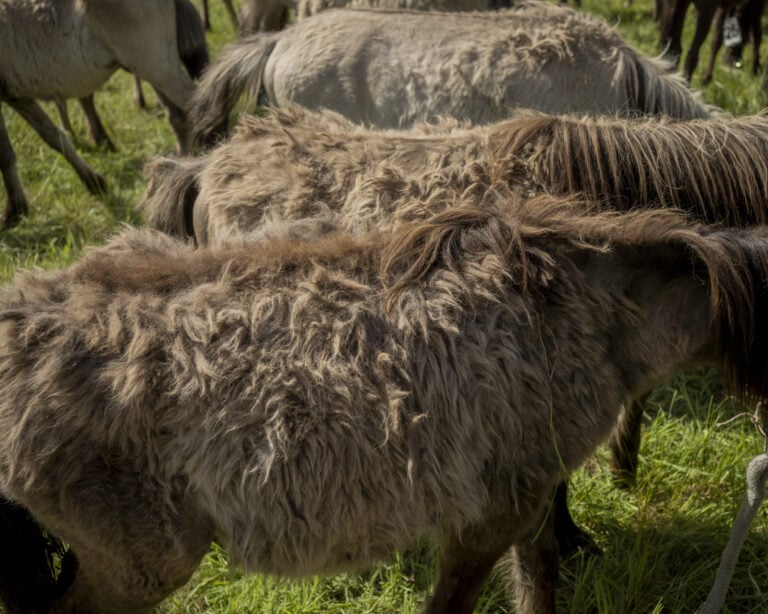
The herd includes not only the yearlings but also foals from the previous year. They are easy to recognise by their shaggy coats.
The catchers, all in blue-and-white striped shirts and red neckerchiefs, form a chain across the arena. They separate a small group of horses from the herd and drive them into one of the pens. When the catchers identify a young colt, they corner him and put a halter on him. The yearling colts, which have never been touched, let alone led, buck, rear, bolt, stop dead, run backwards. The rest of the small group is driven into another fenced-off area. So the next two hours pass.
A young colt is pressed against the fence, his small head squeezed between arms and bars. For some years now the catchers have been trained. They are supposed to learn how a horse should not be caught. But the catchers act on instinct and throw young horses to the ground – triggering one of a horse’s greatest fears.
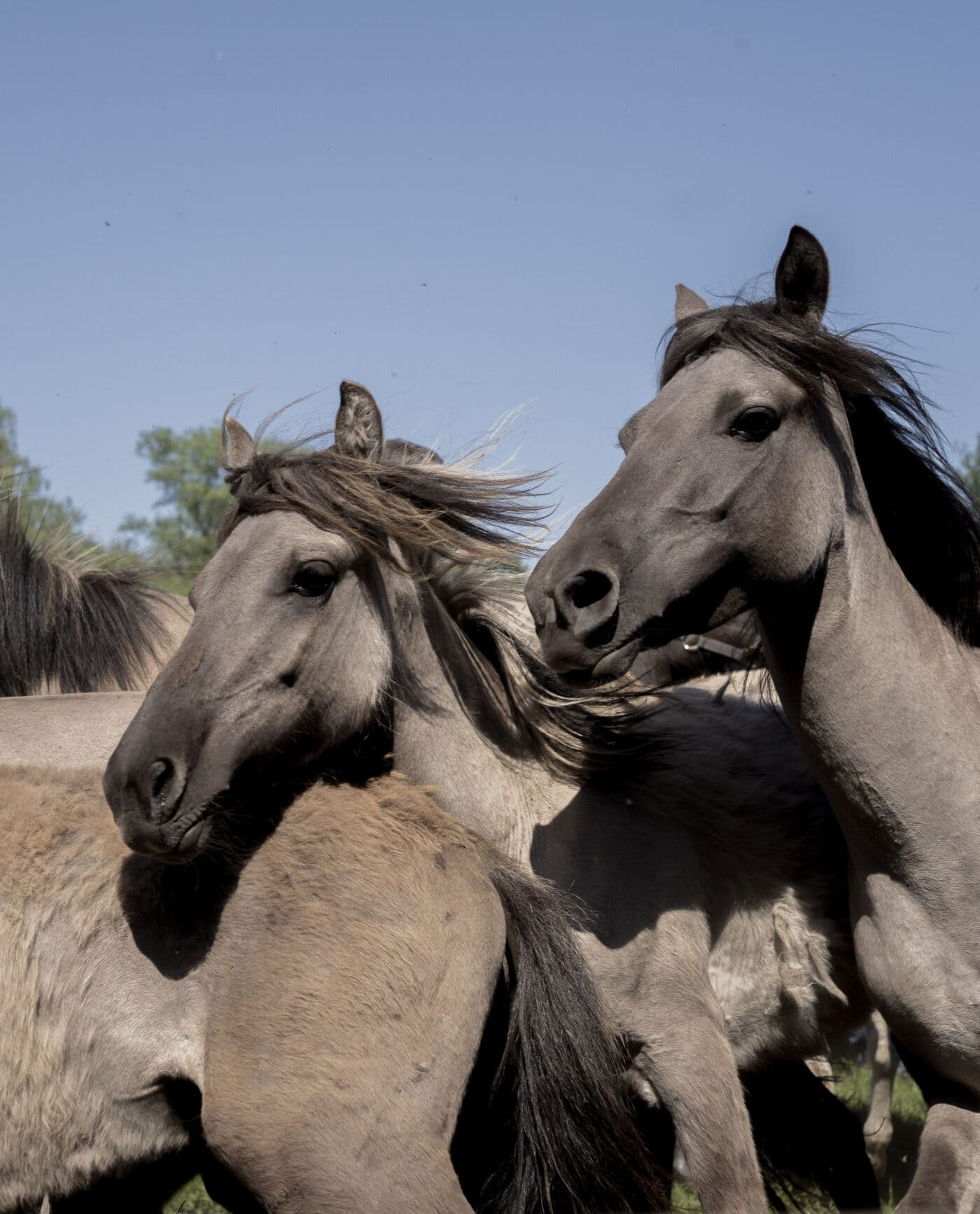 Pferde werden umher getrieben
Catching the yearling colts means a lot of stress for the otherwise wild herd. The animals race through the arena tightly packed together and try to shield their young from the catchers.
With all this spectacle, the question remains whether this can still be called a herd of wild horses. The behavioural scientist Dr Willa Bohnet of the University of Veterinary Medicine Hannover (TiHo) has been following the Dülmen round-up since 2007. Since 2008 she has pushed through various measures to reduce stress for the horses. She also runs the training for the catchers before the event.
Bohnet stresses that the yearling colts have to be taken out. Otherwise the stallions, once sexually mature, would fight over the mares. The horses would multiply uncontrollably, and the herd would soon be too big for its habitat. Bohnet has also suggested separating the young colts before the event using herding pens. The organiser has refused: visitor numbers might fall if the colts were no longer caught in public. Bohnet counters by asking whether such a fight of ‘man against animal’ is still appropriate today.
In fact, ‘Dülmener Wildpferd’ – Dülmen wild horse – is a registered trademark. A trademark that sells well. Year after year, up to 30,000 visitors come to marvel at the event. The round-up has become a major folk festival in the region – a crowd-puller that brings in money. The Dülmen horses have an excellent reputation in the trade. But is the herd really still made up of wild horses? TiHo researcher Bohnet says no.
Of course, the herd lives relatively undisturbed in its area. Even so, the horses are quite used to contact with people. Those in charge try to intervene as little as possible – but it can’t be done without any intervention at all: under the Animal Welfare Act, the horses count as a kept herd. This means they must be given extra feed in winter if the area does not provide enough food. Sick or old horses, or those born with deformities, also receive veterinary care. If necessary, they are taken out of the herd and put down. Those in charge are under no circumstances allowed to leave the animals entirely to themselves and to death. Humans also influence the herd’s gene pool: over the centuries the Dülmen horses have repeatedly mixed with other breeds. By carefully selecting the breeding stallions, the aim is to breed back the original Dülmen wild horse.
Even if that succeeds, they will no longer be truly wild horses. The human influence is too strong.
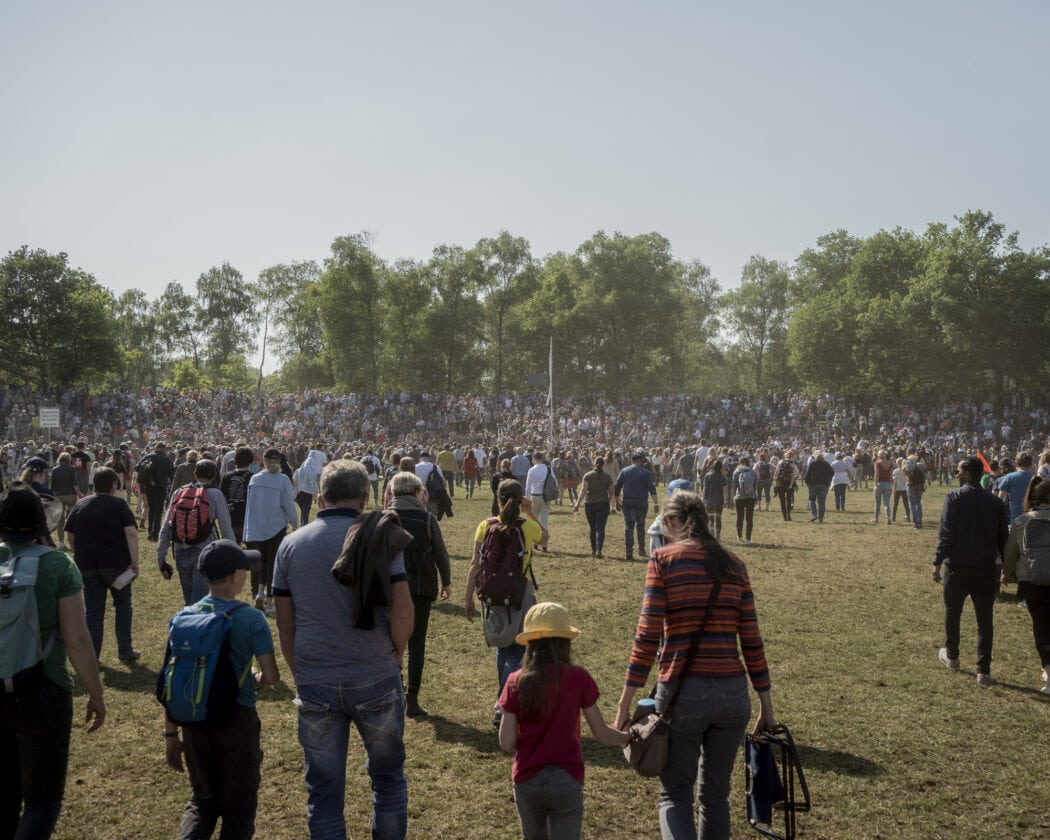
Once the yearlings have been caught, the auction of the captured horses begins straight away. Visitors stream into the arena to the fenced-off area to inspect the colts. A special highlight: the first five colts caught are raffled among the visitors. The winners can then decide whether to keep the colt themselves or release it for the auction that follows and take the proceeds.
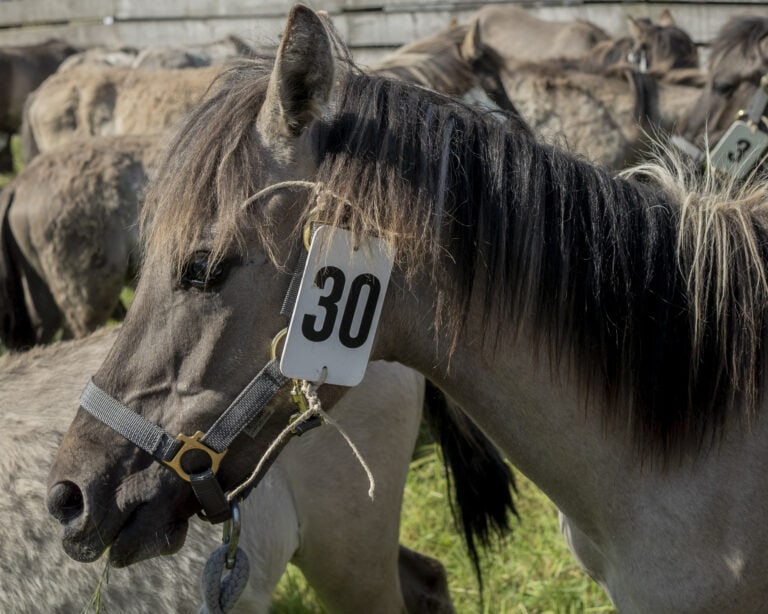
For the auction each yearling is given a number, which is attached to its halter. One by one, they are then shown to the audience and auctioned off.
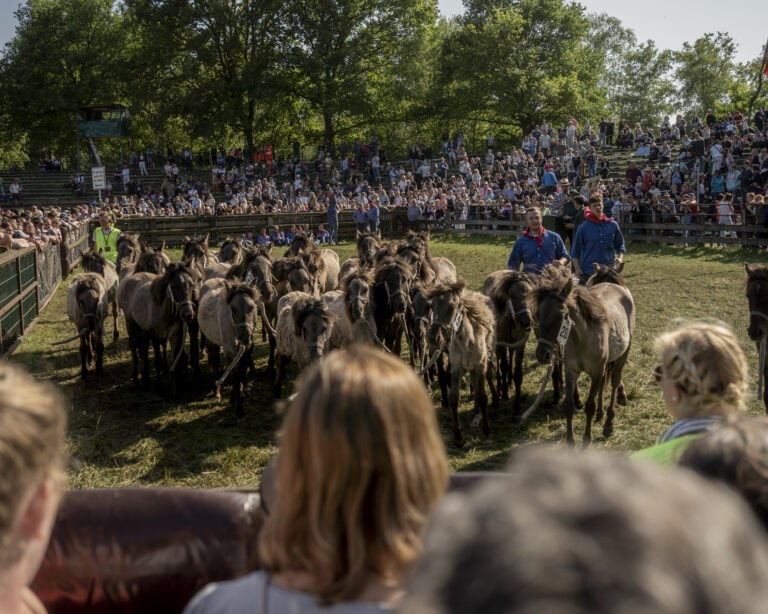
The auction is run by Volker Raulf, who also commentates on the round-up itself. While he stands at a lectern in the middle of the pen, praising the colts to the spectators, the catchers keep driving them around him to show them off at their best.