Closeness without sex: a visit to a cuddle party in Hamburg
Clear rules, lots of mindfulness, no ulterior motives: what an evening of touching strangers feels like.
By Jana Junker


A few years ago a friend spontaneously dragged me along to a cuddle evening. Yes, exactly that: an evening full of hugs and touch with complete strangers. I felt totally out of place. Getting so close so quickly to someone I didn’t know felt about as relaxing as a trip to the dentist. But as I lay rather stiffly between two women, I couldn’t help noticing how happy and relaxed everyone else looked. And one participant’s words stuck with me in particular: ‘Touch and closeness give me so much strength to cope with all the hardships in my life. It’s what keeps me afloat.’
Somehow that evening left its mark on me. Maybe there was more to it than I thought at the time. Sometimes it’s the little things – or in this case the warm, cuddly moments – that help us get through everyday life. So I set out to find out more.
Touch and closeness give me so much strength to cope with all the hardships in my life. It’s what keeps me afloat.
 Hamburg, January 2025
Participants say they feel more relaxed and balanced after a cuddle event.
Rebecca Böhme, a neuroscientist and the author of the book ‘Human Touch’, stresses how essential touch is for our well-being and health. According to Böhme, touch isn’t a luxury but a vital need. It influences our decisions, gives us access to our emotions and supports our inner balance. Even newborns benefit from skin contact, as it stimulates their emotional development. In old age, too, touch remains an important factor for health, since regular contact can prolong life and aid recovery. Then Aske and Lorenz agree to let me accompany a cuddle evening with my camera. The two run the Kuschelraum in Hamburg, which offers various workshops and events centred on touch. I’m really looking forward to it, and at last the little adventure begins.
The large period flat close to Hamburg’s main station welcomes its visitors with an almost cinematic cosiness: high ceilings, indirect lighting and furnishings in which every detail seems to say, ‘Why not stay a while and just make yourself at home?’ Antique wooden furniture, lots of pictures on the walls, wide floorboards. In the cuddle room, mattresses with green covers are neatly laid out, with pillows and blankets on top. A pleasant scent that I can’t quite place fills the room. Opposite the door, a large, heavy sofa stands against a wall with a floral pattern.
 Hamburg, January 2025
Regular cuddling can boost self-esteem and well-being.
 Hamburg, January 2025
Cuddle clubs have become increasingly popular in recent years – especially in big cities.
One by one the 12 participants arrive, in comfy, cosy clothes. Tracksuit bottoms, a soft onesie and stretchy tops set the tone. Some still seem to be finding their bearings. The first conversations get going quickly, though some are still a little tentative – rather like an orchestra warming up, a few notes here and there that soon come together in harmony. ‘Wow, I’m really nervous,’ I hear from the hallway. Me too, I think, me too. After the welcome comes a round of introductions in a large circle. Some are at the Kuschelraum for the first time; others already know each other. Everyone briefly describes how they’re feeling. Then the rules and warm-up exercises are explained, designed to help everyone notice and respect their own boundaries and those of others.
If you notice that you’re sexually aroused, it’s important to respond mindfully.
One exercise goes like this: walk around the room, make eye contact with someone and ask whether you may hug them. Interestingly, everyone is supposed to say no three times on purpose, to practise saying no. ‘If it feels like a maybe, it’s a no,’ is one of the rules. Another is that touching intimate areas is off limits. Just as I’m wondering what actually happens if sexuality suddenly comes into play, Lorenz says: ‘If you notice that you’re sexually aroused, it’s important to respond mindfully. Please withdraw from the situation. That’s how we keep things respectful.’
One participant voices her worry about feeling rejected again. ‘That hurt me, and I’m afraid it’ll happen again now.’ Aske is clear: ‘We’re not here to do each other favours. We’re here for ourselves, so please just look after yourselves. And nothing is compulsory. Nobody has to cuddle.’ Over time, the movements become more fluid and the interactions more confident. To me, the room takes on a tangible dynamic, shaped by respect and openness. What seemed hesitant at first looks more and more natural. Every now and then there’s a laugh or a giggle.
 Hamburg, January 2025
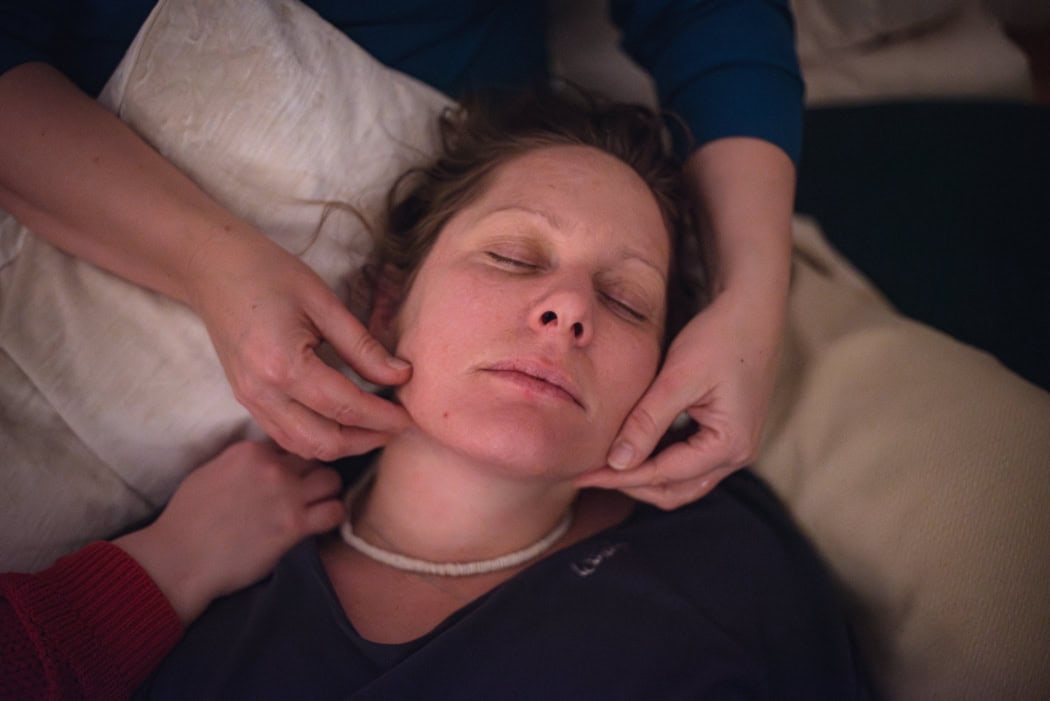
Especially for people who experience little physical closeness in everyday life, cuddle events offer a chance to experience touch in a respectful setting.
The neuroscientist Böhme also explains in her book that touch creates deeper bonds in friendships and relationships by releasing the bonding hormone oxytocin. It fosters closeness and trust – in the person touching as well as in the person being touched. A lack of touch, on the other hand, can have negative psychological and physical consequences. At some point the free cuddling begins. Aske and Lorenz are right in the thick of it too. Every touch is asked for first. Some start with a tentative hug; others simply sit side by side as small groups gradually form. A quiet, almost meditative murmur fills the room, interrupted now and then by questions like ‘May I hold your hand?’ or ‘Is it OK if I lean against you?’ And I hear a no surprisingly often.
A lack of touch can have negative psychological and physical consequences.
 Rebecca Böhme
The atmosphere stays calm throughout. I get the impression that nobody is pushy. Some seem to sink deep into themselves, eyes closed, as they feel a hand on their body or touch others themselves, back to back with someone or lying tightly entwined. Others seek out conversation and combine their quiet words with gentle gestures, like a relaxed exchange on a new, wordless level. One participant sits a little apart and simply watches. When someone asks him if he’s all right, he replies: ‘I don’t feel like joining in with the cuddling right now. And I’ve noticed I have a problem getting close to men in this way. But I’m really happy here.’
Groups keep breaking up and re-forming. Anyone who needs a break simply withdraws or lies down on one of the mattresses off to the side. The dimmed light and soft music in the background make the room feel almost like an island, shielded from the rest of the world. Time passes almost imperceptibly. And as things draw to a close and I sit down and lower my camera, a tentative question comes from beside me: ‘Would the photographer like a cuddle too?’ I check in with myself and say: ‘Yes, I’d love one.’ And so I lie down in soft, warm arms. The body holding me is a stranger’s, and yet I can let go. I practically melt. It’s a wonderful feeling. In everyday life I have my loved ones around me and plenty of cuddles, but this encounter is different. It moves me deeply that it’s possible to share such human, familiar warmth with a stranger in so short a time. So close. So attentive.
 Hamburg, January 2025
Besides cuddle clubs, there are also professional cuddle therapists who offer one-to-one sessions.
 Hamburg, January 2025
Every touch is asked for first. Some start with a tentative hug; others simply sit side by side.
And then the cuddle evening is over. ‘I don’t want to go out there at all. I’d much rather carry on being a human teapot between you all,’ I hear someone say as we put our shoes on. The comment is met with laughter and nods of agreement. And then everyone goes their separate ways. Inside, the world was warm and full of comfort. Outside, the cold, harsh reality hits me, pulsing frantically.
Cuddling is much more than a nice gesture. It’s a way of opening up, letting go of fears and experiencing real connection. And what can I say? My broad grin on the way home is surely impossible to miss – despite the hectic reality all around me.