Interviewing like a pro: how to stay in control, even with politicians. An interview with a politician can quickly turn into a power struggle. We show you how to conduct an interview with confidence, avoid typical interview traps and keep the upper hand even against professionals.
 German Savings Banks Day, Hannover, 28 June 2023. Photos: Martin Steger
Friedrich Merz interviewed by former ZDF presenter Klaus Kleber. Leading politicians like him are media-savvy – they answer questions every day, steer topics and use every stage for their own agenda.
 CDU party conference, Hannover, 10 September 2022
Interview with the broadcaster Phoenix. In conversations with politicians, the way the interview is conducted often decides which topics come up at all.
Contents
1. Going into the interview well prepared. What you need to know before the conversation
2. Staying in control during the conversation. How to steer the interview with confidence
3. When things get tricky. How to respond to rhetorical tactics
4. After the interview is before the story. How to follow up successfully
5. Mistakes happen. What matters is how you deal with them
1. Going into the interview well prepared
What you need to know before the conversation
Good preparation determines how your interview goes. Expect a trial of strength – a battle over ‘who keeps the upper hand in the conversation’, says Hans-Peter Fischer, journalism lecturer at Hochschule Hannover.
Politicians pursue clear interests of their own – be aware of that before you go into the conversation. If you want to come across as confident, one thing matters above all, says Fischer: ‘Research, research and research.’
Clarify the following questions before the interview:
• Which party is the interviewee fighting for?
• What does the party stand for and pursue, and what does it campaign against?
• What are its current concerns and goals? Where does your interviewee stand within the party?
• What political agenda are they pursuing?
• What personal ambitions do they still have?
Once you have answered these questions, it’s time to prepare the content. You should be just as much at home in the subject as the person you are interviewing. Find out the facts, the background and the lines of conflict, so that you don’t lose control of the conversation.
Now you need to form a picture of the person you’ll be talking to. Past interviews are a good way to do this. Go through them so that you know what to expect. Ask yourself: was the person cooperative or confrontational in the past? Eloquent or monosyllabic? Have they mastered rhetorical tactics and evasion strategies?
It’s important to treat what you find out only as a rough guide – after all, there’s no guarantee that your interviewee will behave the same way next time. Their form on the day and their mood play a role too.
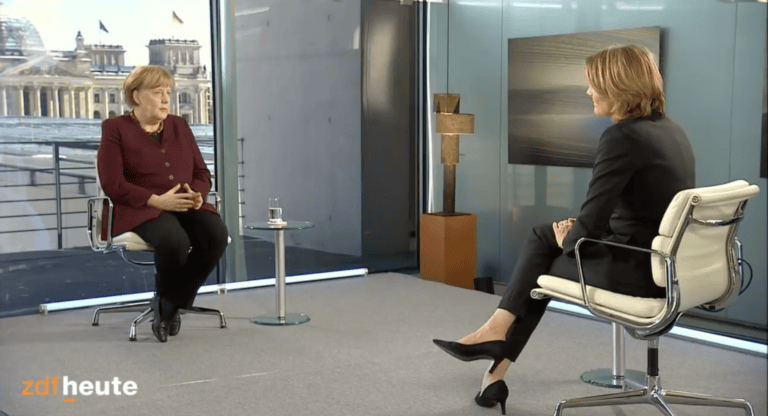 Angela Merkel interviewed by Marietta Slomka, ‘ZDF heute’, 12 February 2021
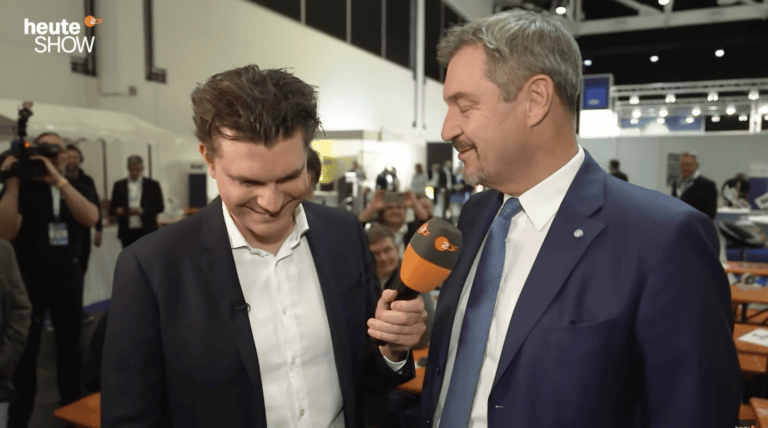 Markus Söder interviewed by Lutz van der Horst, ‘heute-show’, 18 October 2024
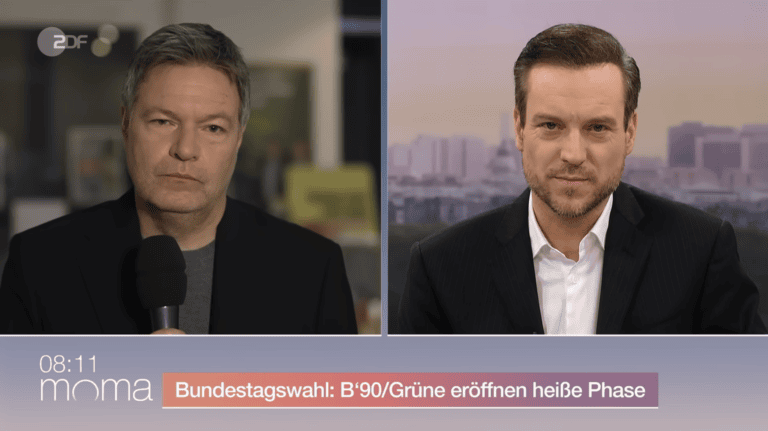 Robert Habeck interviewed by Andreas Wunn, ‘ZDF-Morgenmagazin’, 7 January 2025
Once you’ve ticked off these points, it’s time to draw up a list of questions. It should follow a dramatic arc that you can orient yourself by during the conversation. Both the subject and the time available play a role here. If there is enough time, it helps to start with harmless questions and save the delicate, exciting ones for later in the conversation.
But a well-prepared list can only give you security if you bear two things in mind. Under no circumstances should you reveal your questions in advance – otherwise you lose your position of power. And despite all your preparation, it is important to leave yourself room to react spontaneously to answers during the conversation.
Immediately before the interview, you should also take time to check your technical equipment. Technical glitches not only make you look unprofessional; they can also eat away at your self-confidence and affect how assured you are in the conversation. You should also clarify whether the interviewee needs to approve the interview before any publication.
Now your preparation is complete – you’re sitting opposite your interviewee and nothing stands in the way of the interview. Or does it?
2. Staying in control during the conversation.
How to steer the interview with confidence
For your preparation to pay off, the details on site matter. Think about the layout of the room and secure a good seat. That way you can make sure you hear the other person well and don’t have to shout to make your question heard.
Stick to the usual forms of politeness – regardless of your own views. ‘You don’t have to like the person opposite you, but you should still treat them with respect,’ stresses lecturer Fischer.
You don’t have to like the person opposite you, but you should still treat them with respect.
 Hans-Peter Fischer
A little small talk relaxes the situation for both sides. If you’re friendly, the other person usually responds in kind. To be on the safe side, ask beforehand whether you may record the interview, and record their consent. For the recording itself, a smartphone with a recording app already delivers broadcast-quality sound.
Clarify in advance how much time you have – that way you avoid rushing and nerves. Be prepared for your interviewee to want to leave earlier than agreed. Otherwise you risk not managing to ask all the relevant questions.
What matters is not only which questions you ask – but how.
Prof. Wilfried Köpke is a former journalism lecturer at Hochschule Hannover and an experienced interviewer. During the conversation, you can follow his 10 rules for asking good questions:
1. Follow your curiosity and stay flexible
2. Use precise, clear, simple and natural wording
3. Ask short questions
4. Avoid multiple questions rolled into one!
5. Avoid leading questions!
6. Judge as little as possible
7. Strike a sensible balance between conventional and challenging questions
8. Be clear in advance where the conversation should end up (in terms of content)
9. Allow time to think
10. Note down possible follow-up points during the conversation
Note: despite all your planning and notes, it’s important to be present in the conversation and to show it clearly. That’s the only way to keep the upper hand.
Stay alert, listen carefully and don’t miss any nuances! That includes sitting up straight and an alert, interested gaze. Speaking calmly can also help you secure your position of power in the interview.
As well as steering the conversation flexibly, it is sometimes important to be persistent. If a question about a relevant point isn’t answered satisfactorily, you have to keep asking until you get an adequate answer. Some politicians have prepared statements that they repeat during the interview. In that case, it helps to rephrase the question in order to ‘perhaps get round a blockade after all’, says Hans-Peter Fischer.
Whoever asks the questions is in control.
Hans-Peter Fischer
For politicians, the interview is an opportunity to present their position. You, on the other hand, should act in the interests of the audience. A conflict can also be relevant to the public: ‘Your job isn’t to make sure politicians get a big stage for themselves in the interview – it’s to shine a spotlight on the points that matter to the audience,’ explains Fischer.
To make sure of that, you should never hand control of the conversation over to the other person. The rule is: ‘Whoever asks the questions is in control.’
What sounds simple isn’t always easy in practice. Politicians know exactly how to throw interviewers off track or seize control of the conversation. But you can prepare for that, too.
3. When things get tricky.
How to respond to rhetorical tactics
If your interviewee refuses to give a clear answer despite repeated questioning, say so. According to Fischer, a suitable way of putting it is: ‘You haven’t answered my question, so I’ll ask it again.’ This not only highlights your interviewee’s stubbornness but also strengthens your position of power.
Politicians often answer questions in a different context. The aim of this tactic is to avoid critical scrutiny or even to put a problem in a positive light.
Lecturer Fischer offers a possible example: ‘Asked about possibly abolishing the tax break for company cars (cost to the federal government: between 3.5 and 13.7 billion euros, depending on the estimate), politicians could reply that subsidising what are often large, high-powered vehicles is in fact a stimulus programme for German carmakers, because they are strong in this segment.’
You need to recognise that your interviewee is shifting the ‘frame’ of the answer. If the answer doesn’t satisfy you, respond accordingly, ask your question again and make the context clear.
If you pick a fight, you should also be able to take it and see it through.
Hans-Peter Fischer
You may also come across the ‘Helmut Kohl tactic’ in an interview: ‘Interviewees reject the question (“That’s not what matters!”), come up with a question of their own (“What matters is: where do we go from here?”) and then answer it as they please,’ says Fischer. Here, too: if the answer matters to you, stay calm and repeat your question.
Even if you stay polite, your interviewee may treat you condescendingly – in short, portray journalists as ‘stupid’. It’s up to you whether you react calmly or take up the fight. For lecturer Fischer, though, one thing is clear: ‘If you pick a fight, you should also be able to take it and see it through.’
Some politicians are effusively friendly in interviews – that can be a tactic too. The expert thinks caution is called for here: ‘Don’t let yourself be won over – be friendly and polite, but keep a polite distance from your interviewee.’
And one more thing: it’s rare, but you may be confronted with deliberate or unintentional untruths during the conversation. In a live situation, your good preparation really comes into its own. You should expose a lie immediately if you can. If the interview is published later, you can of course correct the statement afterwards.
Checking facts and correcting them where necessary is therefore essential. But what else is involved in following up an interview?
4. After the interview is before the story.
How to follow up successfully
Transcription
Transcribe your interview – that way you keep track and can back up answers. Linguistic slips, mistakes and so on can stay in, as long as the meaning is clear to readers.
If you want to save time, you can use a program that does part of the work for you. There are several options available free of charge. Important: you should still listen to your recording again yourself and make corrections, because errors can’t be ruled out. Examples of transcription tools are Goodtape.io, trint.com, the transcription function in Word and the transcription feature in Adobe Premiere Pro.
Editing the interview
Since a transcript on its own can rarely be published as it is, you will usually need to turn it into a further text.
To do this, be clear about the form in which you want to publish the interview. Should your piece follow a question-and-answer format, or would you like to write an as-told-to piece, for example, which reads as if the interviewee were telling the story themselves? With interviews with politicians, you will probably choose a classic form in which the answers follow your questions, but it is still worth checking what makes most sense in each case.
Once you have decided on a form, you can get to work – checking both the language and the content.
Editing the content
Check every statement for accuracy. Then, depending on the form you want, you can edit the text and adapt it to the dramatic arc you planned. You can also change the structure of the interview or of the answers so that it fits the end result better. But it is important not to take any answers out of context or reproduce them in a misleading way.
Fine-tuning the language
Here you should correct grammatical mistakes and, in consultation with your publication and your interviewee, decide on gender-inclusive language. You should also consider how many of your interviewee’s linguistic quirks you want to keep. Dialects can be endearing, and grammatical mistakes can reveal social backgrounds. Even so, it often makes sense to shorten things and, for example, remove superfluous filler words.
Once you have edited what was said, you can put it into the right form. You can also come up with an exciting opening and perhaps add bracketed remarks describing the interviewee’s emotions, gestures and facial expressions.
5. Mistakes happen.
What matters is how you deal with them
Whether in preparation, follow-up or during the interview itself – mistakes are part of it. (Aspiring) journalists should above all ‘learn from their mishaps and not lose their nerve’, says Hans-Peter Fischer.
Mistakes happen – especially when talking to professionals. What matters is that you learn from them and spot typical pitfalls early.