Shopping with autism: too bright, too loud, too much
Glaring lights, flashing adverts, a babble of voices: for our author, the supermarket regularly becomes an ordeal.
By Marlene Fliege

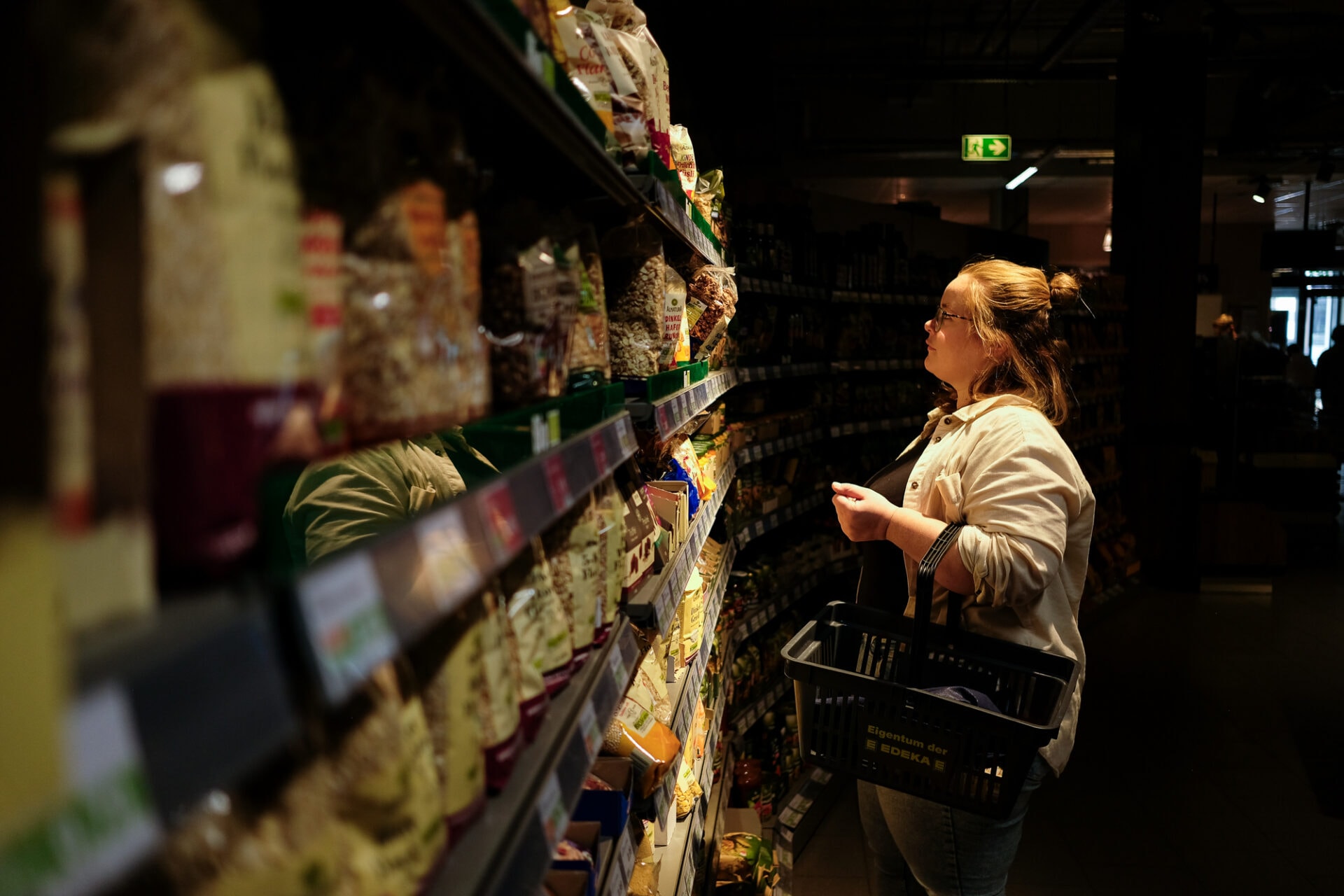
With a clear goal in mind, I set off into the world of tinned vegetables and advertising banners – supermarket hell. The range on offer there is almost as diverse as that of my condition: autism. Somewhere between the oat milk and the frozen food section, the next meltdown is already lying in wait. I close my eyes, breathe in and out deeply a few times and visualise the things I need. ‘Shit!’ I blurt out: my favourite chocolate is sold out today!
In its usual place, a whole range of other bars towers in front of me – as frightening and seemingly endless as the road to Mordor. Now I have to scrutinise every single one, carefully weighing up the pros and cons before I can even think about putting one of them in my basket. During my essential analysis, a stabbing headache begins to build. To me, the supermarket lights feel like a techno party. Even through my noise-cancelling headphones, I can’t block out bickering people and screaming children. Frustrated, I abandon my inspection and decide simply to go round other supermarkets until I get my favourite bar.
Somewhere between the oat milk and the frozen food section, the next meltdown is already lying in wait.
Even though the prospect turns my stomach, it is still better than staying where I am for a second longer. So into the next shop, target in sight, grab it, pay and dash out again as fast as my legs will carry me. Exhausted, I sink into the car seat and do some breathing exercises. The heat gnaws at me; suddenly I feel that every sensation is too much. I feel the fabric of my clothes like sandpaper on my skin, my own breath like acid in my lungs – and, to top it all, I am far too aware of the existence of my toes right now.
The short adventure has knocked me out so much that for the rest of the day I can only leave my bed to go to the loo. The blind is down, all the doors are closed and the pleasant silence calms my mind. Thank goodness I have loving people around me who can catch me when my body and mind go on strike once again because of sensory overload.
But not everyone on the autism spectrum has this privilege. If the people around you seem strange to you once again – or even brusque and rude – please remember: perhaps you have just met a neurodivergent person on their desperate search for silence.
What is autism?
Autism is a neurodevelopmental condition that affects how people perceive information, experience social interaction and communicate. There is a broad spectrum of behaviours and traits, all of which are called autistic – which is why people often speak of autism spectrum disorder (ASD).
How does autism show itself?
How autism shows itself varies from person to person. Some common traits are difficulties with social interaction, limited communication, repetitive behaviours and interests, and sensory sensitivities. Some autistic people have particular abilities or interests in certain areas.
What is Asperger’s syndrome?
Asperger’s syndrome is a form of autism characterised by average to above-average intelligence, special interests, difficulties with social interaction and limited communication. Compared with other forms of autism, people with Asperger’s syndrome often have no impairment in language development, which allows them to develop particular talents.
The term ‘Asperger’s syndrome’ has been replaced by the more general term ‘autism spectrum disorder’ to emphasise the diversity of the autism spectrum.
Author’s notes
If you want to find out more about the bigger picture of Asperger’s, autism and neurodivergence, I can only
recommend it. The differences between cis men and people of all other genders are enormous, because medical knowledge relates mainly to the stereotype of the ‘man’. One fascinating read, for example, is ‘Aspergirls’ by Rudy Simone. Also worth watching is the video ‘Autismus: ich habe das Asperger-Syndrom’ (Autism: I have Asperger’s syndrome) on the German YouTube channel ‘auf Klo’, which clears away a few clichés. Approaching people on the spectrum without prejudice is always best – far removed from media portrayals and from public stigma or our own.