The fisherwoman of Memmingen: the row over the Fischertag
Can a single woman break open a centuries-old male ritual? A small town in the Allgäu is struggling to find an answer.
By Anna Scheld (text), Anton Vester (photos)


Memmingen lies in Upper Swabia, between the Allgäu and Munich. A pretty old town, cobblestones, pastel-coloured façades. The market square gleams with medieval charm; time passes more slowly here than elsewhere. And yet the little town has an international airport outside its ancient gates. Ryanair grandly named the airport, with its seven gates, ‘Munich West’; in good times up to 1.7 million holidaymakers a year took off from here for Mallorca or Alicante. But that is in the past. Before Covid, before the fuel price crisis. Hard times now. Nothing is as it was.
Now even a woman is allowed to jump into the town stream. The world, say some of Memmingen’s men, is going down the drain – and Christiane Renz is partly to blame. Four weeks to go. Christiane Renz is sitting in a café in Memmingen’s pedestrian zone, complaining to the waitress about the cream on her iced chocolate. It isn’t sweet enough, she says. Not far from her sundae glass flows the town stream, the Memminger Ach – more trickle than river. But the stream packs a punch: once a year more than 1,000 men of Memmingen jump into it to try to catch the heaviest trout of the year. There is no need for gender-inclusive language in that sentence, because only men are allowed to compete for the throne at the traditional ‘Fischertag’ – in other words, to become Fisher King.
Were allowed, to be precise. In 2021 the regional court in Memmingen handed down a ruling: for the first time in 425 years a woman may now jump into the stream too – or, as they say here, ‘neijucken’. Christiane Renz has used a court ruling to invite herself to a party from which she had been expressly excluded.
Three days to go until the big day. Christiane Renz strolls along the stream to the market square. There, in a former pharmacy, the ‘Feminist Action Group’ has its premises. The group has added two little dots to the old lettering above the entrance: the ‘Mohren-Apotheke’, named after an old racist term for Black people, now reads ‘Möhrenapotheke’ – the carrot pharmacy. Renz has come to collect her T-shirt for the Fischertag; the action group has ordered several. ‘Equality hurts no one’ is printed on it – which in Swabian dialect comes out roughly as ‘Gleichheit duat koim wea.’
Renz is welcomed by Selina. Blue hair, nose ring, husky voice. Her fingers are covered in dabs of colour; she has just been painting placards. Of course she could move to Hamburg, to St. Pauli, the epicentre of the left-wing scene. But what would happen to her home town then? ‘If we left,’ she says, ‘Memmingen would be a conservative hole where nothing ever changes.’
 Landesgartenschau grounds, Memmingen, 20 July 2022
Christiane Renz at the place she often visits for walks, to recharge her batteries and be close to nature.
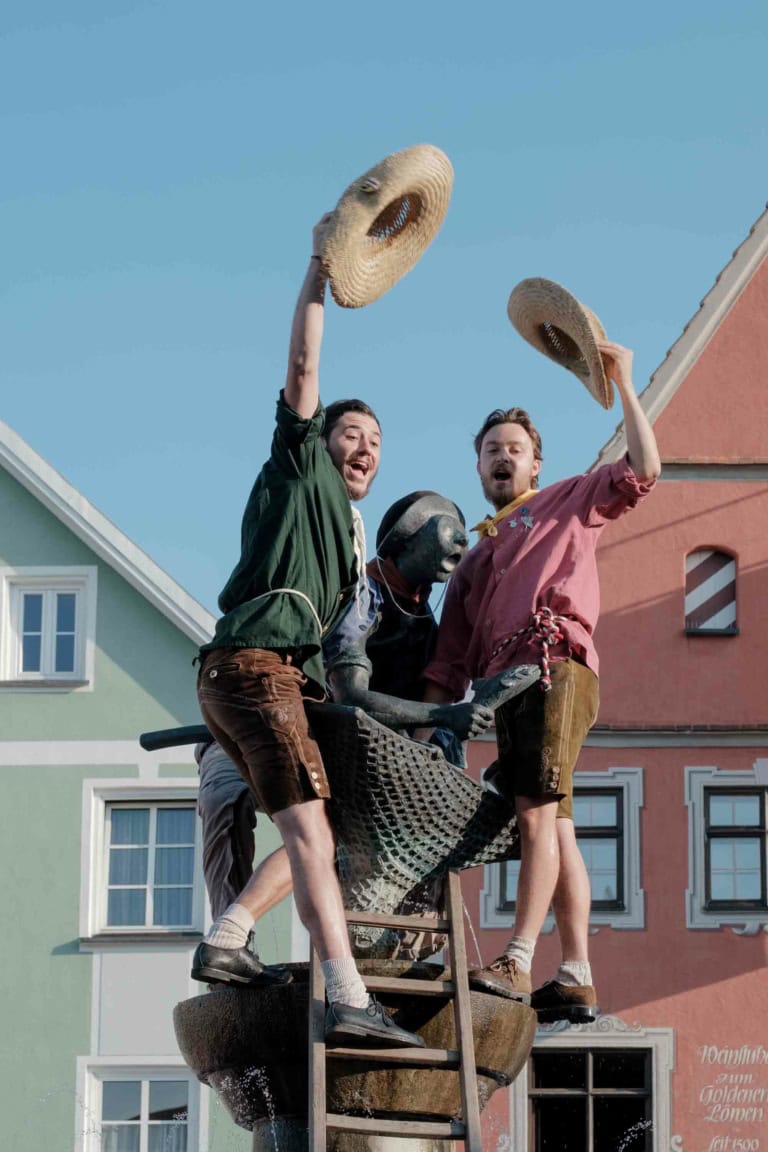 At the Fischerbrunnen, Memmingen, 22 July 2022
By tradition, the fisherman statue on the Fischerbrunnen fountain in Schrannenplatz is dressed up. The two association members pictured call out to the spectators and celebrate the moment with the crowd; in the centre is the statue of a fisherman holding up a trout.
 Back yard of the socio-cultural association ‘Konnex’, Memmingen, 20 July 2022
Selina Lorenz, a close confidante of Christiane Renz, avowed feminist and one of the association’s most active members.
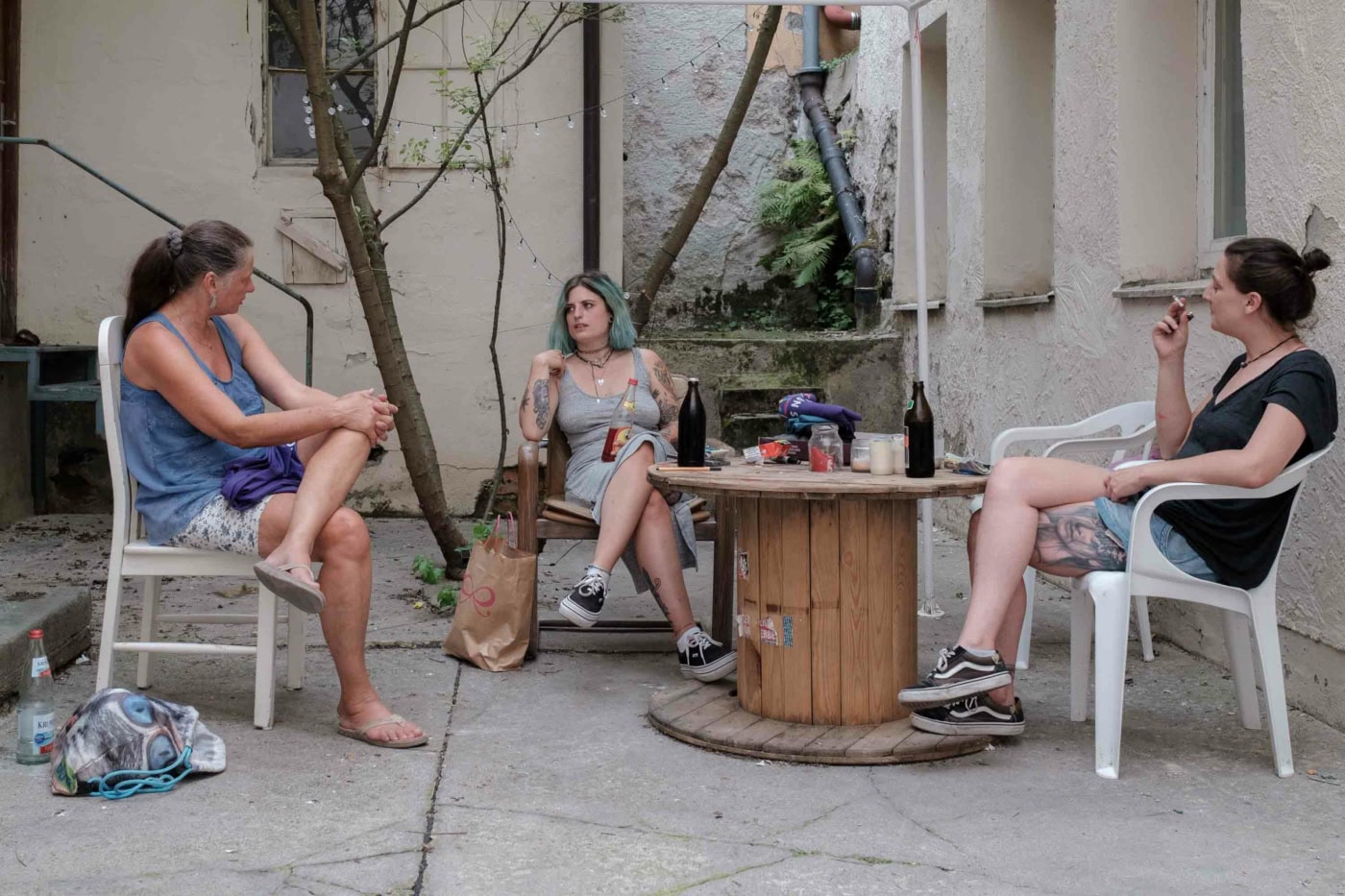 Back yard of the ‘Konnex’ clubhouse, Memmingen, 20 July 2022
Christiane Renz (left), Selina (centre) and a Konnex member (right) discuss the plan for the upcoming poster campaign and hand out the T-shirts for the Fischertag.
For Memmingen the Fischertag is the high point of the year. More important than Christmas. Fishing out the town stream in summer is a custom that has wound its way from the Middle Ages through the centuries to the present day. The man who lands the heaviest fish becomes Fisher King. A who’s-got-the-biggest tradition, organised by the Fischertag association, the most powerful club in town with 4,300 members. Ask them what the festival and the association mean to them and their eyes light up. A dreamy look into the distance, a search for words. Usually a single word is enough for the answer: ‘Heimat’ – home.
Women may be members of the association. But on the big day they stand at the edge as ‘Kübelweiber’ – bucket women – guarding the trout that their men hand up to them from the stream. They are not allowed to fish. That, until now, was what the association’s statutes laid down.
Christiane Renz was about 20 when she joined the association in the early 1980s. A young woman who had grown up with the illusion of equality. At the girls’ school she attended, the teachers made no distinction between the sexes – after all, there were no boys. Her eureka moment came at 15, when she borrowed Egalia’s Daughters, a novel by the Norwegian author Gerd Brantenberg, from a friend. She read and read and immersed herself in a fictional world where women don’t wear bras – instead, men wear penis holders. Even the language is turned on its head: in the German translation, the verb for ‘to rule’, herrschen, which contains the word for ‘master’, becomes frauschen. A utopia in which gender roles are completely reversed. From that moment on, Renz says, she never let an explanation go unchallenged and questioned everything. Including the Fischertag.
While Renz unpacks her T-shirt in the ‘Möhrenapotheke’, a few hundred metres away Werner Eberhardt sits in his workshop and predicts: ‘Everyone will laugh at her if she doesn’t catch anything.’ He gave up his post in the Fischertag association when it became clear that Christiane Renz would be allowed to fish. His grandfather was already a member, and so was his father. ‘You could probably have measured it on a seismograph,’ he says, pointing over his shoulder out of the window towards the cemetery, ‘how my grandfather turned in his grave when the statutes were changed.’
Where the dead are spinning in their graves, the living are torn apart all the more. Nothing is sacred any more, nothing safe from the decay of good old customs. ‘In the old days,’ says Eberhardt, his voice now half agitated, half menacing, ‘we used to knock the fish out on the railings by the stream, ten of them one after the other into the bucket, bam, bam, bam.’ Today numerous safety regulations have to be met, and the trout that are caught are killed professionally with a stab to the heart in a tent under the eyes of vets. That’s what it has come to.
‘And now a woman is allowed to fish as well.’ Eberhardt shakes his head. Years ago, he says, his father told him on his deathbed: ‘If a woman jumps in, you have to stop.’ So he did. As we leave his workshop, he makes one more request: ‘Whatever you do, don’t use my name.’ He doesn’t want any trouble. That is why Eberhardt’s real name is different.
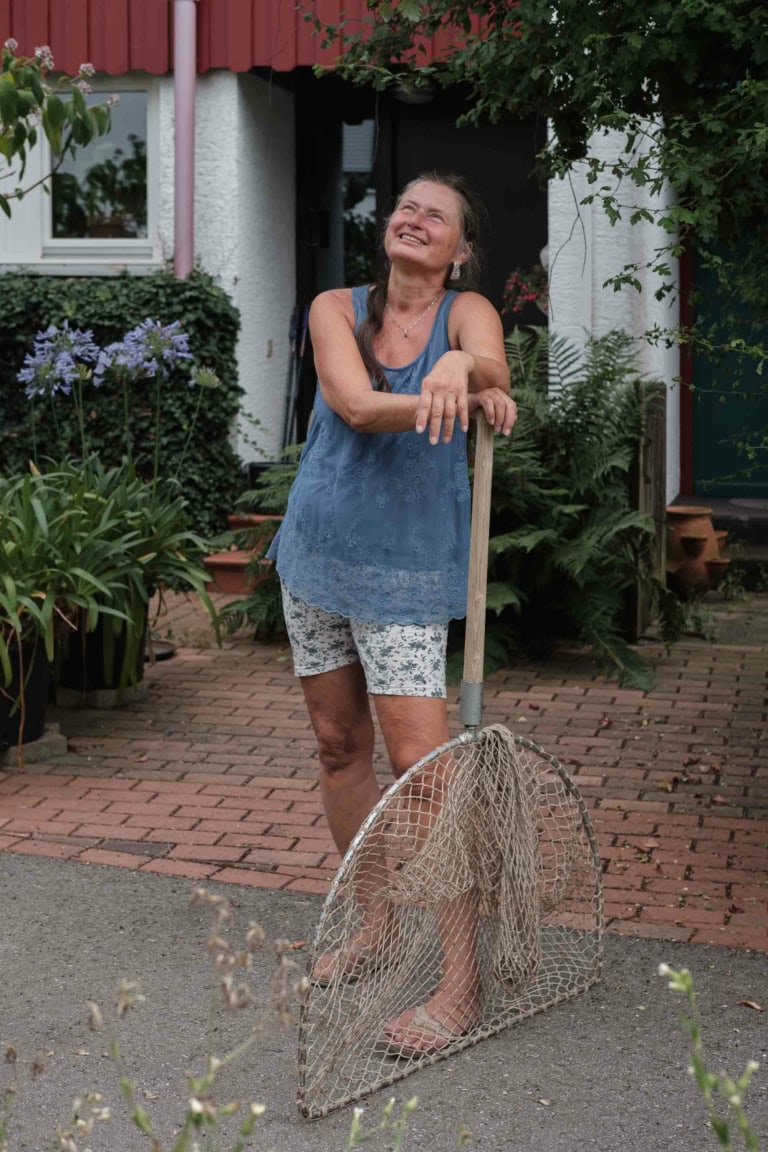 Memmingen, 20 July 2022
Christiane Renz outside the front door of a couple she is friends with. She is picking up her so-called ‘Bär’ (landing net), on which she is leaning, while chatting to a neighbour whose attention has been caught.
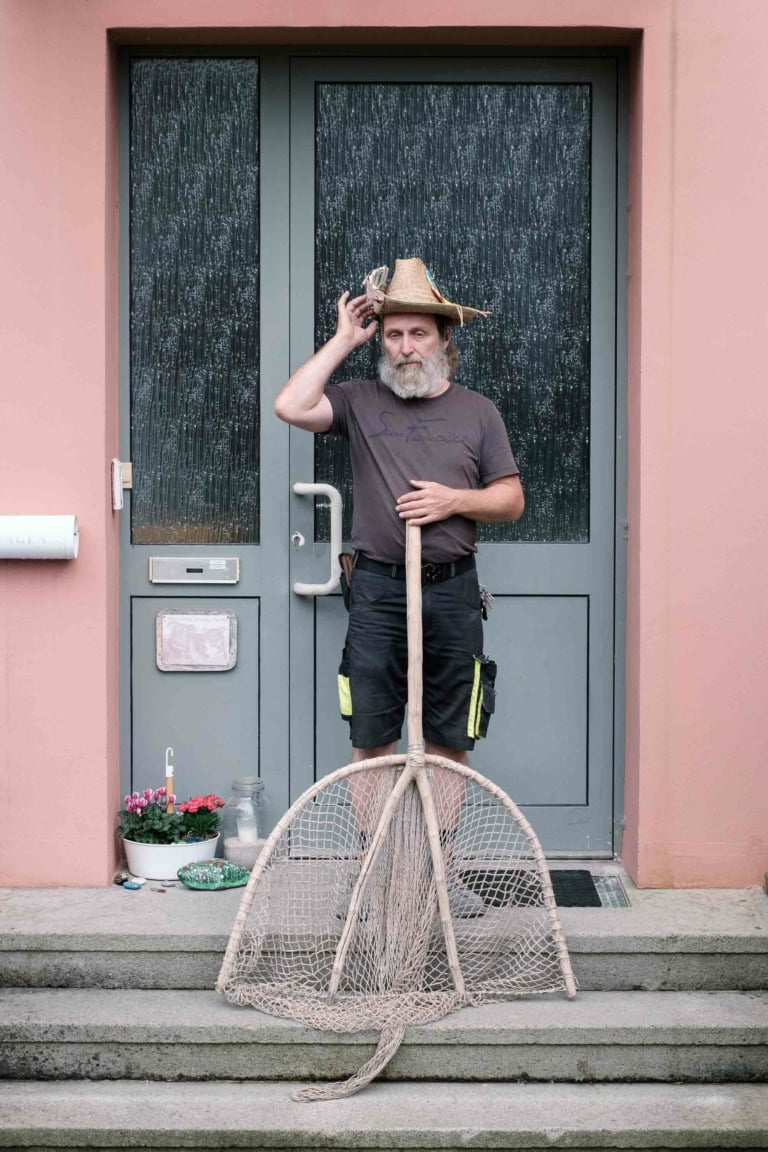 Memmingen, 21 July 2022
Andreas Lorenz, 54, caretaker at the Vöhlin-Gymnasium, standing outside the door of his flat on the school grounds. He wears work clothes, the typical fishing hat and his home-made wooden ‘Gabelbär’ net, and has run the preparatory courses for the Fischertag for many years. Recent developments in the association worry him. He says: ‘The last bastion has fallen.’
Christiane Renz’s revolution began politely: five or six years ago she spoke to the only woman on the committee and raised the subject. Wasn’t it about time the association changed its statutes? Women should be allowed to take part too. But even the question was sacrilege and was dismissed as ‘fouling one’s own nest’, says Renz.
Again and again she submitted motions, and again and again she was rebuffed. During meetings nobody spoke to her any more. She was overlooked in the room as if she weren’t there at all. Once she asked for the motion to be read out in full, including the reasoning. About 15 of the 200 delegates voted for the change. Many applauded when the motion was rejected.
Then she saw a report on the TV news. It was about a Berlin lawyer who had gone to court to get her daughter into a boys’ choir. Renz emailed the lawyer and told her about the Fischertag: ‘Perhaps this might interest you.’
A lot has changed in the Bavarian foothills of the Alps in recent decades, too: twelve of the 41 seats on Memmingen’s city council are currently held by women (29 per cent), Memmingen is a ‘Future of Mobility model region’, and the ice hockey club ECDC has already been wondering whether ‘Indians’ is still the right nickname for the team. The days when people here would have voted for a broomstick as long as it was a CSU member are long gone, anyway. At the last federal election the CSU did not even reach 30 per cent in Memmingen. The town likes to see itself as modern yet proud of its traditions. ‘Laptops and lederhosen’, the Bavarian slogan, applies here too. That is why the town’s flyers proclaim: ‘Memmingen – a town with prospects’. Mostly male ones.
In the days before the Fischertag the town changes. With every hour that brings it closer, the restlessness, the anticipation and the tension grow. Up to 40,000 visitors come every year to watch the spectacle. This year, too, the hotel rooms are fully booked and the pubs are often packed in the evenings. Will she really jump? Will Christiane Renz become the first woman in the world – indeed in the entire cosmos – to officially ‘neijucka’ into the town stream? Will she claim the right that first the local court and then the regional court granted her, and against which there can be no further objection or appeal, not even before the Federal Constitutional Court?
Two days to go. Renz doesn’t like the fuss about her. She doesn’t gloat, at least not out loud. This afternoon, at 37 degrees, she is cooling her feet in the stream in the town park. She often comes here when the hustle and bustle in town gets too much for her. Too many thoughts of her own, too many other faces. Then she needs trees instead of concrete, green instead of grey. She stares at bees crawling into blossoms and loses herself in thinking about nothing.
She calls this state ‘das Guckerle’. Her gaze fixes on something and at the same time drifts into space. And her mind flies free.
Renz is good with animals. Much better than with people, she says. She is a vet, and at her practice she runs courses to treat troubled relationships between people and their dogs. The aim, she writes on her website, is for an animal to unlearn unwanted behaviour. With animals she knows how to do it. But with men?
The market square on the evening before the Fischertag. The ‘Büttel’, the town crier, in his historical costume announces tomorrow’s Fischertag from the stage, flanked by the outgoing Fisher King and the mayor. The spectators in the stands clap to the beat of the drums. Then the Büttel unrolls a huge scroll of paper and reads from it. His name is Gottfried Voigt; he is leader of the Free Voters group on the city council and wrote the speech himself. He spent several weeks polishing it. He begins in the broadest Swabian: ‘Liabe Leit, liabe Gäschd’ – dear people, dear guests. After a few lines he pauses. Then: ‘Oh, now I’ve completely forgotten the gendering!’
In the next sentence he says ‘fisher slash woman’ and talks about the ‘trout and troutess prize’. The crowd in the stands roars. Then whistles shrill and boos rain down from the stands. They are meant for Christiane Renz.
Saturday. Fischertag. 6 a.m. Christiane Renz stands among 1,100 men in the playground of the former secondary school to collect the stamp that allows her to take part. Everything, including the ‘neijucken’ into the town stream, has its proper order. The men stand around in little groups; some talk to each other, others bellow until they are red in the face and are already toasting each other with beer bottles at this early hour. Again and again they glance at her out of the corner of their eyes. ‘Isch se da?’ – is she here? – they hiss from all directions.
 Memmingen market square, 21 July 2022
Visitors and locals cross the market square while the stages are set up for the upcoming Fischertag and Wallenstein festivals.
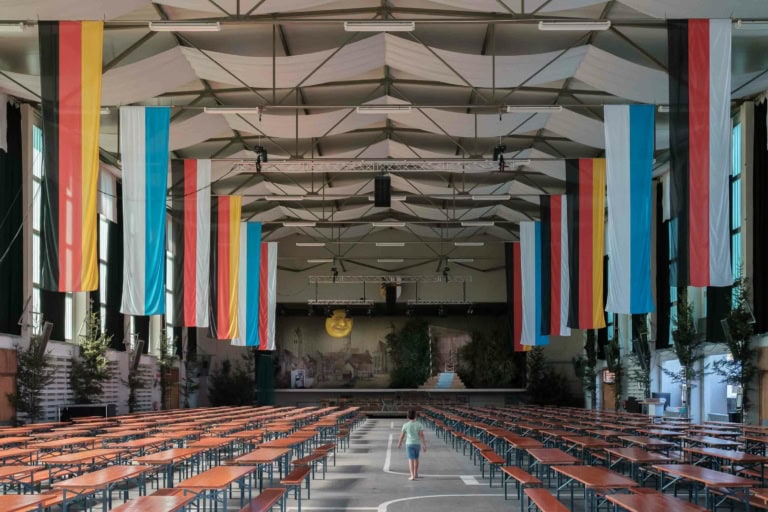 Memmingen, 22 July 2022
Stadium hall of FC Memmingen 1907 e.V., on the eve of the fishing festival. The festival hall is decorated with flags – seen from the left, the German, Bavarian and Memmingen flags in repeating order – and in the centre is a stage with a throne for the Fisher King. Shortly before the festival is proclaimed, the association’s lighting and technical manager arrives with his son Matthis to make the final lighting adjustments. While his father works on the lights, Matthis plays in the hall and counts the beer-table sets. There is a smell of fir. All is quiet.
 Memmingen, 21 July 2022
On the way to the stadium hall: children’s procession with many participating schools. Central float, on the left: local politicians; seated on the right: specially chosen young girls who have been asked to greet all the spectators with a friendly smile.
 Market square, Memmingen, 22 July 2022
A member of the association’s feminist activist group shows a sticker reading ‘D’r Mau isch a Frau!’ (The Memmingen moon is a woman). The moon is used as a symbol of the Memmingen fishing festival and comes from a Memmingen legend.
 Market square, Memmingen, 23 July 2022, 6 p.m.
Various groups from the Fischertag association take part in the Fisher King’s procession. The scene shows the fishermen’s group marching noisily through the streets, delighting the spectators.
 Fischerbrunnen, Memmingen, 22 July 2022
On the eve of the Fischertag, the town crier (man with bell and scroll) proclaims the Fischertag together with the town guard in traditional costume. Second from left: the former Fisher King Walter Gröner, known as ‘Walter IV, the Diver’; centre, on the podium: the town crier; to his right: a young woman whose job is to hold the beer. Other members of the association and spectators can also be seen.
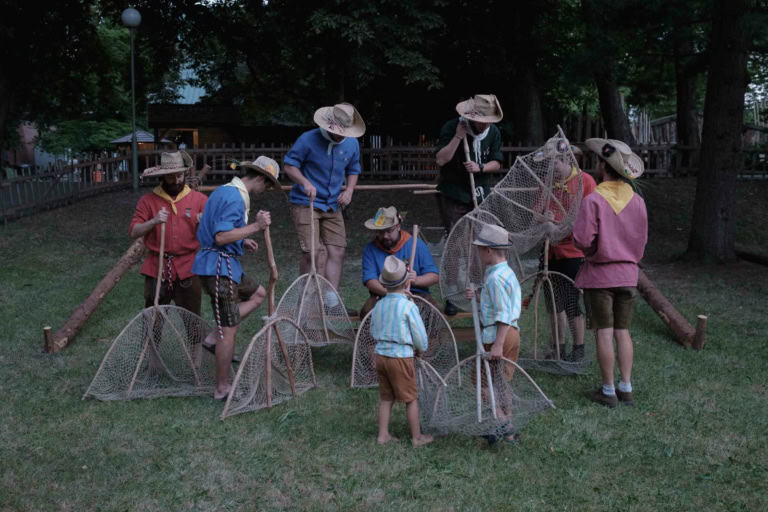 Stadtpark Memmingen, 22 July 2022
A group of young men and two boys get ready for a group photo. They wear traditional hats and hold the ‘Gabelbären’ (landing nets) they use to catch trout on Fischertag.
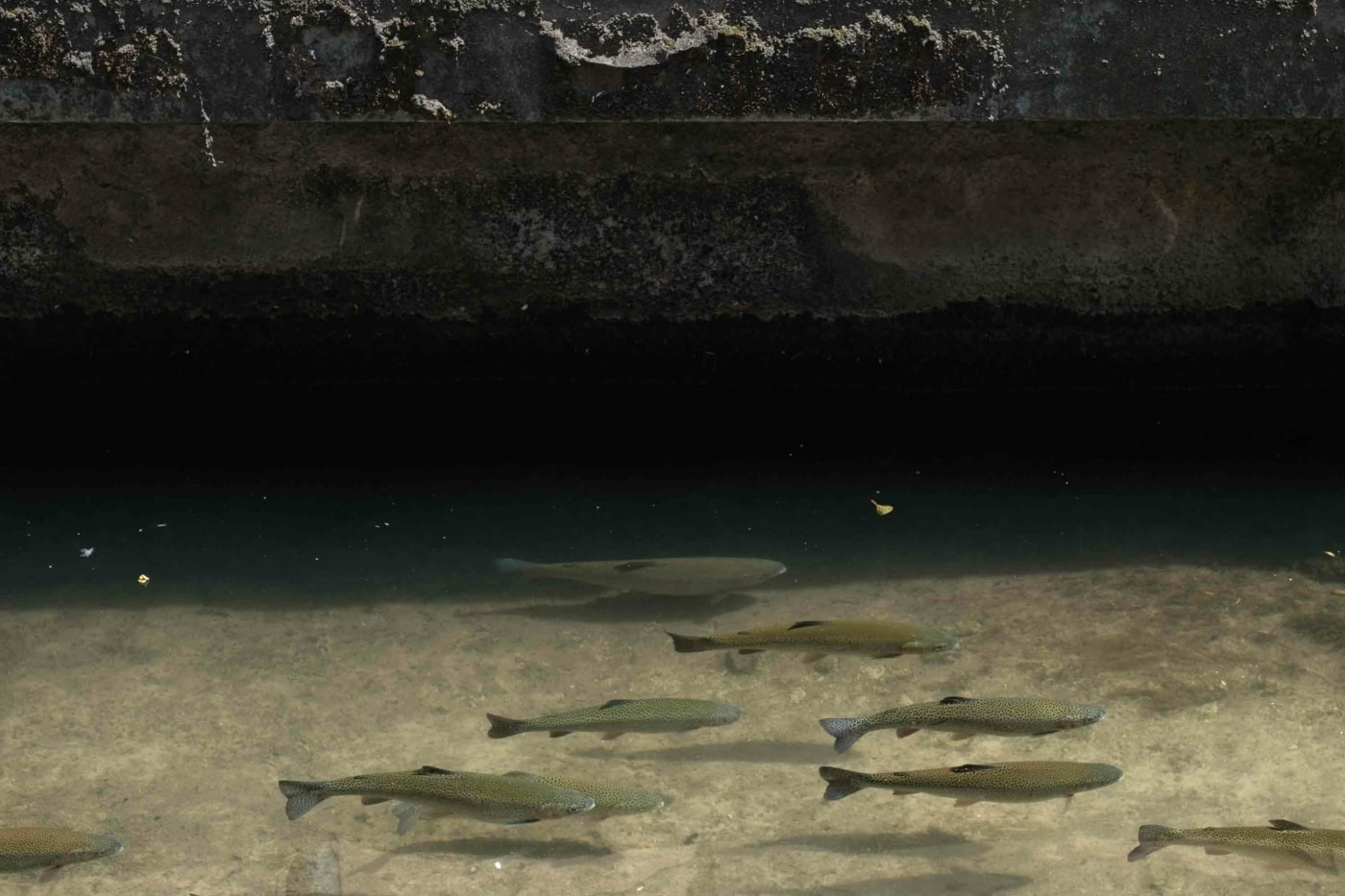 Memminger Stadtbach, town centre, 22 July 2022
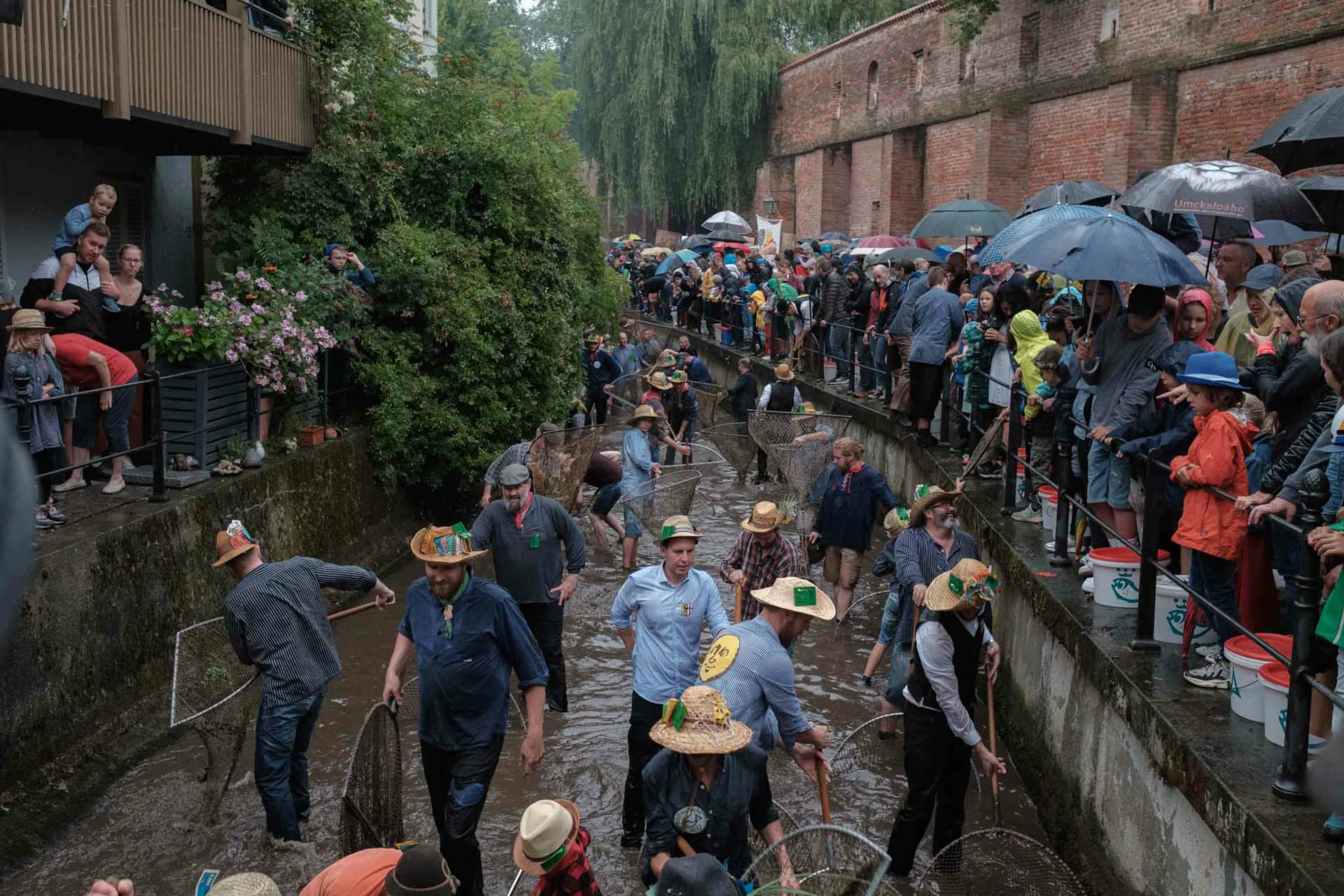
Mainly rainbow trout hold position in a shoal in the stream. Rainbow and brown trout from a nearby fish farm are released into it every year.
You can’t tell from her face what she is thinking. She keeps her chin slightly raised. Her eyes dart between the different groups of men. One comes over, shakes her hand and attempts a joke: ‘What you’re doing here is reckless.’ Then he leaves again. Her brother comes over; he stays out of the whole business. But now he pulls a single blade of grass from his hat and sticks it in hers. The male fishers’ hats are hung with dozens of colourful slips of paper bearing the stamps of previous years. On Christiane Renz’s hat hangs a single light-green slip – Fischertag 2022.
You hear the Fischertag before you see it. Men greet each other with a deep, throaty ‘Heeey’, raising their landing nets – which they call ‘Bären’, bears – or their fishing hats. Many roar their ‘Heeeeey’ with a beer bottle held high. Yesterday it was still a polite, sharp call for the official occasion of the Büttel’s speech: ‘Hey!’ Now it is a heated barking in quick succession, ‘HeyHeyHey’. A martial, guttural cry. Raw masculinity. As if it had broken through from the depths of the past into the present.
Just after 7 a.m. 1,100 fishermen and Christiane Renz march in procession, accompanied by several brass bands, into the town centre. Onlookers crowd the sides. The bands play the Schmotz March, the official song of the Fischertag, and the fishermen sing along in dialect, a rowdy chant about muck and a dirty pig. A light summer rain has begun. A little way off, a group of women in dirndls walk through the lanes to the stream, biting into pretzels and sipping takeaway coffee. One of them raises her palm to the sky and says: ‘Heaven is weeping. Because of the woman.’
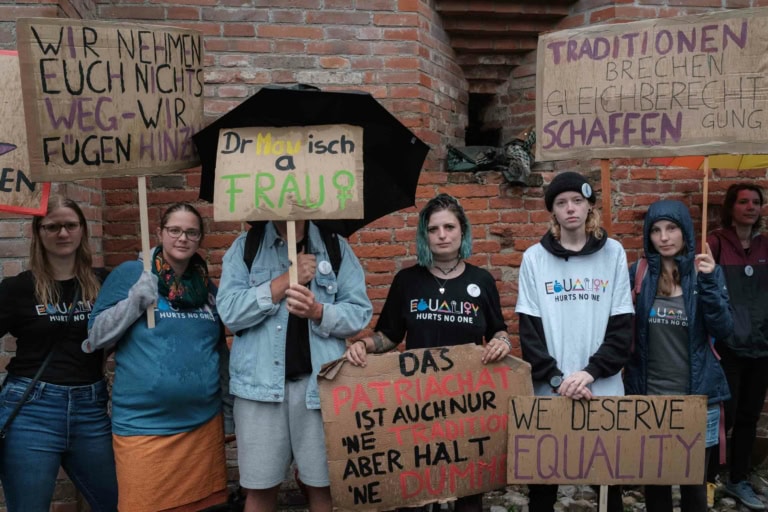
At the stream, shortly before eight. Mostly women and children stand around the railing when the men and Christiane Renz arrive. The ‘Feminist Action Group’ has hung a banner from a street lamp and lines up along the town wall with cardboard placards.
Christiane Renz has changed mode. Now she too bellows ‘HEY!’ at the top of her voice, and several TV cameras pounce on her every move. Renz’s partner fills the bucket with water from the stream. He is taking on the role of bucket woman. Even her lawyer, Susann Bräcklein, has travelled from Berlin, and a few more relatives and friends stand around her. Almost as if to protect her.
Shortly before eight a collective ‘Pssssscchhhht’ rings out – that is the tradition – and a charged silence creeps along the bank. Christiane Renz is already sitting behind the railing, legs bent as if riding side-saddle.
A church bell strikes eight, then a cannon shot shatters the silence. BOOM.
Her eyes widen for a split second, then she jumps into the stream together with 1,100 men. Water splashes; everyone stands calf-deep in the murky stream, frantically dragging their nets through the muddy current. They shout, they bellow, they yank their nets up and tip the wriggling fish into the buckets on the bank.
Ten seconds after the cannon shot, Renz too feels a weight in her net. She has done it. Applause on the bank. ‘Unbelievable, what a whopper!’ someone shouts. Carefully, Renz hands her catch up to her partner. Cameras click. A woman calls out: ‘Ms Renz, I feel honoured that you jumped in right here. I live just up there. Great that you’re doing this!’
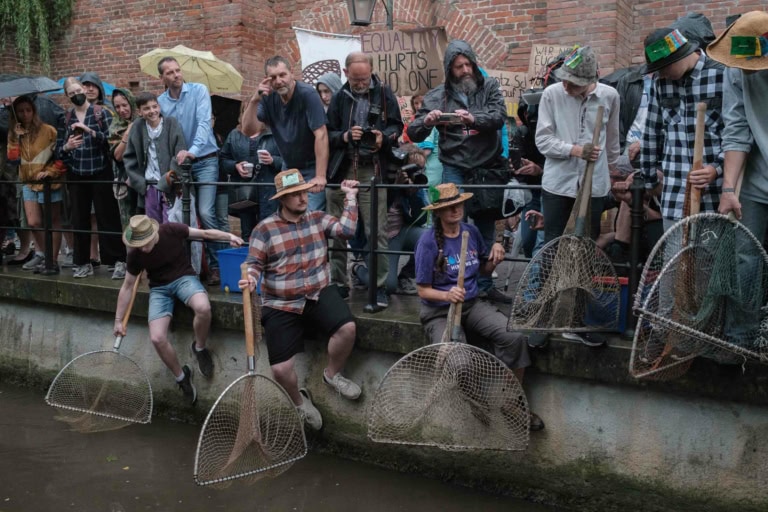 Stadtbach Memmingen, 23 July 2022, shortly before 8 a.m.
At the entry point near the Bettelturm, Ms Renz gets ready for the so-called ‘reinjucken’ (jumping in and fishing), surrounded by plenty of press and many male fishermen, some casting critical glances at her. Shortly afterwards, the starting shot for the fishing rings out.
 Stadtbach Memmingen, 23 July 2022, at the entry point near the Bettelturm
Behind the spot where Ms Renz is fishing, young people, among them Selina Lorenz from the Konnex association, have lined up with placards to draw attention to equal rights and support Christiane.
With a full bucket Renz and her people later make their way to the service tent, where the fish are killed. At a traffic light Renz meets other fishermen. One hisses at her from the side: if she wants to cause trouble, she should go somewhere else. A car waits for the light to change; two fishermen are sitting in its open boot. They call out to her: ‘So, how many?’ – ‘Two!’ – They raise their hats in recognition.
At eleven o’clock the new Fisher King takes office: Luca Wassermann, 28, key account manager. Hobbies: football and skiing. His trout weighs 2,000 grams. They give him his royal name: Luca I, the Fresh. He waves from a throne of birch wood, already swaying heavily. The people applaud. It’s like a funfair. A huge hall with beer tables and benches, the band playing, women and girls in dirndls, men and boys in embroidered lederhosen and checked shirts. Here and there a fishing hat on a visitor’s head.
A little girl with braided hair stands on one of the beer benches to see better. She eats chips from a paper bag and watches as Luca I is crowned king with a swing of a fishing hat.
 Memmingen, 23 July 2022.
A cry of joy and relief at how well the morning has gone, while behind her in the tent her partner properly takes care of the trout she caught.