‘It was raining ice, and our feet were frozen’
A personal visit to the memorial: a survivor’s voice guides us through the history of the Bergen-Belsen concentration camp – between grief and new beginnings.
By Lion Knirsch (text), Salome Ophelia Ziermann (photos)


This place draws me in. A gravitational pull of frosted glass and grey concrete. But it is not only the hard edges of the architecture that weigh on my mind. It is those of the history this site on the edge of Bergen and Belsen tells – on the edge of reason.
Many years ago I already had to look into this human abyss once. But not with a notepad and camera – with a school bag and a packed lunch. Now I am older; I and the way I see the world have changed. But this place has not changed at all – like a rock of concrete in the surf of forgetting. I had forgotten a lot; I could remember neither exact figures nor pictures. But I remembered very well the feeling of standing here.
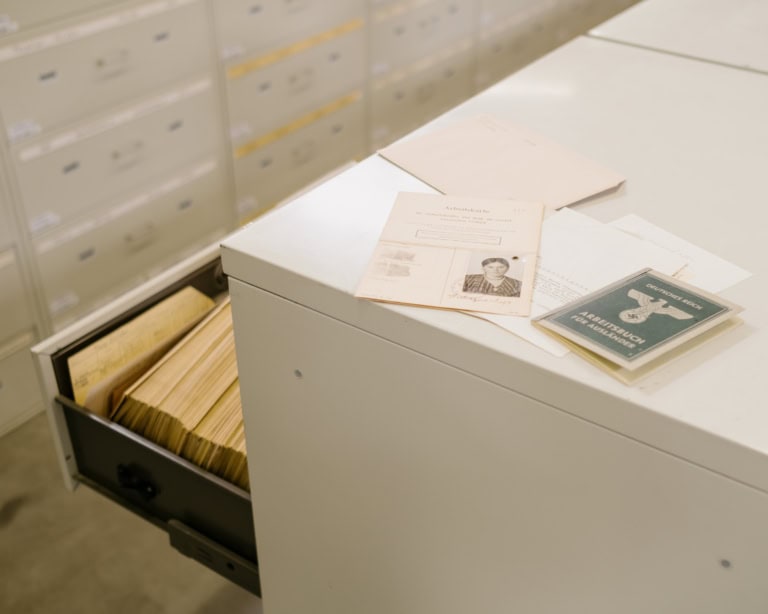
But it is not only my memory. The walls inside the documentation centre are riddled with cracks too, as if they were also breaking under the weight of the past – a weight embodied in photos, testimonies and quotations. I read of hunger so great that people ate bark, belts, even the dead. I saw photos of stacked corpses, naked, pale and starved, and next to them prisoners calmly preparing their food. It all struck me as a deeply perverse caricature, as if Dante Alighieri had described it in his Inferno. Every photo, every word, every quotation another crack through my view of the world.
I could remember neither exact figures nor pictures. But I remembered very well the feeling of standing here.
 Lion Knirsch
When the doors to the grounds opened, I felt liberated. Instead of a guard of honour of barbed wire and sentries, I was greeted by one of bushes and trees. Instead of screams, I heard birdsong. Instead of emaciated bodies, leaves covered the ground. Only the information boards, memorial stones and burial mounds hint at what happened here between 1940 and 1945. Behind glass and concrete lies the past, outside the present – and, like my reflection in the window pane, I was trapped somewhere in between. I could no longer see any huts or watchtowers, but what I had heard still echoed inside me.

The almost windowless building ends right at the former camp boundary. So as not to touch the ground here, the building was designed so that the space hovers above it.

The documentation centre records 200,000 visitors a year. They all enter the park-like grounds through a concrete passage around 200 metres long.

The end wall of the building, only about 18 metres wide, opens into a hall with panoramic windows that give an unobstructed view of the grounds.

At second glance, the exposed concrete of the memorial reveals a wood grain. It recalls the wooden huts of the former Bergen-Belsen concentration camp.

The artist couple Ingema Reuter and Gerd Winner conceived the ‘House of Silence’ as a walk-in memorial. Visitors are invited to linger here. Many leave messages and candles in memory of the victims of the Shoah.
‘The winter was harsh; we were half naked; it was raining ice and our feet were frozen,’ recalls the survivor Edith Bruck. In more than 100 transports and death marches between December 1944 and mid-April 1945, at least 85,000 men, women and children reached Bergen-Belsen – all of this after other concentration camp sites of this kind near the front had been evacuated towards the end of the war. In those months alone, 35,000 of them died – more than 70,000 in all by the end. And all because they believed ‘wrongly’, loved ‘wrongly’, lived ‘wrongly’.
It was testimonies from the past like these, together with the architecture of the present, that drew me in – from mere observer to eyewitness. What must it have been like between fences metres high, with no way out, no future? Eyes fixed rigidly ahead, despite – or even because of – the misery. How great must the hunger have been for people to start falling upon corpses? How great must the fear have been of being executed anywhere, at any time, for any reason? All these questions riddled my mind, and I have not been able to get them out of my head since.
And I am not the only one searching for answers. All over the site, thousands of candles, letters and inscribed stones adorn the monuments and memorial plaques – even after so many years. ‘NEVER FORGET’ is written on one of the stones. But is that possible? Just as grass has grown over the old camp boundaries, one day it will grow over the memorials too.
Yet every year around 15 April – the day of liberation – those survivors who died in the previous year are still remembered. And even if one day there are no more names, I know there is hope. For as long as we do not forget what happened and must never happen again, there will be a tomorrow.
The walls are riddled with cracks, as if they themselves were breaking under the weight of the past.
Lion Knirsch

The long passage takes visitors out of their everyday lives and leads them, surrounded by high walls, out onto the site of the former camp.